The Best Online Interview Practice Platforms in 2026
The Best Online Interview Practice Platforms in 2026

Use an AI-driven mock-interview platform that offers on-demand, role-tailored interviews, transcripts, and a structured scorecard. That’s the short answer. Start with a free session on Iterationinterview right now, before you read another word.
Here’s what to do in your first 30 minutes:
- Sign up for a free account
- Upload your resume and select your target role
- Run a 30-minute mock interview (behavioral or technical)
- Review your transcript and scorecard
- Note the two weakest areas flagged and schedule a targeted drill
Key Takeaways
AI-driven, role-tailored mock interview practice with transcripts and scorecards is the most effective way to improve interview performance before a live interview.
| Point | Details |
|---|---|
| Choose a platform with real feedback | A transcript plus a multi-axis scorecard is the minimum worth paying for. |
| Practice cadence matters | Three to five focused mocks per week produces scorecard improvement within two to four weeks. |
| Test the free tier first | Run one full mock and check whether the scorecard feedback is specific enough to act on. |
| Target your weakest answers | Drill the lowest-scoring responses from each session before moving to new questions. |
| Iterationinterview recommended | On-demand AI mocks with resume tailoring, transcripts, rewrites, and ranked practice games. |
Table of Contents
- What do online interview practice platforms actually provide?
- How do you choose the right interview practice tool?
- How Iterationinterview delivers the features that matter
- A 5-step plan to get the most from mock interviews
- What does interview practice cost, and when will you improve?
- What’s the verdict on online mock interview practice?
- What do users say about AI interview practice platforms?
- What devices and technical setup do you need?
- What kind of support do interview practice platforms offer?
- What are the refund policies on interview practice subscriptions?
- Why evidence-based practice beats generic prep
- Iterationinterview: start your first AI mock session today
- Sources
What do online interview practice platforms actually provide?
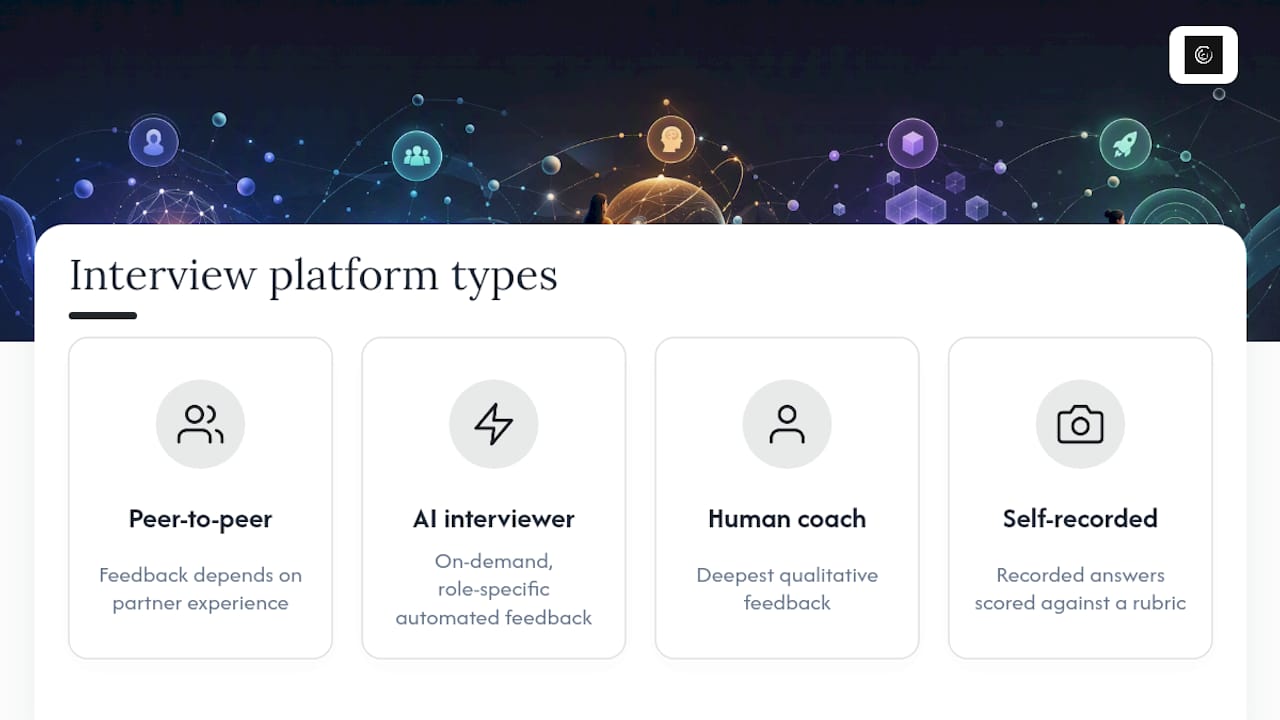
Online interview practice has moved well past the “record yourself on your phone” era. Today’s platforms fall into four distinct types, and knowing the difference saves you from wasting time on the wrong one.
Peer-to-peer live mocks pair you with another job seeker for a real-time practice session. The feedback quality depends entirely on your partner’s experience. AI interviewers run on-demand sessions at any hour, ask role-specific questions, and return automated feedback within minutes. Human coach sessions offer the deepest qualitative feedback but cost more and require scheduling. Recorded self-practice with automated feedback sits in the middle: you record your answers, and the platform scores them against a rubric.
Most platforms support several interview formats. Behavioral questions (STAR-method answers) are universal. Technical and coding rounds, system design, product sense, and situational questions are increasingly common, especially on platforms built for software engineers and product managers.
The core feedback features that separate useful platforms from forgettable ones: a full transcript of your answers, a multi-axis scorecard (clarity, structure, relevance, communication), personalized follow-up drills targeting your weak spots, and progress tracking across sessions. Free, scripted tools like the Barclays LifeSkills virtual interview practice tool show what the entry-level model looks like: useful for absolute beginners, but short on tailored feedback and scorecards that drive measurable improvement.
Continued startup activity in interview-prep and HR tech, tracked by outlets like TechCrunch, confirms that the market keeps iterating. That’s good news for job seekers: features that were premium two years ago are now standard.
How do you choose the right interview practice tool?
The decision comes down to six questions. Answer them honestly and the right platform becomes obvious.
- Does it cover your interview format? A behavioral-only tool won’t help a software engineer preparing for a system design round.
- Does it tailor questions to your resume and target role? Generic questions produce generic answers.
- What does the feedback actually include? A transcript plus a multi-axis scorecard is the minimum worth paying for.
- Is it on-demand or scheduled? Scheduled sessions add friction; on-demand practice means you can run a mock at 11 PM before a morning interview.
- Is there a human-review option? For senior roles or high-stakes interviews, a human coach’s notes on top of AI scoring can catch nuances the algorithm misses.
- What are the privacy and recording terms? Know whether your video and transcript data is stored, shared, or used for model training before you hand over sensitive career information.
What to watch out for
Red flags worth avoiding: free-only tools with no structured feedback, platforms that serve the same question bank regardless of your role, missing or incomplete transcripts, no data export, and vague privacy policies on recordings.
Pricing and seniority expectations
Pricing shapes vary across the market. Free tiers typically offer limited practice rounds per month with limited feedback depth. Monthly subscriptions unlock more sessions and deeper analysis. Pay-per-session models suit occasional users. Human-coach add-ons sit at the premium end.
| Seniority level | Most important features | Typical pricing fit |
|---|---|---|
| Entry-level | Behavioral question bank, basic scorecard, transcript | Free tier or low-cost subscription |
| Mid-level | Role-tailored questions, multi-axis scorecard, drills | Monthly subscription |
| Senior/staff | System design, human-review option, analytics | Subscription plus coach add-on |
A realistic improvement timeline: with regular focused mocks weekly, many job seekers notice measurable scorecard improvement within a few weeks. “Improvement” means higher scores on structure and clarity, not just feeling more comfortable.
How Iterationinterview delivers the features that matter
Iterationinterview is built around one idea: practice should be specific to your actual interview, not a generic simulation. Every session is on-demand, timed, and conducted on camera or via microphone, so the pressure feels real.
The core feature set:
- Resume and role tailoring: questions are generated from your uploaded resume and target role, so you’re practicing the answers you’ll actually need
- Multi-axis AI scorecard: each response is graded on clarity, structure, relevance, and communication quality
- Full transcripts and rewrites: you can read exactly what you said, compare it to a stronger version, and understand the gap
- Targeted drills: weak responses from past sessions feed directly into your next practice queue
- Ranked practice games and leaderboard: compete against other users to add stakes and track relative progress
A typical workflow looks like this: sign up and upload your resume, run a 30–60 minute mock, review the transcript and scorecard, identify the two or three lowest-scoring responses, run targeted drills on those specific answers, then repeat the cycle. The leaderboard on Iterationinterview’s ranked practice arena adds a competitive layer that accelerates improvement for users who respond to external benchmarks.
Pro Tip: Use the ranked practice feature not just to compete, but to benchmark your answer quality against the top performers. Read the highest-scoring answers in your role category and reverse-engineer what structure they use. That’s faster than waiting for your own scorecard to tell you what’s missing.
Forbes documents the recurring interview mistakes that cost candidates offers: poor structure, unstated assumptions, and weak communication. Iterationinterview’s scorecard is built to surface exactly those gaps.
A 5-step plan to get the most from mock interviews
Consistent practice beats occasional heroic sessions. Here’s a repeatable routine.
- Set a goal and timeline. Pick your target interview date and work backward. Three to five mocks per week for three weeks is a realistic baseline for most roles.
- Replicate the real environment. Use the same device, camera angle, and room you’d use for an actual video interview. Dress the part. Treat it as the real thing.
- Run focused mocks. Don’t try to cover every question type in one session. Pick one format (behavioral, technical, situational) and go deep.
- Analyze your transcript and scorecard. Read your answers as text. Weak answers are usually obvious on paper in a way they aren’t when you’re speaking. Mark every answer that scored below your target threshold.
- Drill your weak areas. Take the lowest-scoring responses and rewrite them. Then re-record. Repeat until the rewrite scores higher than the original.
Pro Tip: When reviewing your transcript, read it aloud as if you’re hearing it for the first time. Filler words, circular reasoning, and missing specifics jump out immediately. Mark them before you look at the scorecard so you build your own critical eye, not just scorecard dependency.
Camera and audio setup matters more than most job seekers realize. A stable internet connection, a neutral background, and a microphone that doesn’t pick up room echo are baseline requirements for video interview practice. Test your setup before your first session, not during it.
Coursera’s interview-skills courses pair well with mock practice: courses teach frameworks like STAR and SOAR; mocks train you to deliver those frameworks under pressure. Use both.
What does interview practice cost, and when will you improve?
Free tiers exist across the market and are worth using to evaluate a platform before committing. The Barclays LifeSkills tool is a well-known free option for beginners. Iterationinterview offers a free tier with limited monthly usage, enough to run a first session and test the scorecard quality.
Common pricing shapes:
- Free tier: limited practice rounds per month, basic feedback
- Monthly subscription (Pro/Ultra): more rounds, deeper analysis, transcript rewrites, targeted drills
- Annual subscription: lower per-month cost for committed users
- Human-coach add-ons: available on some platforms at a premium per session
What to test in your first free session: run one full mock, read the transcript, and check whether the scorecard feedback is specific enough to act on. If the feedback says “be more specific” without telling you where, the platform won’t accelerate your improvement.
Realistic improvement windows: with three to five focused mocks per week, most job seekers see scorecard movement within two to four weeks. The clearest signal of real progress is live interview performance: second-round callbacks, fewer follow-up questions from interviewers, and higher personal confidence on camera.
What’s the verdict on online mock interview practice?
AI-driven, role-tailored practice with transcripts and scorecards is the most effective approach available right now. Iterationinterview delivers all of it on-demand, without scheduling friction, and with a ranked practice layer that keeps you honest about where you actually stand.
Immediate next steps:
- Try a free mock session today (30 minutes, role-tailored, scorecard included)
- Schedule three practice sessions this week and commit to reviewing every transcript
- Import a past interview transcript to see exactly which answers cost you points
What do users say about AI interview practice platforms?
User feedback on AI-driven platforms consistently points to two things: the transcript review is the feature that changes behavior fastest, and the scorecard’s specificity determines whether practice actually transfers to live interviews. Job seekers who use platforms with vague feedback (“good answer, but could be improved”) report little measurable change. Those using platforms with axis-level scoring (structure: 6/10, specificity: 4/10, communication: 7/10) report faster improvement because they know exactly what to fix.
For Iterationinterview specifically, users highlight the transcript rewrite feature as the most underused and most valuable tool on the platform. Seeing a stronger version of your own answer, side by side with what you actually said, closes the gap between knowing what a good answer sounds like and being able to produce one under pressure.
What devices and technical setup do you need?
Most AI interview practice platforms, including Iterationinterview, run in a standard web browser with no software installation required. You need a device with a working camera and microphone, a stable internet connection, and a modern browser (Chrome, Firefox, Safari, or Edge). Mobile browsers work for audio-only practice; video-based mocks are better on a laptop or desktop where camera positioning is easier to control.
Check your microphone input levels before your first session. Background noise and echo are the two most common technical issues that affect both your practice experience and your scorecard accuracy on platforms that analyze speech patterns.
What kind of support do interview practice platforms offer?
Support quality varies significantly across the market. Entry-level free tools typically offer documentation and community forums. Subscription platforms usually add email support with response times ranging from a few hours to a business day. Premium tiers on some platforms include live chat.
Iterationinterview provides support through its platform interface. For technical issues or questions about your subscription, the fastest path is through the in-platform help channel. Platforms that use community feedback to refine their question sets and scoring rubrics tend to improve faster over time, since candidate input directly shapes what gets measured.
What are the refund policies on interview practice subscriptions?
Refund policies in the SaaS interview-prep space are not standardized. Most platforms offer a free tier or a short trial period specifically to reduce the risk of paying for something that doesn’t fit your needs. Iterationinterview’s free tier lets you test the core features before upgrading.
Before subscribing to any platform, check the terms for: whether unused sessions roll over, what happens to your data if you cancel, and whether annual plans offer a pro-rated refund window. When in doubt, start with a monthly plan rather than an annual one until you’ve confirmed the platform fits your workflow.
Why evidence-based practice beats generic prep
Most interview advice focuses on what to say. The harder problem is knowing whether what you actually said landed. Generic prep, whether from a book or a free scripted tool, can’t answer that question because it has no record of your specific answers.
AI-driven practice closes that gap. When a platform scores your actual words against a structured rubric, you stop guessing about your weak spots and start fixing them. The Udacity technical interview course is a strong complement for candidates preparing for coding rounds: it teaches the frameworks, while a platform like Iterationinterview trains you to deliver them under real pressure. The combination is more effective than either alone.
The interview-prep market is crowded, and not every tool earns its subscription fee. The ones that do share one trait: they give you specific, answer-level feedback you can act on the same day.
Iterationinterview: start your first AI mock session today
Most interview prep stalls because feedback is too vague to act on. Iterationinterview fixes that with on-demand AI mocks that score your actual answers, return a full transcript, and queue up targeted drills for your weakest responses, all without booking a session in advance.
Start a free mock on Iterationinterview and get a role-tailored question set, a multi-axis scorecard, and a transcript in your first session. The free tier covers enough to know whether the platform fits your prep style. If you want more rounds and deeper analysis, Pro and Ultra plans are available monthly or annually. Your recordings and transcript data stay private; review Iterationinterview’s terms before your first session for full details on data handling.