How to Prepare for a Panel Interview and Win
How to Prepare for a Panel Interview and Win

Panel interview preparation comes down to five moves: research every panelist before the day, build a bank of 4–6 STAR stories mapped to the job’s core competencies, practice answering under timed, multi-person conditions, test your tech if the session is virtual, and send individualized thank-you notes within 24 hours. Do all five and a panel stops feeling like an ambush.
Your one-page prep checklist:
- Research panelists. Pull LinkedIn profiles for each name the recruiter gives you. Note their role, tenure, and any shared professional ground.
- Map stories to the job description. Treat every bullet in the posting as a scoring criterion. Build one STAR story per major competency.
- Practice out loud, on camera. Time yourself. Aim for 90–150 seconds per behavioral answer.
- Prepare your questions. Have at least one question ready for each panelist’s area of expertise.
- Run a tech check (virtual panels). Camera height, lighting, microphone, and internet stability — all confirmed the evening before.
- Plan your follow-up now. Draft a thank-you template you can personalize within an hour of leaving the room.
In-person vs. virtual differences at a glance: In-person panels require printed resume copies (bring one per panelist), a route plan, and deliberate eye-contact rotation. Virtual panels add a 15-minute pre-join tech routine, a clean camera background, and the challenge of simulating eye contact through a lens rather than across a table.
Pro Tip: A short grounding routine before you walk in — three slow breaths, a final glance at your notes — shifts you from nervous reactivity to deliberate engagement, according to Coursera’s panel interview guidance. It takes 90 seconds and costs nothing.
Key Takeaways
Effective panel interview preparation is built on five repeatable moves: research each panelist, build a targeted story bank, practice under realistic conditions, manage the room deliberately, and follow up with precision.
| Point | Details |
|---|---|
| Research panelists first | Ask the recruiter for names and roles; use LinkedIn to tailor one story angle per interviewer. |
| Build 4–6 STAR stories | Map each story to a core job competency; keep every answer under 150 seconds when spoken aloud. |
| Use the asker-first sweep | Address the questioner, sweep the panel, close back on the asker — on every single answer. |
| Test tech the night before | Confirm camera height, lighting, microphone, and internet; join 1–2 minutes early for video panels. |
| Send individualized thank-yous | Email each panelist within 24 hours and reference a specific moment from their questions. |
| Practice with Iterationinterview | Use AI-graded timed drills to get objective feedback and track improvement across sessions. |
Table of Contents
- What is a panel interview, and what should you expect?
- How to prepare before the day of your panel interview
- How to structure your answers for a panel of interviewers
- What to do during the panel: eye contact, pacing, and recovery
- How to handle video and hybrid panels without tech derailing you
- Common mistakes that quietly sink panel interviews
- How to rehearse so your practice actually transfers
- What to do after the panel: follow-up that actually works
- Why panels reward preparation more than perfection
- Iterationinterview gives you objective feedback before the stakes are real
- Sources
What is a panel interview, and what should you expect?
A panel interview is a single session where two or more interviewers assess one candidate simultaneously. That’s the whole definition. The format exists because organizations want multiple perspectives on a hire without scheduling five separate conversations, and because it’s harder for a candidate to tailor a performance to one person when three are watching.
Who’s typically in the room:
- HR or recruiter: Evaluates culture fit, compensation alignment, and whether you meet baseline qualifications.
- Hiring manager: Cares most about whether you can do the job and whether they’d trust you with their team’s work.
- Technical evaluator or subject-matter expert: Probes depth of knowledge, problem-solving approach, and whether your claimed skills hold up under follow-up.
- Peer or future teammate: Often the most candid questioner; they’re assessing whether they’d actually want to work alongside you.
- Quiet observer: Speaks rarely but often carries significant influence. JobHelpGuide flags this role specifically — include them in your eye-contact rotation and treat their eventual question with extra care.
Panel roles and their priorities differ enough that the same answer can land differently depending on who asked it. HR hears “I led a cross-functional project” and thinks collaboration; the technical evaluator hears it and immediately wants to know what stack you used.
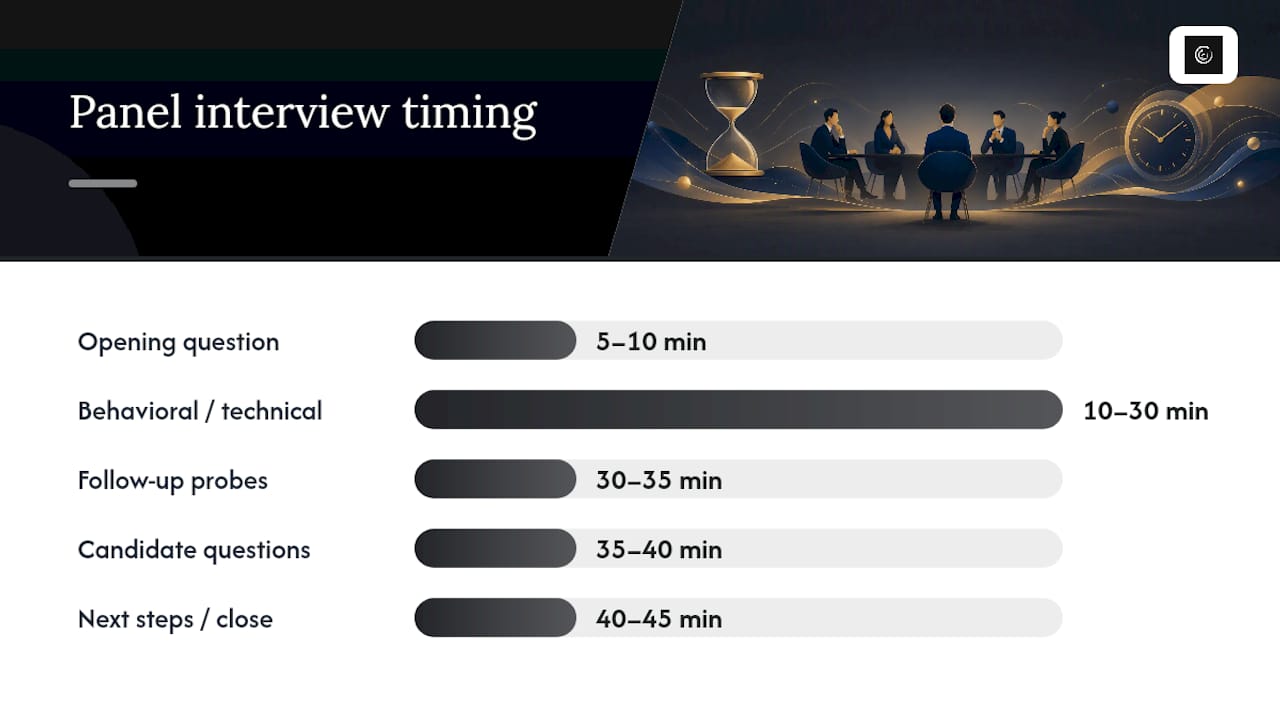
A typical 45-minute panel flow:
| Time | What’s happening |
|---|---|
| — | Introductions: each panelist states their name and role |
| 5–10 min | Opening question (“Tell me about yourself”) |
| 10–30 min | Behavioral and technical questions, often rotating by panelist |
| 30–35 minutes | Follow-up probes; interruptions most likely here |
| 35–40 minutes | Candidate questions |
| 40–45 minutes | Next steps and close |
Phone screens and short recruiter calls typically run 20–30 minutes and function as filters before a full panel. Treat phone screen preparation with the same seriousness — a weak phone screen means no panel at all.
How to prepare before the day of your panel interview
The single most effective prep move is also the simplest: ask the recruiter for the names and titles of every panelist before the interview. This is a professional, expected request — not a presumptuous one. Most recruiters will share the list without hesitation, and having it turns a generic prep session into a targeted one.
Once you have names, here’s the sequence that converts anxiety into a concrete plan:
- Research each panelist on LinkedIn. Look for their current role, how long they’ve been at the company, any articles or posts they’ve published, and shared professional interests. You’re not building a dossier — you’re finding one or two specific details that help you tailor a story or a question.
- Read the job description like a scorecard. Every bullet is a competency the panel will likely probe. Underline the five or six that appear most critical and map a STAR story to each one.
- Build your story bank. Four to six stories is the right range — enough to cover most competency areas without forcing you to memorize a script. Keep each story under two minutes when spoken aloud. USC Online’s career guidance emphasizes rehearsing answers to common questions so you’re not scrambling to construct them mid-panel.
- Prepare role-specific angles. The same story about leading a product launch reads differently to HR (teamwork, communication) than to a technical evaluator (methodology, tools used). Know which angle to lead with for each panelist.
- Sort your logistics. For in-person: print one resume copy per panelist, confirm the address and parking, and plan to arrive 10–15 minutes early. For virtual: test your camera, microphone, and internet the evening before and have a backup plan (phone hotspot, secondary device) ready.
- Draft your questions. Prepare at least one question per panelist tied to their specific role. A question for the hiring manager about team priorities differs from a question for a peer about day-to-day collaboration.
Pro Tip: When researching panelists, look for what they’ve written or shared publicly — a LinkedIn post, a conference talk, a published article. Referencing a specific idea they’ve put into the world (naturally, not sycophantically) is far more memorable than a generic “I read about your company’s growth.”
How to structure your answers for a panel of interviewers
Lead with the result. Before you explain the situation or walk through the timeline, give the panel a one-line claim that tells them where the story ends.
That answer-first habit matters in panels because multiple interviewers are scoring you simultaneously. A clear opening line lets each person lock onto the relevant competency before you’ve finished the first sentence.
STAR and its variants:
- STAR (Situation, Task, Action, Result): The standard. Use it for behavioral questions about past experience. Keep Situation and Task brief — one or two sentences combined. Spend most of your time on Action and Result.
- CAR (Challenge, Action, Result): Useful when the situation is self-evident from context. Skips the setup and gets to the problem faster.
- PAR (Problem, Action, Result): Best for technical or analytical questions where the problem itself needs precise framing before the solution makes sense.
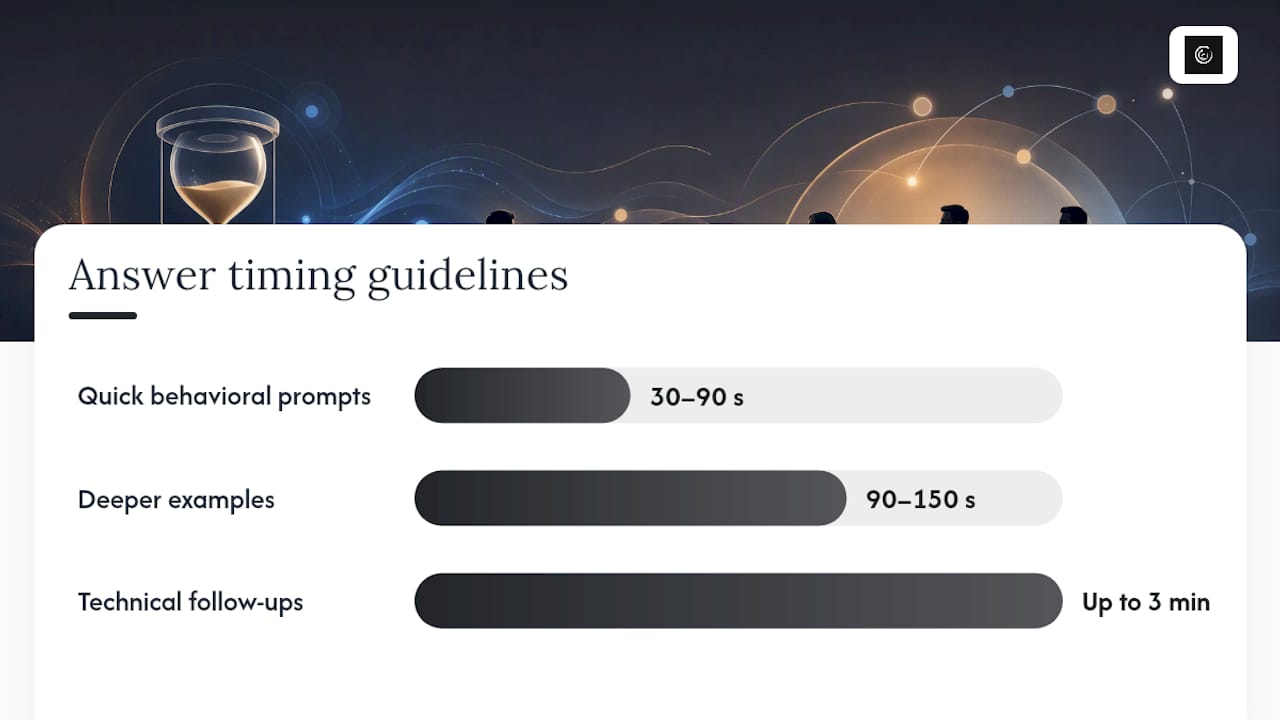
Timing guidelines:
- 30–90 seconds for quick behavioral prompts (“Give me an example of a time you disagreed with a manager”)
- 90–150 seconds for deeper examples requiring context
- Up to 3 minutes for technical follow-ups where methodology matters
interviewers](https://apna.co/career-central/panel-interview-tips/) find behavioral questions effective for evaluating candidate potential — which means the panel is almost certainly using them, and a structured answer is what they’re scoring for.
Three sample answer structures you can adapt:
Behavioral (leadership under pressure): “In Q3 last year, our deployment timeline collapsed by two weeks. My job was to keep the client relationship intact while the engineering team rebuilt the schedule. I set up daily 15-minute standups with the client’s PM and gave them a revised milestone tracker every 48 hours. We delivered four days late, but the client renewed the contract and cited communication as the reason.”
Teamwork/conflict: “A senior engineer and I disagreed on the database architecture for a new feature. Rather than escalating, I proposed a two-day spike where we each prototyped our approach and presented the results to the team. His approach won on performance benchmarks. I documented the decision and the reasoning so future engineers would understand the tradeoff.”
Technical troubleshooting: “A production API started returning intermittent 503s with no obvious pattern. I started by pulling the error logs and correlating timestamps with traffic spikes. The issue turned out to be a connection pool limit that hadn’t been updated after a traffic increase six months earlier. I updated the config, added a monitoring alert for pool saturation, and wrote a postmortem.”
Notice that each answer opens with context, moves quickly to action, and ends on a concrete outcome or artifact. That’s the structure to copy and swap your own details into.
What to do during the panel: eye contact, pacing, and recovery
The “asker-first sweep” is the most practical eye-contact technique for panels. When someone asks a question, make direct eye contact with them for the first sentence of your answer. Then sweep the rest of the panel as you develop the point. Close back on the original asker for your final sentence. This approach includes everyone without the mechanical, rotating-sprinkler feel that makes candidates look rehearsed rather than confident.
Pacing and interruptions:
- Take a two-second pause before answering any question. It signals that you’re thinking, not just reacting — and it gives you time to pick the right story.
- If two panelists ask questions simultaneously, acknowledge both: “I want to make sure I get to both of those — let me start with [first question] and then come back to yours.” Then do it.
- If a panelist interrupts mid-answer, stop cleanly. Don’t talk over them. Finish their thought, then ask: “Would it help if I continued with the example, or would you rather I address that directly?”
Note-taking during the panel:
Write down each panelist’s name when they introduce themselves — you’ll use those names in your thank-you emails. Jot a word or two next to each name to capture the question they asked or a point they made. Keep the notepad flat on the table and glance at it briefly; don’t let it become a barrier between you and the panel.
Recovery moves when you’re stuck:
- “That’s a good question — let me think through it for a moment.” (Pause. Think. Answer.)
- “I haven’t encountered that specific scenario, but here’s how I’d approach it: [walk through your reasoning process].”
- “I want to make sure I give you an accurate answer rather than a fast one — can I come back to that after I address [other question]?”
The third option works especially well in technical panels. Panelists generally respect intellectual honesty over confident bluffing.
How to handle video and hybrid panels without tech derailing you
Test everything the evening before, not 10 minutes before the call. Camera height matters more than most candidates realize: the lens should sit at eye level or just above, so you’re looking slightly up rather than down at the panel. A laptop on a stack of books works fine.
Your 15-minute pre-join routine:
- Close every browser tab and application you don’t need.
- Confirm your background is clean and uncluttered (or use a neutral virtual background).
- Check your lighting — a window or lamp in front of you, not behind.
- Test your microphone with a quick recording. Listen back.
- Confirm your internet connection. If it’s unstable, switch to a wired connection or enable your phone hotspot as a backup.
- Join the meeting room 1–2 minutes early, as recommended for video panels, and wait quietly.
Simulating eye contact on camera:
Look at the camera lens when you’re delivering a key point — not at the faces on your screen. It feels unnatural at first, but it reads as direct eye contact to the panel. Glance at the screen to read reactions, then return to the lens.
Pro Tip: Put a small sticky note with a smiley face just above your camera lens. It gives you a focal point and reminds you to keep your expression open rather than tense.
If audio or video lags:
Say so immediately. “I think there may be a slight delay on my end — please let me know if I’m cutting out.” Panels appreciate a candidate who manages tech issues calmly rather than pretending they’re not happening.
Hybrid panels (some panelists in-room, some remote) require extra coordination. Greet the in-room panelists when you arrive, then explicitly acknowledge the remote attendees on screen before the session starts. Bring one extra printed resume for each in-room panelist. When answering, alternate your eye contact between the room and the camera so remote panelists don’t feel like observers.
Common mistakes that quietly sink panel interviews
Most panel interviews aren’t lost on the hardest questions. They’re lost on small, fixable behaviors that signal a candidate wasn’t fully prepared.
- Locking onto one interviewer. Candidates often gravitate toward the friendliest face in the room and direct most of their answers there. The hiring manager or technical evaluator who got ignored will notice. Use the asker-first sweep on every answer.
- Rambling past the timing window. A 4-minute answer to a behavioral question doesn’t signal depth — it signals poor self-editing. If you’re still in the Situation after 45 seconds, you’re already running long.
- Bluffing technical answers. Panels with a subject-matter expert will probe. If you don’t know something, say so and walk through how you’d find the answer. “I’d start by checking the documentation and running a quick test in a sandbox environment” is a better answer than a confident guess that unravels under follow-up.
- Sending a generic group thank-you. One email addressed to “the panel” reads as an afterthought. Individualized notes that reference a specific moment from the interview are what actually move the needle.
- Forgetting the quiet observer. That person who barely spoke? They often have a strong vote. Include them in your eye contact during the session and address a thank-you note to them specifically.
How to rehearse so your practice actually transfers
The gap between knowing what to say and saying it well under pressure is closed by repetition, not by reading more guides. Mock panels with structured STAR practice and timed rehearsals improve clarity and keep answers scorable across multiple interviewers.
Running a realistic mock panel:
- Recruit two or three people to play different panelist roles (HR, manager, technical). Brief them on the job description and ask them to rotate questions.
- Set a timer. Run the session for 40–50 minutes without stopping to debrief mid-answer.
- Record the session on your phone or laptop.
- Rotate questioners across practice sessions so you’re not just getting comfortable with one person’s style.
What to watch for in the recording:
- Eye contact: are you sweeping the panel or staring at one spot?
- Filler words: “um,” “like,” “you know” — count them per answer.
- Story structure: does each answer have a clear result, or does it trail off?
- Timing: are you consistently over or under the 90–150 second target?
Scoring your own practice:
Use four criteria: clarity (could a non-expert follow the answer?), structure (did you follow STAR or a clear variant?), relevance (did the answer actually address the question?), and delivery (pace, volume, eye contact). Rate each on a 1–5 scale. Track the scores across sessions. Expert-designed prep materials and structured scoring consistently improve outcomes compared to unstructured review.
Rambling and structural drift become obvious at that pace in a way they don’t when you’re in the moment.*
Using Iterationinterview for objective feedback:
Self-scoring has limits — you can’t fully hear yourself the way a panel does. Iterationinterview’s AI-graded practice gives you timed, on-camera drills with structured feedback on clarity, story structure, and delivery. You can paste a full interview transcript or a single answer for immediate analysis, and the platform flags your weakest responses so you can drill those specifically rather than re-practicing what you already do well. The ranked practice format adds competitive pressure that mirrors the real stakes of a panel — which is exactly the condition that makes practice transfer.
What to do after the panel: follow-up that actually works
Send individual thank-you emails within 24 hours. Not a group message, not a LinkedIn note — a direct email to each panelist at the address the recruiter provided or that you collected during introductions.
What to include in each note:
- A specific reference to a question they asked or a point they made. “Your question about how I handle competing priorities made me think about a project I didn’t get to mention…” is far more memorable than “Thank you for your time.”
- A one-sentence reinforcement of your fit for the role, tied to what that specific panelist cares about.
- Anything you forgot to say. A follow-up email is a legitimate place to add a short example or clarify an answer you felt was incomplete.
Pro Tip: Write the first draft of each thank-you note in the parking lot or on the train home, while the specific moments are still fresh. You can polish and send later, but the details fade faster than you’d expect.
If you haven’t heard back:
- Wait the timeline the recruiter gave you. If they said “two weeks,” don’t follow up at day eight.
- If no timeline was given, one polite follow-up after seven business days is appropriate.
- Keep it short: “I wanted to follow up on my interview for [role] on [date]. I remain very interested and am happy to provide any additional information.”
Numbered follow-up sequence:
- Thank-you emails: within 24 hours of the panel.
- First follow-up (if no response): seven business days after the stated decision timeline.
- Second follow-up (if still no response): five business days after the first follow-up, then let it go.
Three contacts is the professional ceiling. Beyond that, you’re not demonstrating persistence — you’re creating friction.
Why panels reward preparation more than perfection
There’s a version of panel interview advice that focuses almost entirely on scripting — memorize these answers, rehearse these exact phrases, hit these keywords. It’s the wrong frame.
Panels are specifically designed to break scripts. Multiple interviewers, rotating questions, unexpected follow-ups, and a quiet observer watching your reactions — the format is built to see how you think, not just what you’ve memorized. A candidate who has drilled five STAR stories until they’re automatic will outperform a candidate who has memorized fifteen answers they’ve never said aloud under pressure.
The distinction matters because it changes what you practice. Scripting is about content. Preparation is about capacity — building the mental muscle to retrieve the right story, frame it clearly, and deliver it to three different people simultaneously. That capacity comes from repetition under realistic conditions, not from reading one more guide the night before.
Structured, repeatable practice also exposes the gaps that self-assessment misses. Most candidates think their weakest area is nerves. Usually it’s timing — answers that run 30 seconds too long, or stories that never quite land on a concrete result. You can’t hear that in your own head. You need a recording, a rubric, or an objective feedback source to see it clearly. That’s the argument for mock panels, for scoring rubrics, and for AI-assisted review: not because they replace human judgment, but because they make your preparation measurable rather than just hopeful.
Iterationinterview gives you objective feedback before the stakes are real
Most candidates walk into a panel having practiced alone, in their head, with no one pushing back. Iterationinterview changes that. The platform puts you on camera with timed behavioral questions, grades your answers on clarity, structure, and delivery, and flags the specific responses that need work — so your next practice session targets your actual weak spots instead of repeating what you already do well.
Paste a full interview transcript or a single answer and get an immediate AI review. Run ranked practice matches that simulate the pressure of a real panel. Use the targeted drills to tighten the stories that keep trailing off. The free tier gives you enough to identify your gaps; the Pro and Ultra plans give you the volume of practice that actually builds the capacity panels are designed to test. Start your first timed practice session and see exactly where your answers stand before the panel does.
Sources
The sources below were used to build this guide. Each one is worth reading directly for additional depth on the specific areas noted.
- How to Succeed in a Panel Interview: 5 Tips to Know — Coursera
- How to Ace Your Next Panel Interview — USC Online
- How to Handle Panel Interviews Without Getting Overwhelmed (2026 Guide) | Apna Career Central
- Panel Interview Guide — JobHelpGuide