Questions to Ask Interviewer: 25 Smart, Research-Backed Picks
Questions to Ask Interviewer: 25 Smart, Research-Backed Picks

Ask 3–5 tailored questions every interview, and use follow-ups to show you were listening. That combination does two things at once: it signals genuine interest and helps you diagnose whether the role is actually right for you. Harvard Business Review research found that candidates who ask follow-up questions referencing something the interviewer just said are rated significantly more likable than those who move straight to the next prepared question.
Here are five questions to ask an interviewer that work in almost any first-round conversation:
- “What does success look like in this role at the 90-day mark?”
- “How would you describe the team’s collaboration style?”
- “What’s the biggest challenge the team is working through right now?”
- “What do you enjoy most about working here?”
- “What are the next steps in your hiring process?”
When an interviewer gives you a rich answer, pause and echo one specific word or phrase they used before asking your next question. That single habit, backed by Science of People’s research-based guide, separates candidates who feel like conversations from candidates who feel like checklists.
Key Takeaways
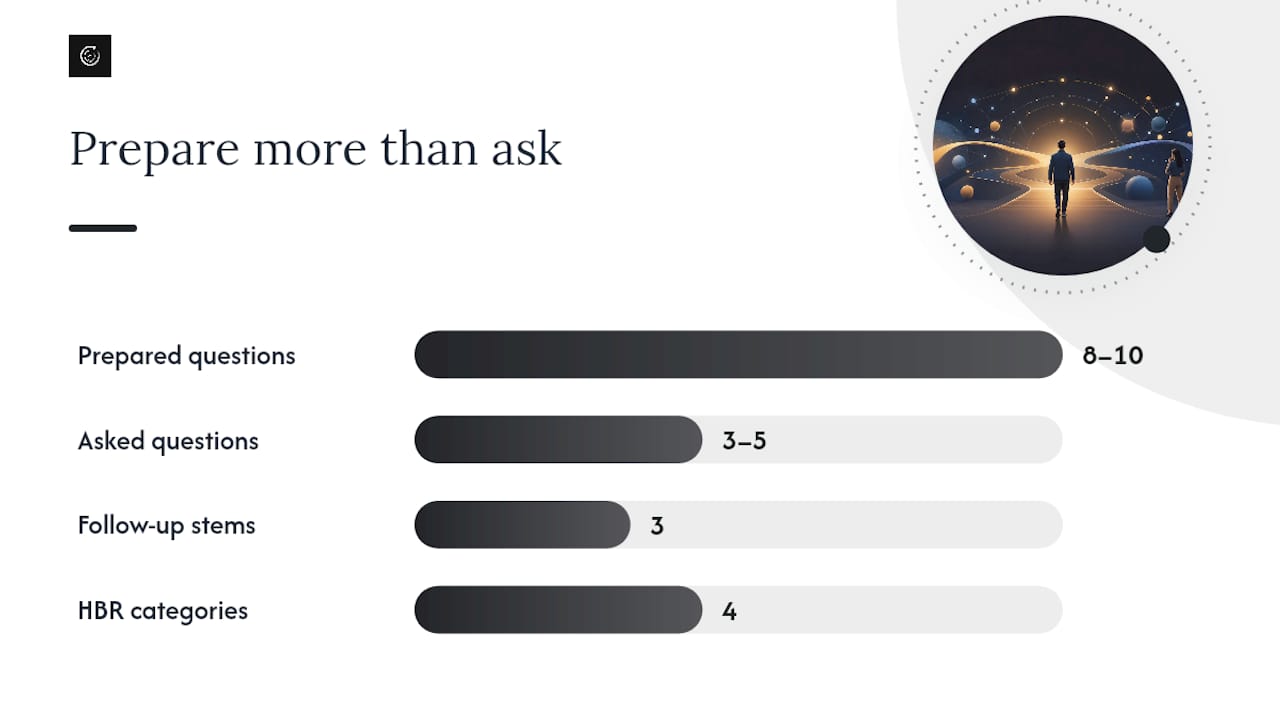
The single most effective strategy is to prepare 8–10 questions, ask 3–5 tailored ones per round, and use follow-up questions that reference what the interviewer just said.
| Point | Details |
|---|---|
| Prepare more than you’ll ask | Prepare 8–10 questions; plan to ask 3–5, since some will be answered during the conversation. |
| Follow-ups beat prepared questions | Echoing a specific detail the interviewer shared builds more rapport than any scripted question. |
| Tailor by interviewer role | Ask recruiters about process, hiring managers about success metrics, and peers about day-to-day tools. |
| Avoid premature salary questions | Hold compensation and benefits questions until an offer exists or the recruiter opens that topic. |
| Iterationinterview for practice | Use Iterationinterview’s ranked AI rounds and transcript review to rehearse questions and follow-ups before the real thing. |
Table of Contents
- Questions that probe the role: daily work, priorities, and early wins
- Questions to learn about the team, peers, and manager
- Questions about performance metrics, feedback, and review cadence
- Questions to read the culture, values, and everyday environment
- Questions about career development, training, and promotion pathways
- Questions about work-life balance, remote/flex policy, hours, and travel
- Questions to close the loop: hiring timeline, next steps, and follow-up
- What not to ask (and when compensation/benefits are appropriate)
- How to ask: follow-ups, tailoring to interviewer role, and note-taking
- What hiring managers actually want to hear when you ask questions
- Practice these questions before your next interview with Iterationinterview
- Sources
Questions that probe the role: daily work, priorities, and early wins
Understanding what the job actually looks like on a Tuesday morning matters more than what the job description says. These questions surface that reality.
- “What are the top three priorities for this role in the first 60 days?”
- “How does a typical week look for someone in this position?”
- “What’s the most urgent problem you’d want me to tackle first?”
- “How has this role evolved over the past year?”
- “What does the ramp-up period look like, and what support is provided?”
The 30/60/90-day question is especially revealing. A manager who answers with specific deliverables and clear milestones signals an organized team. A vague answer (“just get comfortable”) can mean unclear expectations or a role still being defined.
MIT’s career center advises against asking questions already answered during the conversation. Review your notes before the “Do you have any questions?” moment and skip anything that’s been covered.
Questions to learn about the team, peers, and manager
The person you report to shapes your day more than the company’s brand or benefits package. These questions help you read that dynamic before you accept an offer.
If you’re speaking with the hiring manager:
- “How do you prefer to give feedback, and how often?”
- “What does your team do well, and where are you trying to improve?”
- “How do you handle disagreements within the team?”
If you’re speaking with a peer:
- “What do you wish you’d known before joining?”
- “How does the team typically make decisions on projects?”
- “What tools does the team use day-to-day?”
If you’re speaking with a recruiter:
- “How long has this role been open, and why is it available now?”
- “What’s the team size, and how is it structured?”
Tailor your questions to who’s in the room. A recruiter won’t know the manager’s feedback style, and a peer won’t know the budget cycle. Yale’s CDO guide emphasizes this point directly: matching your question to the interviewer’s role gets you more useful, honest answers.
Questions about performance metrics, feedback, and review cadence
Knowing how you’ll be evaluated is as important as knowing what you’ll do. These questions surface the metrics that will define your first year.
- “How is performance measured in this role, and what does a strong first year look like?”
- “How often are formal reviews conducted, and is there a mid-year check-in?”
- “Are goals set collaboratively, or are they handed down from leadership?”
- “What’s the feedback culture like between reviews?”
Pay attention to how specific the answers are. A manager who can name two or three concrete KPIs is operating in a results-oriented environment. If the answer is “we just know when someone’s doing well,” that’s a signal about how structured the team’s expectations actually are.
Questions to read the culture, values, and everyday environment
Culture questions are easy to ask badly. “How would you describe the culture here?” almost always gets a polished, rehearsed answer. These questions are harder to spin.
- “Can you tell me about a time the team handled a mistake or a project that didn’t go as planned?”
- “How does the company recognize strong performance beyond compensation?”
- “What’s changed about the culture in the last two years?”
- “How does the team handle disagreements between departments?”
The mistake question is the most diagnostic. A team that can describe a real failure and what they learned from it is usually one that operates with psychological safety. A team that deflects or pivots to a success story may not.
Pro Tip: Frame culture questions to ask for a specific example rather than a general description. “Can you give me an example of how the team handled X?” produces far more honest answers than “How would you describe X here?”
Indeed’s categorized question bank includes over 60 questions across culture, performance, and process topics you can adapt for this purpose.
Questions about career development, training, and promotion pathways
A role that doesn’t grow with you becomes a ceiling. These questions tell you whether the company invests in the people it hires.
- “What does a typical career path look like from this role?”
- “Can you give me an example of someone who was promoted from this position?”
- “Is there a formal mentorship program, or does that happen more organically?”
- “Does the company support external training, conferences, or certifications?”
- “How does internal mobility work if I want to move into a different function later?”
Vague answers here are worth following up on. If a manager says “we support development” but can’t name a recent example of someone who moved up or laterally, that’s useful information. Ask: “What’s the most recent example of someone on this team getting a promotion or taking on a new challenge?”
Questions about work-life balance, remote/flex policy, hours, and travel
These questions feel personal, but they’re professional due diligence. Ask them directly and without apology.
- “What’s the current remote or hybrid policy, and is that likely to change?”
- “What are the expected core hours, and how does the team handle time zones?”
- “Is there an expectation to be available outside of standard hours?”
- “How much travel is typically involved, and how far in advance is it scheduled?”
The after-hours communication question is one most candidates skip. Phrasing it as “How does the team typically handle urgent messages outside of core hours?” reads as professional and practical, not demanding.
Pro Tip: Note the answers to logistics questions carefully. If the offer comes in and you want to negotiate remote days or flex hours, you’ll have the interviewer’s own words as a reference point.
Questions to close the loop: hiring timeline, next steps, and follow-up
Every interview should end with you knowing exactly what happens next. These questions make that possible.
- “What does the rest of the hiring process look like from here?”
- “How many candidates are you currently interviewing?”
- “When are you hoping to make a decision?”
- “Is there anything from our conversation that gives you pause about my fit for this role?”
- “What’s the best way to follow up with you after today?”
That fourth question is the one most candidates avoid. Coursera’s guide on end-of-interview questions recommends asking a version of it because it gives you a chance to address any hesitation before you leave the room. It also signals confidence.
What not to ask (and when compensation/benefits are appropriate)
Some questions are fine to ask, just not yet. Others signal that you haven’t done your homework.
Avoid in early rounds:
- “What does this role pay?” (unless the recruiter brings it up first)
- “How much vacation do I get?”
- “What are the benefits?”
- “Can I work from home every day?” (before an offer exists)
Avoid entirely:
- Anything already covered in the job description or on the company’s website
- Questions about internal politics or specific individuals
- “How soon can I get promoted?” in a first interview
Compensation and benefits are fair game once you have an offer or the recruiter explicitly opens that conversation. Asking too early reads as transactional rather than curious about the work itself.
Pro Tip: Before every interview, spend 10 minutes on the company’s LinkedIn page, recent press releases, and the job description. Any question you could answer yourself with a quick search is a question you shouldn’t ask.
How to ask: follow-ups, tailoring to interviewer role, and note-taking
The highest-leverage move in any interview isn’t the question you prepared. It’s the follow-up you ask after the interviewer answers.
HBR’s research on question types identified four categories: introductory, mirror, full-switch, and follow-up. Follow-up questions, those that reference a specific detail the interviewer just shared, produced the strongest boost in perceived likability. The mechanism is simple: they prove you were listening.
Three follow-up sentence stems that work in any interview:
- Mirror: “You mentioned [X]. Can you tell me more about how that works in practice?”
- Bridge: “That’s interesting. How does [X] connect to [Y] you described earlier?”
- Curiosity: “What’s the biggest factor that drives [X] in your experience?”
Statistic callout: Science of People recommends preparing 8–10 questions before every interview and typically asking 3–5. That ratio gives you flexibility when some questions get answered naturally during the conversation.
Take brief notes during the interview. Jot down a word or phrase from each answer, not full sentences. Those notes become the raw material for your follow-ups and for your thank-you email afterward.
Pro Tip: When you take a note, say “I want to make sure I get that right” and write it down visibly. It signals seriousness and gives the interviewer a natural pause to add more.
What hiring managers actually want to hear when you ask questions
From a hiring manager’s perspective, the best questions share three traits: they’re specific, they reference something from the conversation, and they show the candidate is thinking about doing the job, not just getting it.
What lands well:
- Questions that reference the company’s recent news, product launch, or challenge (“I saw you recently expanded into X. How does that affect this team’s priorities?”)
- Questions that show you’ve thought about the role’s challenges, not just its perks
- Asking for the interviewer’s personal experience (“What’s been the most rewarding part of your time here?”)
What doesn’t:
- Reading questions off a phone or paper without looking up
- Asking the same question to every interviewer in a panel without acknowledging their different roles
- Asking nothing at all
One line that works in almost every closing moment: “Based on what we’ve discussed today, is there anything you’d want me to clarify or expand on?” It’s direct, it shows confidence, and it gives the interviewer a chance to surface any lingering doubts.
Practice these questions before your next interview with Iterationinterview
Reading a list of good questions is one thing. Delivering them under pressure, with natural follow-ups and confident phrasing, is another skill entirely.
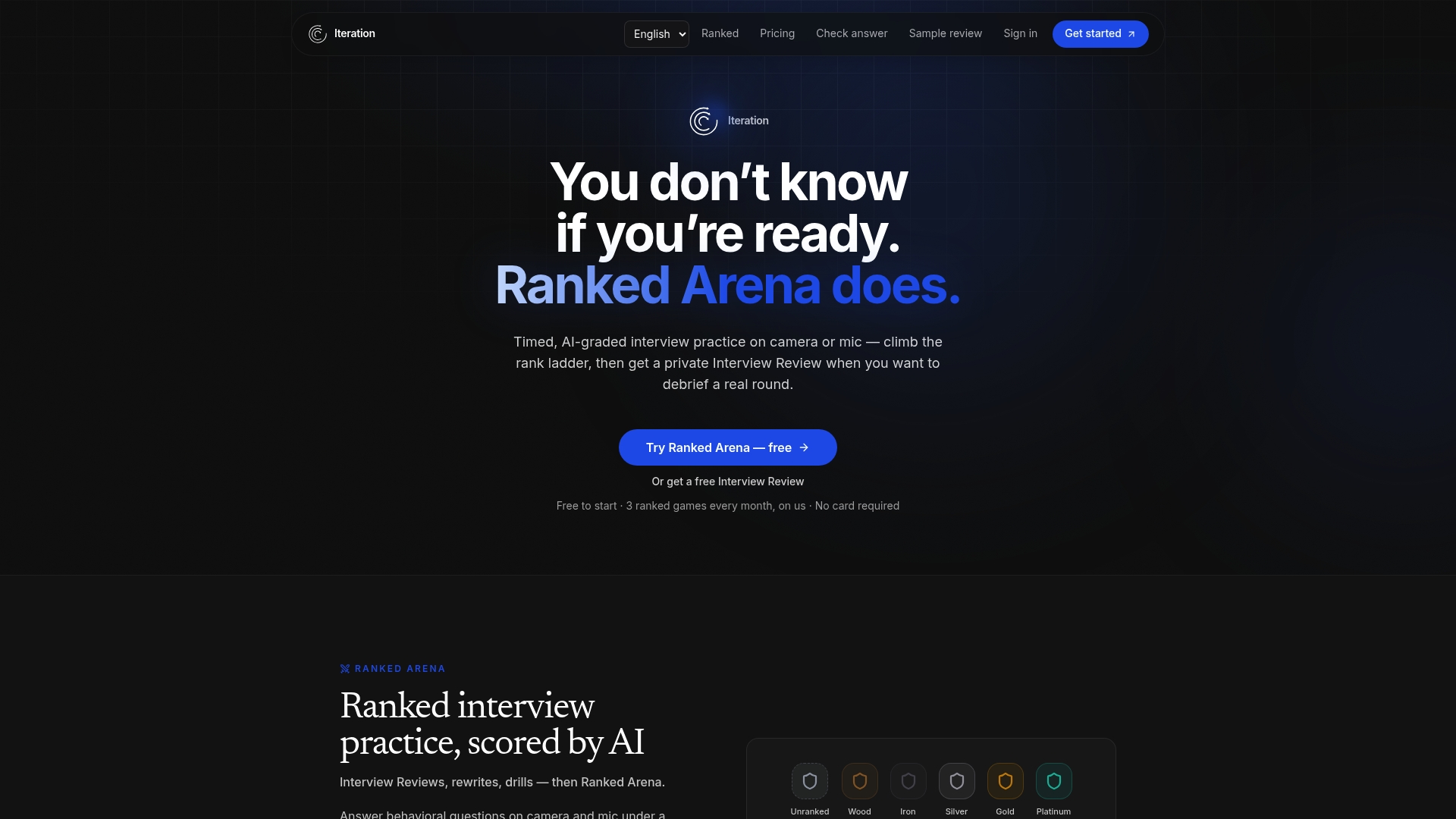
Iterationinterview is built for exactly this gap. The platform’s ranked AI practice puts you through timed, on-camera or mic rounds where you can rehearse your questions and follow-up responses, then get structured AI feedback on clarity, specificity, and delivery. You can also paste a full interview transcript into the try page and see exactly which answers landed and which fell flat. A focused routine of 3–5 practice rounds, one each for role questions, manager questions, and culture questions, builds the muscle memory that makes follow-ups feel natural rather than scripted. Start practicing at Iterationinterview and go into your next interview knowing your questions are sharp.
Sources
These are the primary research and career-center resources behind this article.
- The Surprising Power of Questions
- 45 Questions to Ask an Interviewer (Backed by Research)
- Questions to Ask the Interviewer
- 20 Best Questions to Ask at the End of an Interview
- Indeed