Ranked Interviews: Practice That Actually Improves Your Answers
Ranked Interviews: Practice That Actually Improves Your Answers

Ranked Interviews are gamified, AI-graded mock interviews where your answers are scored in real time and placed on a live leaderboard. That single mechanic, when paired with targeted feedback and spaced sessions, is the fastest documented path from “I think I answered well” to “here’s proof I improved.” Iterationinterview’s ranked practice section is built around exactly this model. Two numbers worth knowing upfront: ML scoring of game-based assessments has shown concurrent validity around r = 0.50 and test–retest reliability of r = 0.68 in large applied samples, which means the scores are both meaningful and consistent enough to track progress over time.
- What they are: Timed, AI-scored practice rounds placed on a leaderboard
- Why they work: Immediate feedback, measurable progress, and competitive structure increase practice frequency
- What the research shows: Concurrent validity r ≈ 0.50; test–retest reliability r ≈ 0.68 from ML scoring studies
- Where to try them: Iterationinterview’s ranked practice section
Key Takeaways
Ranked Interviews are AI-graded mock interviews on a live leaderboard, and the fastest improvement comes from spaced short sessions paired with immediate transcript review and targeted drills.
| Point | Details |
|---|---|
| Session cadence matters | Space 3–5 short sessions across the week; marathon practice degrades retention and increases burnout risk. |
| Review feedback immediately | Read transcript scores within 24 hours of each session to catch patterns while the answer is still fresh. |
| Drill the weak subscore | Tag the lowest subscore after each round and complete a 10–20 minute targeted drill before the next session. |
| Use relative leaderboards | Relative rankings increase engagement for mid-level performers and reduce demotivating social comparison. |
| Iterationinterview’s ranked section | Combines timed scored rounds, transcript drills, and a relative leaderboard in one workflow with a free starting tier. |
Table of Contents
- How do ranked interviews actually work?
- What ranked practice reliably helps with, and where it has limits
- How to use ranked interviews effectively
- How to read your scores and what improvement looks like
- What to ask any vendor about privacy and fairness
- How Iterationinterview implements ranked interviews
- What ranked practice actually changes
- Try Iterationinterview’s ranked practice section free
- Sources
How do ranked interviews actually work?
A ranked practice round follows a clear pipeline: timed response capture → automated scoring → granular feedback → optional targeted drills → leaderboard update. Each step is deliberate.
You select a question type (behavioral, technical, or situational), then record your answer on camera or mic within a set time window. The AI extracts features from your response: content structure, use of the STAR framework, specificity, metrics cited, delivery clarity, and pacing. A scoring model, typically a regularized approach like ridge regression, converts those features into a normalized score. A fairness step checks for group-level score differences before the final number is written to the leaderboard.
Leaderboards come in two forms. Absolute leaderboards rank everyone by raw score. Relative leaderboards show your position within a nearby cluster of performers at your level, which research links to higher engagement and mastery orientation compared to absolute public rankings. Iterationinterview uses this structure to keep competition constructive rather than discouraging.
The leaderboard mechanics also explain why ranked practice drives more sessions. A randomized study found that students exposed to leaderboards completed about 29.6 more interactions on average than controls, with time-on-task mediating improvements in performance. More reps, faster feedback, clearer targets.
The typical ranked round in Iterationinterview:
- Select a question category and difficulty
- Record a timed on-camera or mic response
- Receive an AI score with subscores (structure, specificity, delivery, time management)
- Read the transcript-level feedback highlighting strengths and weak spots
- Run a targeted drill on any flagged weakness
- Watch your leaderboard position update
What ranked practice reliably helps with, and where it has limits
The core benefit is behavioral: ranked practice gets you to show up more often and pay closer attention to feedback. A quasi-experimental study with 159 students found that leaderboard gamification increased quiz completion and improved exam scores over eight weeks, though the authors noted effects can weaken without deliberate retention design.
Concurrent validity r ≈ 0.50 and test–retest reliability r ≈ 0.68 from ML scoring research, validated across 11,574 assessment completions and a separate fairness sample of 3,107 applicants, confirm that AI scores in this context are both meaningful and stable enough to track real progress.
Documented benefits:
- More practice sessions per week due to competitive and feedback-driven motivation
- Faster feedback loop than human review alone
- Targeted drills that address specific weaknesses rather than generic repetition
- Measurable score trends that show consolidation over time
- Positive user experience: a large applied sample reported an NPS of 58 across 4,778 respondents
Real limits to plan around:
- Leaderboard chase behavior can cause burnout if sessions run too long or too frequently
- Abstract scoring interfaces sometimes raise face-validity concerns (“does this score reflect how I’d actually perform?”)
- Motivation can drop for bottom-ranked users when full public rankings are displayed
- Short-term engagement gains don’t automatically translate to long-term retention without spaced practice design
How to use ranked interviews effectively
Spaced short sessions beat marathon practice every time. Science-backed exam-prep guidance consistently supports scheduled, distributed practice over single long blocks, and the same logic applies directly to interview preparation.
A repeatable weekly routine:
- Monday/Wednesday: 10–15 minute warmup round, one scored ranked session
- Thursday: Review AI feedback from both sessions, run one targeted drill per flagged weakness
- Saturday: Rewrite one weak answer using transcript notes, check leaderboard trend
Micro-action checklist for each session:
- Save the transcript immediately after scoring
- Tag recurring weak patterns: STAR structure gaps, missing metrics, answer length issues
- Assign a 10–20 minute drill to each tagged weakness before the next session
- Set a mastery goal (“improve specificity subscore by 5 points”) rather than a rank goal (“reach top 10”)
- Note one concrete improvement from the previous session before starting the next
Pro Tip: Use relative leaderboards or private leagues within Iterationinterview rather than public absolute rankings. Research shows this approach increases engagement for middle and bottom performers by reducing negative social comparison while keeping the competitive structure intact.
How to read your scores and what improvement looks like
Treat any single score as a snapshot, not a verdict. What matters is the trend across five or more sessions. Score variance is normal: test–retest reliability of r = 0.68 means roughly a third of score movement between sessions reflects natural fluctuation rather than real skill change.
Score components to watch:
- Content structure: STAR framework adherence, logical flow
- Specificity: Named examples, quantified outcomes, concrete details
- Delivery: Tone, clarity, filler word frequency
- Time management: Answer length relative to the question’s expected depth
Interpretation rules:
- Gains under 5 points across two sessions: micro-improvements, keep drilling
- Consistent weekly gains of 5–10 points: skill consolidation happening
- Plateau for two or more weeks: change the drill type or request a human review
- Subscore divergence (content up, delivery flat): focus next drill on the lagging dimension
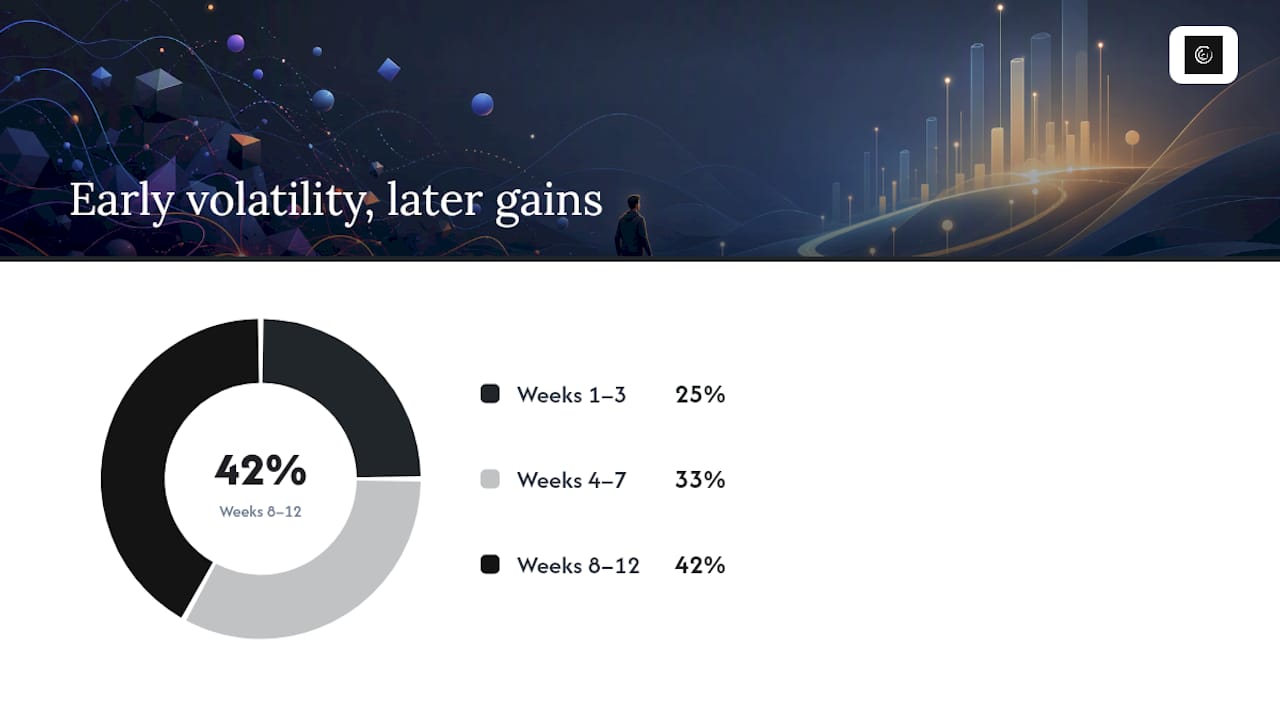
A realistic improvement arc for someone practicing 3–5 short sessions per week: weeks 1–3 show score volatility as you calibrate to the format; weeks 4–7 show consistent gains in structure and specificity; weeks 8–12 show delivery and time management catching up. Most users reach a “competent” threshold around week 6–8 and a “polished” level by week 10–12, though this varies by starting point and drill consistency.
What to ask any vendor about privacy and fairness
Privacy and fairness aren’t secondary concerns when your interview responses are being recorded, transcribed, and scored. Ask these questions before relying on any ranked practice platform for high-stakes preparation.
Vendor checklist:
- How long is response data retained, and is deletion available on request?
- Where is data stored, and under which jurisdiction’s privacy law?
- Are transcripts used to retrain the scoring model, and can you opt out?
- Has the scoring model been audited for group-level differences (gender, race, accent)?
- What adverse-impact metrics are reported, and what sample sizes were used in validation?
- Is a human review option available for disputed scores?
Fairness measures worth looking for:
- Fairness-optimized scoring with documented bias-penalization steps
- Published validation sample sizes (the ML scoring research above used 11,574 completions and a separate 3,107-applicant fairness sample)
- Reported adverse-impact metrics alongside validity figures
- Transparent model documentation, not just a marketing claim
Some platforms offer offline or privacy-limited modes that reduce data-sharing exposure. Check whether the vendor supports local processing or an opt-out from cloud storage if that matters to you.
How Iterationinterview implements ranked interviews
Iterationinterview combines timed on-camera or mic practice, automated AI grading, transcript reviews, targeted drills, and ranked practice games with a live leaderboard into a single workflow designed around the session plan above.
Features you interact with directly:
- Scored mock interviews with subscores across content, specificity, delivery, and pacing
- Full transcript import: paste an answer or an entire interview for AI analysis and rewrite suggestions
- Targeted drills generated from your past weak responses, not generic question banks
- Relative leaderboard showing your position within a peer cluster
- Session history and score trend charts so you can track the 4–12 week arc described above
- Exportable review notes for offline study or human coach review
Pricing: A free tier gives you limited monthly practice rounds to test the workflow. Paid plans (Pro and Ultra, available monthly or annually) unlock more scored rounds per month and deeper analysis, including full transcript rewrites and extended drill libraries. The practical difference is volume and depth: free is enough to test whether ranked practice fits your style; Pro and Ultra are built for candidates in active job searches who need consistent weekly sessions.
Pro Tip: After each session in Iterationinterview, use the tag-and-drill workflow: tag the specific subscore that dropped, open the targeted drill for that category, and complete it before closing the app. This 10-minute habit is what separates users who plateau from those who show consistent weekly gains.

What ranked practice actually changes
Ranked practice changes behavior before it changes scores. The most consistent pattern is that candidates shift from occasional long sessions to frequent short ones, which is exactly what the spaced practice research predicts should happen. A candidate who starts with weak STAR structure typically sees the biggest early gains in content scores within the first three weeks, simply because the transcript feedback makes the gap visible in a way that self-assessment never does. The leaderboard adds a reference point that keeps the work honest: it’s harder to convince yourself you’re improving when the trend chart says otherwise. That accountability, not the rank itself, is what makes the format work.
Try Iterationinterview’s ranked practice section free
Iterationinterview’s ranked interview section gives you the full workflow described above: a timed scored round, AI feedback with subscores, a targeted drill, and a leaderboard position, all in one session. The free tier includes limited monthly practice rounds so you can test the format before committing to a plan.
If the feedback from your first round surfaces a pattern you want to fix fast, the Pro plan unlocks more weekly sessions and full transcript rewrite support. Start with one round, review the feedback within 24 hours, and run the drill before your next session. That single habit, repeated consistently, is what the improvement arc above is built on. Try a ranked round now or see full plan details to choose the tier that fits your search timeline.
Sources
- Frontiers | Game based assessments of cognitive ability in recruitment: Validity, fairness and test-taking experience
- Unlocking student engagement and achievement: The impact of leaderboard gamification in online formative assessment for engineering education | Education and Information Technologies | Springer Nature Link
- An Empirical Test of the Theory of Gamified Learning: The Effect of Leaderboards on Time-on-Task and Academic Performance
- How different gamified leaderboards affect individual students’ learning engagement, strategies, performance, and perceptions in online classes - EdUHK Research Repository
- Spaced Repetition Exam Prep: A Science-Backed Guide — PrepAdmit Blog