Salary Expectations Answer: 3 Scripts You Can Use Now
Salary Expectations Answer: 3 Scripts You Can Use Now

When the interviewer asks about salary, you have three solid moves. Use whichever fits the moment.
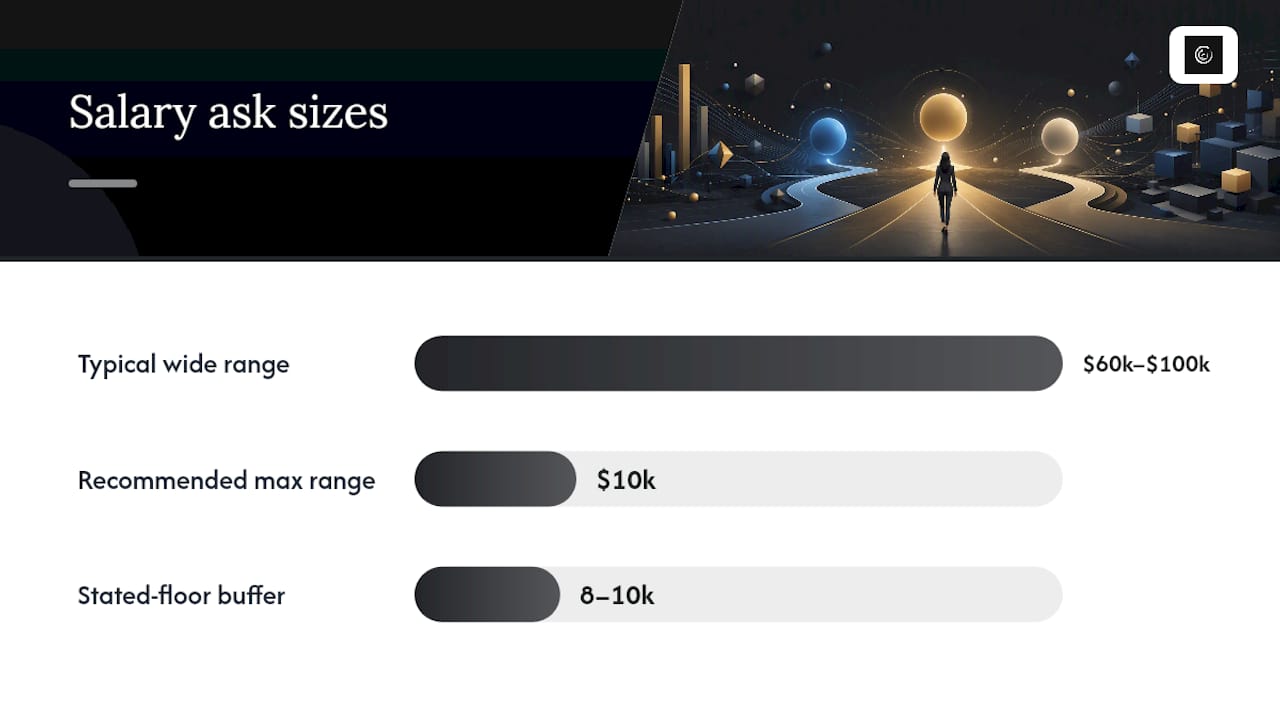
- Give a tight range: “Based on my research and experience, I’m targeting $78,000 to $87,000. I’m open to discussing the full compensation package.” Use this when you’ve done your homework and the role is well-defined. Keep the spread under $10,000 so you signal precision, not desperation.
- Flip the question: “Before I give a number, could you share the budgeted range for this role?” Use this early in the process, especially on a first recruiter screen, when you don’t yet know the full scope of responsibilities.
- Delay politely: “I’d love to get a clearer picture of the role’s responsibilities and total compensation before I name a number. Can we revisit this later in the conversation?” Use this when the question comes too early and you need more information to anchor well.
Each script works. The right one depends on timing, which the rest of this guide covers in detail.
Key Takeaways
A well-researched, tightly ranged salary answer delivered without apology is one of the clearest signals of interview readiness a candidate can send.
| Point | Details |
|---|---|
| Use a tight range | Keep your stated spread at $10,000–$15,000 or less; the bottom should be a number you’d genuinely accept. |
| Flip or delay early | In recruiter screens, ask for the employer’s budgeted range before naming your own number. |
| Factor in total comp | Evaluate bonus, equity, and benefits before comparing offers or stating expectations. |
| Avoid common anchoring errors | Never state your walk-away floor, apologize before a number, or accept an offer on the spot. |
| Practice delivery with Iterationinterview | Use AI-graded mock rounds to refine wording and eliminate hedging before the real interview. |
Table of Contents
- What’s your salary expectations answer for common interview scenarios?
- How do you research a market-backed salary range?
- Which tactic should you use and when?
- What do you say after the employer names a number?
- Salary answer mistakes that cost candidates money
- Pre-interview checklist: is your salary answer ready?
- How Iterationinterview helps you rehearse your exact salary answer
- What hiring teams actually hear when you answer salary questions
- Practice your salary answer with Iterationinterview
- Sources
What’s your salary expectations answer for common interview scenarios?
The scripts above are starting points. Here’s how to adapt them across the situations you’ll actually face.
Entry-level candidate
“Based on my research into the market rate for this role in [city], I’m targeting $52,000 to $60,000. I’m excited about the opportunity to grow here and open to discussing the full package.”
Tip: Lead with research, not need. Saying “I need at least X” shifts the frame in the wrong direction.
Experienced professional (5+ years)
“My research puts the market range for a senior [title] in [city] between $115,000 and $125,000, and given my track record of [specific result], I’m targeting the upper half of that range.”
Tip: Name a result. It turns a number into a justified ask rather than a wish.
Career changer
“I’m transitioning from [field], where I was earning in the $90,000 range, but I understand the market for [new role] sits closer to $75,000 to $83,000. I’m comfortable with that range and focused on building expertise here.”
Tip: Acknowledge the shift before the interviewer does. It reads as self-aware, not apologetic.
Hourly or contract role
“For contract work at this scope, I’m targeting $45 to $52 per hour, which aligns with what I’ve seen for [role type] in this market.”
Tip: Have your hourly-to-annual conversion ready ($48/hour × 2,080 hours = $99,840/year) so you can speak to either format without hesitation.
Early-stage recruiter screen
“I’d rather not anchor too early. Could you share the range your team has budgeted? That way I can tell you right away whether we’re aligned.”
Tip: Recruiters often respect this. It saves everyone time.
Final-round or offer-stage conversation
By the time you’re in final rounds, you should be ready to give a single, justified number rather than a range. “Based on everything I’ve learned about the role, I’m targeting $132,000.” Clean, confident, grounded.
Pro Tip: Record yourself delivering your answer. Phrasing and tone affect how hiring teams interpret a number just as much as the number itself. Play it back and listen for hesitation or apologetic softening.
How do you research a market-backed salary range?
A defensible range starts with data, not gut feel. Here’s a repeatable method.
Step-by-step: building your number
- Pull data from at least two sources. Check the Bureau of Labor Statistics Occupational Employment and Wage Statistics for national and regional medians. Cross-reference with Glassdoor, LinkedIn Salary, Payscale, and Indeed Salaries. City and industry adjustments often move midpoints by 15–25%, so location matters.
- Filter by your specific title, experience level, and metro area. “Marketing Manager” in Austin pays differently than the same title in San Francisco. Narrow the query before you record any numbers.
- Set three internal anchors: your dream number (top of market for your experience), your realistic target (mid-market), and your walk-away floor (the lowest you’d genuinely accept). Never state the walk-away floor in an interview.
- Build your stated range. Set the bottom of your stated range at or above your realistic target, not at your walk-away floor. If your realistic target is $90,000 and your walk-away is $82,000, your stated range might be $90,000 to $98,000. The floor you say out loud should be a number you’d happily accept.
- Keep the spread tight. A $10,000 spread reads as prepared. A $40,000 spread reads as unprepared. Aim for $8,000 to $12,000 between your low and high.
- Factor in total compensation. Benefits, bonuses, and equity can shift the real value of an offer by tens of thousands of dollars. Know what you’d trade base salary for before you walk in.
Quick hourly-to-annual conversion
Use this table when a role is posted as hourly but you want to compare it to salaried positions, or when an interviewer asks you to translate your rate.
Pro Tip: When you use Glassdoor or LinkedIn Salary, filter by “base pay” specifically, then check the bonus and equity fields separately. Combining them inflates the apparent base and can lead you to anchor too high on base while underselling total comp.
Which tactic should you use and when?
Timing changes everything. The same answer that works in a final round can hurt you in a first phone screen.
Mapping tactics to hiring stages
Early recruiter or phone screen: Your leverage is low because the employer hasn’t invested much time yet. Flipping the question (“What’s the budgeted range?”) is your best move here. If the recruiter pushes back and insists on a number, give a range and add: “That said, I’m flexible depending on the full scope and total compensation.”
On-site or hiring manager interview: You know more about the role now. A tight, researched range lands well here. Frame it as a conclusion from your market research, not a personal preference. Candidates gain negotiation leverage as the process advances because the employer has invested time and signaled interest.

Final round or offer stage: Give a single number if asked. You have enough information about the role, team, and scope to justify it. Ranges at this stage can read as indecisive.
Written application form: If the form requires a number, enter a researched midpoint or the bottom of your stated range. Avoid leaving the field blank when it’s required; a blank often screens you out automatically.
| Stage | Best tactic | Leverage | Risk |
|---|---|---|---|
| Recruiter/phone screen | Flip the question | Low | Anchoring too early |
| Hiring manager interview | Give a tight range | Medium | Naming a number before scope is clear |
| Final round | Give a single number | High | Appearing indecisive with a range |
| Application form | Enter researched midpoint | Low | Blank field screens you out |
Pro Tip: If a recruiter asks for your number before sharing the job description, it’s fair to say: “I’d love to see the full job description first so I can give you an accurate answer.” Most will send it.
- Flip the question when you lack information.
- Give a range when you know the role but not the final offer.
- Give a single number when you’re at the finish line.
- Always have a total compensation question ready as a follow-up.
What do you say after the employer names a number?
When the employer shares a figure, your next sentence matters more than your original answer.
- Ask for the full picture before reacting. “Thank you. Could you walk me through the total compensation, including bonus structure, equity, and benefits?” This buys time and surfaces information that might change your read on the offer.
- Counter with your researched range if the number is low. “I appreciate the offer. Based on my research and the scope of this role, I was targeting $X to $Y. Is there flexibility there?” Grounding the counter in market data, not personal need, keeps the conversation professional.
- Ask for time if you need it. “This is exciting. Could I have 24 to 48 hours to review the full package before responding?” Any reasonable employer will say yes. Accepting on the spot rarely benefits you.
- Negotiate levers beyond base pay. If base is fixed, shift to other variables.
Compensation levers worth negotiating:
- Signing bonus
- Annual bonus target or structure
- Equity (stock options, RSUs, vesting schedule)
- Additional PTO or flexible PTO
- Remote work arrangement or home-office stipend
- Title or level (which affects future salary benchmarks)
- Performance review timeline (e.g., a 6-month review instead of annual)
- Professional development budget or tuition reimbursement
- Relocation assistance
Salary answer mistakes that cost candidates money
Most of these mistakes happen because candidates haven’t practiced. Here’s what goes wrong and what to say instead.
- Giving a range that’s too wide. A $60,000 to $100,000 range signals you haven’t done your homework. Do this instead: narrow it to $10,000 or less and anchor the bottom where you’d genuinely be happy.
- Naming a single number too early without justification. Dropping “$85,000” in the first five minutes with no context invites a lowball. Do this instead: attach a one-sentence rationale (“Based on the market rate for this role in [city]…”) before the number.
- Revealing your current salary unprompted. Many states now restrict employers from asking, and volunteering it anchors the negotiation to your past, not your market value. Do this instead: redirect to your target (“I’m focused on what the market pays for this role”).
- Apologizing before you state a number. “I know this might be high, but…” tells the interviewer to push back. Do this instead: state the number plainly, then pause. Silence is not a problem.
- Anchoring to your walk-away floor. If $80,000 is the minimum you’d accept, don’t say $80,000. Do this instead: set your stated floor $8,000 to $10,000 above your walk-away.
- Ignoring total compensation. A $95,000 offer with no bonus, poor benefits, and no equity may be worth less than an $88,000 offer with a 15% bonus target and full health coverage. Do this instead: ask for the full package before comparing offers.
- Accepting on the spot. Even if the offer is great, accepting immediately leaves money on the table and can signal desperation. Do this instead: thank them, express genuine enthusiasm, and ask for 24 hours.
Framing your ask as a conclusion from market analysis rather than a personal preference eliminates most of these mistakes at the root.
Pre-interview checklist: is your salary answer ready?
Run through this before every interview. A “no” on any item means you have a gap to close.
- [ ] Researched at least two salary data sources (BLS, Glassdoor, LinkedIn Salary, Payscale, or Indeed)
- [ ] Filtered data by your specific title, experience level, and metro area
- [ ] Set a stated range where the bottom is a number you’d genuinely accept
- [ ] Kept the range spread at $10,000 to $15,000 or less
- [ ] Factored in total compensation (bonus, equity, benefits, PTO) before finalizing the range
- [ ] Prepared the flip script (“What’s the budgeted range?”) for early-stage conversations
- [ ] Practiced the answer aloud at least three times, including the justification sentence
- [ ] Recorded yourself once and listened back for apologetic phrasing or hesitation
Pressure-test prompt: Ask a friend or use a voice recorder: “What are your salary expectations?” Deliver your full answer, including the justification. If you stumble on the number or soften it with “I know this might be a lot,” you need another round of practice.
How Iterationinterview helps you rehearse your exact salary answer
Knowing your number is half the work. Delivering it without flinching is the other half. Here’s a practical workflow using Iterationinterview’s AI mock-interview tools.
- Record your answer. Use Iterationinterview’s timed, on-camera or mic practice mode to deliver your salary answer as you would in a real interview. The constraint of a live recording surfaces hesitation you won’t catch reading silently.
- Get automated feedback. Iterationinterview’s AI grades your response on clarity, confidence, and wording, then flags specific phrases to improve. If you said “I think maybe around $85,000,” the feedback will catch that hedge.
- Implement the rewrites. Take the three improvement points the platform surfaces and revise your script. A typical revision cycle tightens the justification sentence and removes apologetic softeners.
- Practice again. Run the revised answer through another timed round. The platform tracks your improvement across sessions, so you can see whether delivery is getting cleaner.
Example exercise: Paste your draft salary answer into Iterationinterview’s analysis tool. The AI returns structured feedback: what landed, what to cut, and what to add. Most users produce a tighter, more confident final script in two or three iterations.
Pro Tip: Use Iterationinterview’s transcript import feature to paste an answer you already gave in a real interview. The platform identifies exactly where you hedged or lost the thread, so your next answer is built on real evidence, not guesswork.
What hiring teams actually hear when you answer salary questions
Most candidates treat the salary question as a hurdle. Hiring teams treat it as a signal.
When you give a well-researched range without apology, the interviewer hears: this person knows their market, has thought about the role seriously, and can advocate for themselves without being combative. That combination is genuinely rare. Most candidates either anchor too low out of fear or go wide to avoid commitment, and both moves read as unpreparedness.
The tone matters as much as the number. Deliver the range at the same pace and volume as the rest of your answers. A drop in voice or a trailing sentence tells the room you’re not sure the number is justified. Practicing delivery aloud is not optional if you want the number to land the way it reads on paper.
One practical note on pacing: state the range, then stop. Don’t fill the silence with qualifiers. The pause after a number is not awkward; it’s professional.
Practice your salary answer with Iterationinterview
Knowing the right script is a start. Delivering it under pressure, on camera, without hedging, is what actually gets you the offer.

Iterationinterview gives you timed, on-camera practice rounds where AI grades your salary answer on clarity, confidence, and wording, then returns specific rewrites you can use in your next round. You don’t need a coach or a practice partner. Paste your draft answer or record a live response, and the platform tells you exactly what to fix. Start a free practice round and have a polished, market-backed salary answer ready before your next interview.
Sources
- How to Answer Salary Expectations Questions in an Interview | Coursera
- What Are Your Salary Expectations? (The Muse)
- How to Answer, ‘What’s Your Expected Salary?’ | Robert Half
- How to Answer “What Are Your Salary Expectations?” | Harvard Business Review
- How to Answer “What Are Your Salary Expectations?” | Indeed