Behavioral Interview Questions: Top 10 + 100 Examples
Behavioral Interview Questions: Top 10 + 100 Examples

Behavioral interview questions ask for concrete past examples of how you handled real work situations. The premise is simple: what you did before predicts what you’ll do next. This guide gives you everything you need to walk in prepared — a Top 10 quick-reference list, a categorized bank of 100+ questions, 10+ STAR-based sample answers with role-level variants, a story-inventory workflow, and a practice plan you can start today.
Before you read another word, do this: pick three work stories you’re proud of. One where you solved a hard problem. One where something went wrong and you fixed it. One where you led or influenced without formal authority. Those three stories will cover more ground than you think.
Here’s what this guide delivers:
- Top 10 most common behavioral questions for quick-reference practice
- Categorized question bank (teamwork, conflict, leadership, problem-solving, adaptability, and more)
- STAR templates and 10+ sample answers with timing notes and role-level variations
- A reproducible preparation plan with a story-inventory mapping table and practice drills
Key Takeaways
Behavioral interview questions reward candidates who prepare specific, quantified stories and deliver them in a clear STAR structure — preparation quality, not story quantity, determines your outcome.
| Point | Details |
|---|---|
| Use STAR every time | Structure every answer as Situation, Task, Action, Result — keep it to 1–2 minutes. |
| Prepare five stories, not fifty | Map each story to multiple competencies so one experience covers many question types. |
| Quantify your results | Include at least one metric or estimate per answer — “reduced by roughly a third” beats “improved significantly.” |
| Practice with a rubric | Score yourself on situation clarity, ownership, action specificity, result, and learning after every mock round. |
| Iterationinterview accelerates feedback | AI grading on STAR elements surfaces weak spots in seconds, so you fix the right thing before the real interview. |
Table of Contents
- What are behavioral interview questions, and why do interviewers ask them?
- How to answer behavioral interview questions using the STAR method
- The complete behavioral questions list: Top 10 plus a full categorized bank
- Sample STAR answers and reusable templates
- How to build a story inventory and prepare efficiently
- How to get objective feedback and actually improve
- How to stand out and the mistakes that sink good candidates
- Smart questions to ask after behavioral interviews
- What actually matters in the final week before your interview
- Get objective feedback on your behavioral answers faster
- Sources
What are behavioral interview questions, and why do interviewers ask them?
Behavioral questions follow one rule: ask what you did, not what you would do. Instead of “How do you handle conflict?” an interviewer asks “Tell me about a time you disagreed with a colleague and how you resolved it.” The shift sounds small, but the information it produces is far richer.
The reason hiring teams rely on them is predictive power. Research and practitioner summaries confirm that behavioral interviewing produces a substantially higher predictive signal for future on-the-job performance compared with unstructured, traditional interviews. A candidate who can describe a specific conflict, name the people involved, explain the steps they took, and quantify the outcome is giving an interviewer something to score — not just a polished opinion about themselves.
Structured scoring is the other half of the equation. Hiring teams use behavioral questions with rubrics: they listen for situation clarity, ownership of the action, specificity of the steps, and measurable results. When a candidate’s answer is thin on any of those, a trained interviewer probes with follow-ups (“What was your specific role?” “What happened after that?”). The follow-up is not a trap — it’s the interviewer trying to get enough signal to score you fairly.
Behavioral questions appear across industries and levels because competencies like communication, adaptability, and judgment are relevant everywhere. A data science behavioral interview question about handling ambiguous requirements and a customer-service question about managing an upset client are structurally identical: both ask for a past example, both reward specificity, and both penalize vague generalities.
How to answer behavioral interview questions using the STAR method
The single most reliable answer structure is STAR: Situation, Task, Action, Result. Use it every time.
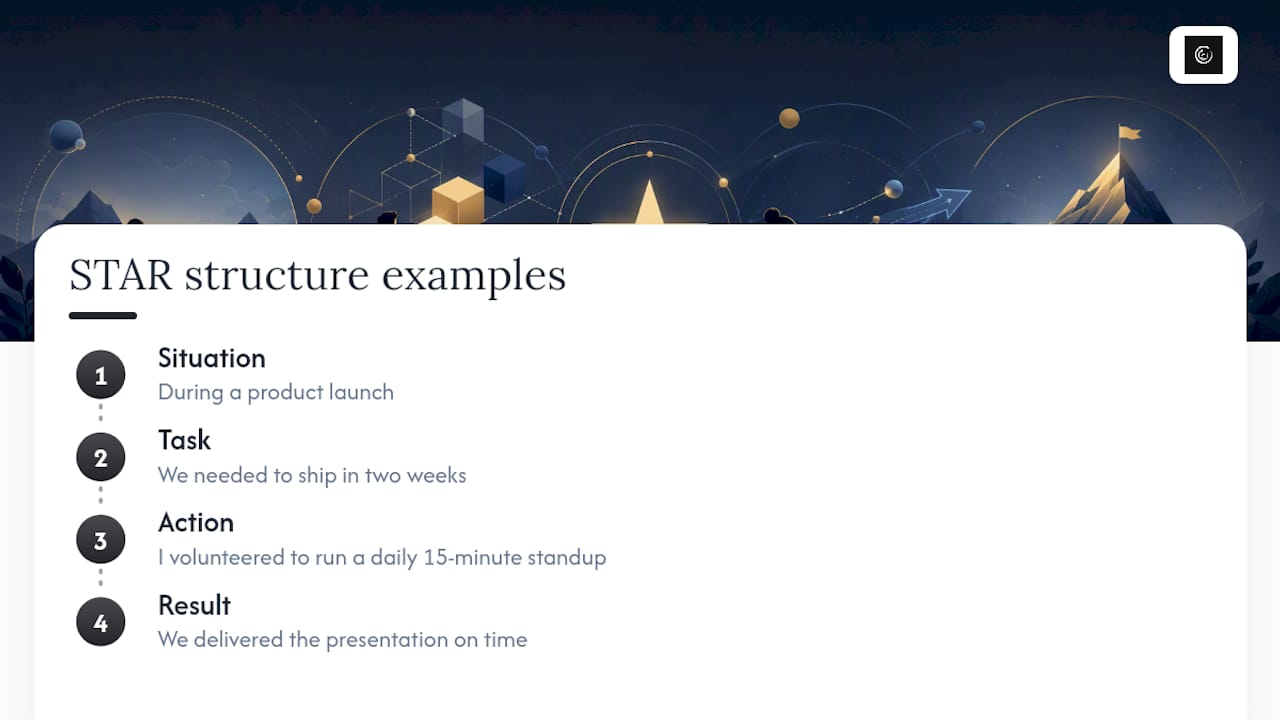
- Situation — Set the scene briefly. One or two sentences. Name the company, team, or project if it’s not confidential.
- Task — State your specific responsibility or the challenge you faced. This is where you establish ownership.
- Action — Describe what you did, step by step. Use “I,” not “we.” Name the tools, methods, or decisions you made.
- Result — Close with the outcome. Quantify when you can: percentages, dollars, time saved, error rates reduced.
Two common variants are worth knowing. CAR (Challenge, Action, Result) collapses Situation and Task into one — useful when the context is obvious or when you’re running short on time. PAR (Problem, Action, Result) works well for problem-solving and analytical roles, like a data analyst behavioral interview practice session where the “problem” framing fits naturally.
Timing matters. Career guidance resources recommend keeping answers to about 1–2 minutes. That’s roughly 200–300 spoken words. Flip it.
Handle follow-ups without panic. If an interviewer probes (“What would you do differently?”), that’s a gift. Use a short bridge: “Looking back, I’d have looped in the stakeholder earlier — we lost two days waiting for approval that I could have gotten in the first meeting.” Honest, specific, and it shows self-awareness.
Pro Tip: Name at least one metric and one teammate or stakeholder in every answer. Metrics prove impact; named roles (not names) prove you understand organizational context. “I worked with the QA lead to…” lands better than “I worked with my team to…”
A few more rules that separate good answers from forgettable ones: never blame a colleague or manager by name, always end with what you learned or what changed, and avoid hypotheticals mid-answer (“I would have…”). Stay in the past tense and stay specific.
The complete behavioral questions list: Top 10 plus a full categorized bank
Expect roughly 6–10 behavioral questions in a 45–60 minute interview, which leaves room for follow-ups on each. That pacing means you won’t face 50 questions — but the ones you do face will go deep. Preparing a small set of well-prepped stories that cover recurring themes is more efficient than memorizing 100 answers.
Top 10 most common behavioral questions
These appear across virtually every industry and level:
- Tell me about a time you faced a significant challenge at work and how you handled it.
- Describe a situation where you had to work with a difficult colleague or stakeholder.
- Give me an example of a time you missed a deadline or made a mistake — what happened?
- Tell me about a time you led a project or initiative without formal authority.
- Describe a situation where you had to adapt quickly to a major change.
- Tell me about a time you had to prioritize competing deadlines.
- Give me an example of when you gave or received difficult feedback.
- Tell me about a time you went above and beyond what was expected.
- Describe a situation where you had to make a decision with incomplete information.
- Tell me about a time you disagreed with your manager and how you handled it.
Teamwork and collaboration
Junior candidates: focus on your specific contribution. Senior candidates: address how you aligned the team.
- Tell me about a time you collaborated with a cross-functional team to deliver a project.
- Describe a situation where a team member wasn’t pulling their weight. What did you do?
- Give me an example of when you had to compromise to move a project forward.
- Tell me about a time you built a relationship with a colleague from a different background or department.
- Describe a project where you had to coordinate with people who had conflicting priorities.
Conflict resolution
Junior: show you addressed the issue directly. Senior: show you resolved it without escalating unnecessarily.
- Tell me about a time you had a conflict with a coworker. How did you resolve it?
- Describe a situation where you disagreed with a decision made by your team or manager.
- Give me an example of a time you had to deliver bad news to a stakeholder.
- Tell me about a time a project was at risk because of interpersonal tension. What did you do?
- Describe a time you had to advocate for a position that was unpopular.
Leadership
Junior: leading a task or small group. Senior: leading through ambiguity, org-wide influence.
- Tell me about a time you motivated a team through a difficult period.
- Describe a situation where you had to make a tough call that affected others.
- Give me an example of when you mentored or coached a colleague.
- Tell me about a time you set a vision or direction for a project.
- Describe a situation where you had to hold someone accountable for underperformance.
Problem-solving and decision-making
These are especially common in data science behavioral interview questions and analytical roles.
- Tell me about a time you identified a problem before it became critical.
- Describe a situation where you had to analyze a large amount of data to make a recommendation.
- Give me an example of a creative solution you developed for a complex problem.
- Tell me about a time you made a decision that turned out to be wrong. What did you learn?
- Describe a situation where you had to solve a problem with limited resources.
Communication
- Tell me about a time you had to explain a complex concept to a non-technical audience.
- Describe a situation where a miscommunication caused a problem. How did you fix it?
- Give me an example of when you had to persuade someone to change their mind.
- Tell me about a time you presented findings or recommendations to senior leadership.
- Describe a situation where you had to tailor your communication style to a specific audience.
Adaptability
- Tell me about a time you had to change your approach mid-project because circumstances shifted.
- Describe a situation where you had to learn a new skill or tool quickly.
- Give me an example of a time you worked through significant ambiguity.
- Tell me about a time your priorities changed suddenly. How did you respond?
- Describe a situation where you had to work in a new or unfamiliar environment.
Time management and prioritization
- Tell me about a time you had to manage multiple high-priority projects simultaneously.
- Describe a situation where you had to say no to a request to protect your priorities.
- Give me an example of a time you delivered a project under a tight deadline.
- Tell me about a time you missed a deadline. What happened and what changed afterward?
- Describe how you organize your work when everything feels urgent.
Initiative and motivation
Strong territory for new grad behavioral interviews — use academic projects, internships, or volunteer work.
- Tell me about a time you took initiative on a project that wasn’t part of your job description.
- Describe a situation where you identified an opportunity and acted on it without being asked.
- Give me an example of a time you set a challenging goal and achieved it.
- Tell me about something you built or improved that you’re proud of.
- Describe a time you kept going on a project when others had given up.
Customer service and stakeholder management
- Tell me about a time you turned a frustrated customer or client into a satisfied one.
- Describe a situation where you had to manage a stakeholder’s expectations.
- Give me an example of when you went out of your way to help a client or user.
- Tell me about a time you received negative feedback from a customer. How did you respond?
- Describe a situation where you had to balance customer needs with business constraints.
Ethics and integrity
- Tell me about a time you faced an ethical dilemma at work. What did you do?
- Describe a situation where you had to speak up about something that felt wrong.
- Give me an example of a time you maintained your principles under pressure.
- Tell me about a time you had to be transparent about a mistake or failure.
- Describe a situation where you prioritized doing the right thing over the easy thing.
Academic career centers and HR departments organize questions exactly this way — by competency — because it makes structured scoring easier for interviewers and preparation more systematic for candidates. The University of Virginia HR team’s competency-based frameworks follow the same logic.
Sample STAR answers and reusable templates
These examples are compressed to show structure, not to be memorized verbatim. Adapt the details to your own experience.
“Tell me about a time you had a conflict with a coworker.”
Situation: During a product launch, I disagreed with the lead designer about the priority of a feature that affected our mobile users. Task: We needed to ship in two weeks, and the disagreement was blocking the sprint.
Result: We launched on time. The phased approach actually reduced QA time by a day, and the designer later told me the data framing helped them make the case to their own manager.
“Tell me about a time you made a mistake.”
Situation: I misconfigured a data pipeline that sent incorrect weekly reports to three regional sales managers for two weeks. Task: I was responsible for the pipeline and for communicating the error. Action: I caught it during a routine audit, immediately flagged it to my manager, sent a corrected report with a clear explanation of what changed, and added an automated validation check to the pipeline. Result: No business decisions had been made on the bad data. My manager used the validation check as a template for two other pipelines. I now run a weekly sanity check before reports go out.
“Tell me about a time you led without formal authority.”
Situation: Our team was preparing for a major client presentation with no designated project lead. Task: Three workstreams were running in parallel with no one coordinating dependencies. Action: I volunteered to run a daily 15-minute standup, built a shared tracker in Notion, and flagged a timeline conflict between the data team and the design team two days before it would have become a problem. Result: We delivered the presentation on time. The client extended the contract. My manager cited the coordination work in my performance review.
“Describe a time you had to manage ambiguity.”
Situation: I joined a project mid-stream with no documentation and a vague brief from the client. Task: I had to produce a competitive analysis in five days without a clear scope. Action: I drafted a one-page scope document, got sign-off from the client in 24 hours, and used that to prioritize three competitors instead of ten. Result: The analysis was delivered on time and the client used it to make a go/no-go decision on a new market. They told us it was the clearest deliverable they’d received from any vendor that quarter.
“Tell me about a time you worked under a tight deadline.”
Situation: A regulatory filing was due in 48 hours and the analyst who owned it had a family emergency. Task: I had to pick up the work with no handoff. Action: I spent the first two hours reviewing the prior year’s filing to understand the format, identified the three sections that needed new data, and pulled in a colleague from the finance team to verify the numbers while I handled the narrative. Result: We filed on time. I documented the process afterward so we now have a backup protocol for exactly this scenario.
“Give me an example of receiving difficult feedback.”
Situation: My manager told me my written reports were too long and that senior stakeholders weren’t reading them. Task: I needed to change my communication style without losing the analytical depth my team relied on. Action: I started leading every report with a one-page executive summary, moved the detailed analysis to an appendix, and asked my manager to review the next two before they went out. Result: Response rates from senior stakeholders went up noticeably. One VP started forwarding my summaries to her own team.
“Tell me about a time you took initiative.”
Situation: Our onboarding process for new analysts had no documentation — everyone learned by asking questions. Task: There was no formal request to fix this; I just noticed it was slowing people down. Action: I spent three Fridays building a wiki in Confluence covering our data sources, naming conventions, and common queries. I ran a 30-minute walkthrough for the next two new hires. Result: The onboarding time for new analysts dropped from roughly three weeks to ten days, based on manager feedback. The wiki is still in use two years later.
“Describe a time you adapted to a major change.”
Situation: Our team switched from a waterfall to an agile workflow mid-project with two weeks’ notice. Task: I had to restructure my work plan and learn Jira while keeping deliverables on track. Action: I completed a Jira tutorial over a weekend, rewrote my task list as user stories, and paired with a senior engineer for the first sprint to calibrate my estimates. My manager used my sprint retrospectives as examples for the rest of the team.
“Tell me about a time you gave difficult feedback.”
Situation: A junior analyst on my team was submitting work with recurring errors that were reaching the client. Task: I wasn’t their manager, but I was the one catching the errors. Action: I asked for a private conversation, showed them three specific examples with the corrections, and offered to do a 20-minute review session before their next submission. Result: The error rate dropped significantly over the next month. They later told me the direct feedback was more helpful than the vague notes they’d been getting in email.
“Describe a time you went above and beyond.”
Situation: A client asked for a basic summary report; our contract covered exactly that and nothing more. Task: I noticed their data had a pattern that pointed to a significant cost-saving opportunity they hadn’t asked about. Action: I flagged it in a one-paragraph addendum to the report, explained the finding in plain language, and offered to walk them through it on a call. Result: They scheduled the call, acted on the recommendation, and expanded our engagement the following quarter.
Reusable template:
Career sites confirm that keeping answers to about 1–2 minutes, quantifying results when possible, and avoiding blame are the three most consistent markers of a strong behavioral answer.
How to build a story inventory and prepare efficiently
Preparation for behavioral questions is not about memorizing answers. It’s about building a small library of stories you know cold, then mapping each story to multiple competencies so one experience can answer five different questions.

Step 1: Collect your stories. Pull up your last two or three performance reviews, your resume, and any project documentation you have. Write down every significant project, problem, or decision you were involved in. Aim for 10–15 raw stories.
Step 2: Extract the core elements. For each story, identify: the conflict or challenge, the specific actions you took (not the team), the measurable outcome, and what you learned. If you can’t name a metric, estimate one (“reduced by roughly half,” “saved about two weeks”).
Step 3: Map stories to competencies. One story almost always covers multiple question types. A story about fixing a broken data pipeline might cover problem-solving, initiative, communication (explaining the error), and adaptability (learning a new tool). Use a simple mapping table:
Step 4: Build 30-second and 90-second versions. The 30-second version is your hook — result first, then the one-line action. The 90-second version is the full STAR. Practice both. Interviewers sometimes ask for a quick example; sometimes they want depth.
Step 5: Align with the job description. Before each interview, read the job description and highlight the competencies it emphasizes. Reorder your story priority list so your strongest story for each emphasized competency is at the top.
Comprehensive guides recommend planning for roughly 6–10 behavioral questions per 45–60 minute interview, which means you’ll face follow-ups on most stories. Knowing your stories cold — not scripted, but genuinely familiar — is what lets you answer follow-ups without freezing.
Pre-interview checklist:
- Three stories ready with 30-second hooks and full STAR versions
- Each story mapped to at least two competencies
- At least one metric per story
- Resume reviewed so story details match what’s on paper
- One sentence of learning or takeaway for each story
How to get objective feedback and actually improve
Most people practice by talking to a friend who says “that sounded great.” That feedback is nearly useless. What you need is structured, rubric-based critique that tells you which element of your answer was weak.
Interviewers score STAR answers on five dimensions. Knowing these helps you self-evaluate:
- Situation clarity — Did the context make sense in under 30 seconds?
- Ownership — Did the candidate say “I” or hide behind “we”?
- Action specificity — Were the steps concrete and sequenced, or vague?
- Result and impact — Was there a measurable outcome, or just “it went well”?
- Learning — Did the candidate show self-awareness or growth?
The STAR framework works as an interviewer checklist for exactly this reason — each letter maps to a scoring dimension. When a candidate’s answer is thin on one, the interviewer probes. When it’s thin on all of them, the candidate scores low regardless of how confident they sounded.
A practice workflow that actually produces improvement:
Record yourself answering a question on your phone. Play it back and score yourself on the five dimensions above. Identify the weakest dimension — usually Action specificity or Result. Run a targeted drill on just that element: answer the same question again, this time forcing yourself to name three specific steps in the Action and one metric in the Result. Repeat until both score a 4 or 5 out of 5. Then move to a new question.
After self-practice, do at least one external mock round. A peer, a career coach, or an AI-assisted platform can catch things you can’t catch yourself — filler words, passive voice, missing metrics, answers that run too long. Structured feedback and iterative practice produce clearer outcomes than unstructured “how did I do?” conversations.
Iterationinterview’s AI scoring grades your answers on STAR elements automatically, flags missing metrics, and surfaces length issues — so you get rubric-level feedback in seconds rather than waiting for a friend’s opinion. You can paste a full interview transcript or a single answer and see exactly where your response fell short.
Pro Tip: The most common thing objective reviewers miss when giving “sounds good” feedback is the absence of a result. Ask your reviewer specifically: “Did I give you a measurable outcome?” If they have to think about it, you didn’t.
How to stand out and the mistakes that sink good candidates
The difference between a forgettable answer and a memorable one usually comes down to specificity. Interviewers hear “I worked with my team to solve the problem” dozens of times a day.
What strong candidates do:
- Quantify results, even roughly (“cut time by about a third,” “reduced errors from weekly to monthly”)
- Name roles and relationships, not just “my team” (“the product manager,” “our QA lead,” “the VP of Sales”)
- State their specific contribution clearly, even in team stories
- End every answer with a result or a learning, never with the action
- Use the 30-second hook when an interviewer asks for a “quick example”
The mistakes that cost candidates offers:
- Blame stories. Any answer that positions a colleague, manager, or company as the villain makes the interviewer wonder how you’d describe them to your next employer.
- Vague generalities. “I’m a good communicator” is not a behavioral answer. “I translated a 40-page technical spec into a two-page brief for the executive team” is.
- Overlong setup. Spending two minutes on Situation and running out of time before the Result is the single most common structural error.
- Skipping the result. An answer without an outcome is a story without an ending. Interviewers need the result to score you.
- Hypotheticals mid-answer. “I would have…” signals you’re reconstructing, not remembering. Stay in the past tense.
Quick checklist for mock interviews:
- Did I say “I” at least three times in the Action section?
- Did I give a specific number or estimate in the Result?
- Did I finish in under two minutes?
- Did I end with a result or a learning, not an action?
- Did I avoid blaming anyone by name?
Behavioral questions are substantially more predictive of future performance when candidates give specific, structured answers — which means the checklist above isn’t just good practice, it’s what separates candidates who get offers from those who get polite rejections.
Smart questions to ask after behavioral interviews
The end of a behavioral interview is not a formality. The questions you ask signal how you think about the role, the team, and what success looks like. Tie your questions to the themes of the conversation — it shows you were listening.
Ten questions worth having ready:
- “What does success look like in this role in the first 90 days?”
- “How does the team typically handle disagreements about approach or priority?”
- “Can you tell me about a time the team had to adapt quickly to a change? How did that go?”
- “What’s the biggest challenge the person in this role will face in the first six months?”
- “How does the team give and receive feedback day-to-day?”
- “What competencies do your strongest performers in this role tend to share?”
- “How are decisions made when there’s ambiguity about ownership?”
- “What does the onboarding process look like, and how long before someone is fully ramped?”
- “Is there anything in my background you’d like me to clarify or expand on?”
- “What do you enjoy most about working on this team?”
A few of these can double as follow-ups to your own stories. If you told a story about managing ambiguity, question 7 (“How are decisions made when there’s ambiguity?”) shows you’re already thinking about how to navigate that environment in this specific role. That kind of continuity reads as genuine curiosity, not a rehearsed list.
Ask two or three questions, not all ten. Prioritize the ones most relevant to what came up in the interview. Save the compensation and benefits questions for the recruiter.
What actually matters in the final week before your interview
Here’s the honest version of interview prep advice: most candidates over-prepare on content and under-prepare on delivery. They memorize 30 stories and can’t tell any of them cleanly in under two minutes. The better move is to know five stories cold — really cold, the way you know your own name — and practice delivering each one at different lengths.
In the final week, run one full mock interview per day. Record it. Watch it back with the five-dimension rubric in mind. Fix the weakest element. Repeat. That loop, done consistently for five days, produces more improvement than reading 50 more sample answers.
The follow-up matters too. After the interview, send a short thank-you note that references one specific thing from the conversation. If you told a story about a data pipeline and the interviewer asked a great follow-up about your validation process, mention it. It shows you were present, not just performing.
Get objective feedback on your behavioral answers faster
Most candidates don’t know which part of their STAR answer is weak until they’ve already bombed an interview. Iterationinterview fixes that by grading your answers on STAR elements automatically — situation clarity, action specificity, measurable result — and telling you exactly where to drill.
The platform gives you timed, on-camera or mic practice so you experience real interview pressure, not just a quiet rehearsal. After each session, AI scoring surfaces missing metrics, flags answers that run too long, and generates targeted drills based on your weakest responses. You can also paste a full interview transcript and see a line-by-line breakdown of what landed and what didn’t. For candidates who want to see how specialized AI feedback compares to a general-purpose tool, Iterationinterview’s comparison with ChatGPT for interview feedback lays out the difference clearly. Start with the free tier at Iterationinterview and run your first practice round today.
Sources
These are the sources referenced throughout this guide, organized by what each one is best for: