How to Answer "Why Should We Hire You?" and Win
How to Answer “Why Should We Hire You?” and Win

The strongest answer to “why should we hire you” follows a single formula: name the skill the role needs most, back it with one concrete result, and close by connecting that result to what the employer is trying to accomplish. Say it in under 60 seconds. That structure works because it shifts the conversation from “here’s what I want” to “here’s what I’ll do for you” — and that shift is what hiring managers are listening for.
Your ready-to-say template: “I bring [core skill], which I’ve applied to [specific situation], resulting in [measurable outcome]. That experience maps directly to [role requirement or company goal], and I’m confident I can deliver similar results here.”
Three 30–60 second scripts you can use now:
-
Experienced hire: “I’ve spent several years in B2B sales, consistently exceeding quota by focusing on consultative discovery rather than pitch-first selling. In my last role, I rebuilt the outbound sequence and significantly reduced the average sales cycle duration. You’re scaling a mid-market team, and that’s exactly the motion I know how to run.”
-
Entry-level graduate: “I don’t have years of experience yet, but I’ve spent the last two semesters leading a 12-person capstone team that shipped a data dashboard now used by our university’s financial aid office. I learn fast, I deliver on deadlines, and I’m ready to contribute from day one.”
-
Career changer: “I spent eight years in clinical coordination, which means I’ve managed high-stakes logistics, cross-functional teams, and compliance requirements under pressure. The operations manager role you’re filling needs exactly that — someone who can hold a complex process together when things go sideways.”
a very brief 15–20 second script for phone screens: “My background is in [field], with a track record of [one result]. That lines up with what you need in this role, and I’d love to show you how.”
Minimum proof elements to include:
- One specific skill or strength tied to the job description
- One piece of evidence (a number, a named project, or a concrete outcome)
- One forward-looking connection to the employer’s goal or current challenge
Key Takeaways
A strong answer to “why should we hire you” combines a named skill, one concrete proof point, and a direct connection to the employer’s current goal — delivered in under 60 seconds.
| Point | Details |
|---|---|
| Use the three-part formula | Name your skill, back it with one metric or result, and connect it to the role’s top requirement. |
| Tailor for every role | Scan the job posting for 2–3 priority requirements and map your proof to those before each interview. |
| Metrics beat adjectives | A specific number (satisfaction rate, time saved, quota hit) is more memorable and credible than any trait claim. |
| Practice under time pressure | Drill at 60s, 30s, and 15s to find your essential core and build delivery confidence. |
| Iterationinterview accelerates refinement | Paste your answer for AI grading and targeted drills that fix weak spots faster than solo practice. |
Table of Contents
- Why do interviewers ask “Why should we hire you?”
- What answer structure actually works?
- How do you tailor your answer to the job description?
- Five sample answers you can personalize right now
- What strengths can you honestly claim?
- What mistakes kill a good answer?
- A focused practice plan to sharpen your answer
- How do you turn accomplishments into employer value?
- Why do metrics make your answer more persuasive?
- How do you identify and communicate your unique value proposition?
- How do you manage nerves and deliver with confidence?
- How should you adapt your answer for different interview formats?
- What a recruiter actually listens for in your answer
- Sharpen your answer faster with Iterationinterview
- Sources
Why do interviewers ask “Why should we hire you?”
The question sounds like an invitation to brag. It isn’t. Hiring managers use it as a quick diagnostic: can this person articulate their value clearly, and does that value match what we actually need right now?
Employers expect specificity and measurable outcomes more than ever, partly because AI-polished resumes have made written materials less reliable as signals. When every resume reads well, the live interview becomes the real filter. A candidate who can name a concrete result under pressure is demonstrating something a resume can’t fake.
Four things the question is actually measuring:
- Problem awareness. Do you understand the specific challenge this role is hired to solve?
- Speed to productivity. Will you need six months of hand-holding, or can you contribute quickly?
- Team fit. Does your working style match how this team operates?
- Communication. Can you make a clear, concise case for yourself without rambling?
The answer also reduces the hiring manager’s perceived risk. Every hire is a bet. A candidate who says “I’ve done this specific thing before and here’s the result” makes that bet feel smaller. Vague answers (“I’m a hard worker, I’m passionate about this industry”) do the opposite — they give the interviewer nothing to hold onto, which reads as uncertainty.
Robert Half notes that hiring managers want tailored answers tied to the organization’s current priorities, not a generic pitch. That means your answer should change slightly for every role you interview for.
What answer structure actually works?
Two frameworks cover most situations: the three-part formula and a condensed STAR variant. Neither is complicated. The difference is in when you reach for each one.
The three-part formula
- Role match: Name the skill or experience that directly fits the job description.
- Proof: Give one concrete example or metric that backs the claim.
- Forward impact: Connect that proof to what the employer needs going forward.
JobSprout’s guidance confirms this structure — relevant skill, proof, connection to role — as the most reliable way to build a concise, evidence-backed case. It runs 45–60 seconds when delivered at a natural pace, which is the sweet spot for most in-person and video interviews.
The condensed STAR variant
STAR (Situation, Task, Action, Result) is built for behavioral questions, but you can compress it for this one: skip the situation setup, open with the action you took, and close with the result plus a one-line tie to the role. That trims a full STAR story from 90 seconds down to 30–40.
| Format | Best used when | Typical length |
|---|---|---|
| Three-part formula | Standard interviews, first-round screens | 45–60 seconds |
| Condensed STAR | Panel interviews, follow-up probing questions | 30–45 seconds |
| Micro-script | Phone screens, rapid-fire formats | 15–20 seconds |
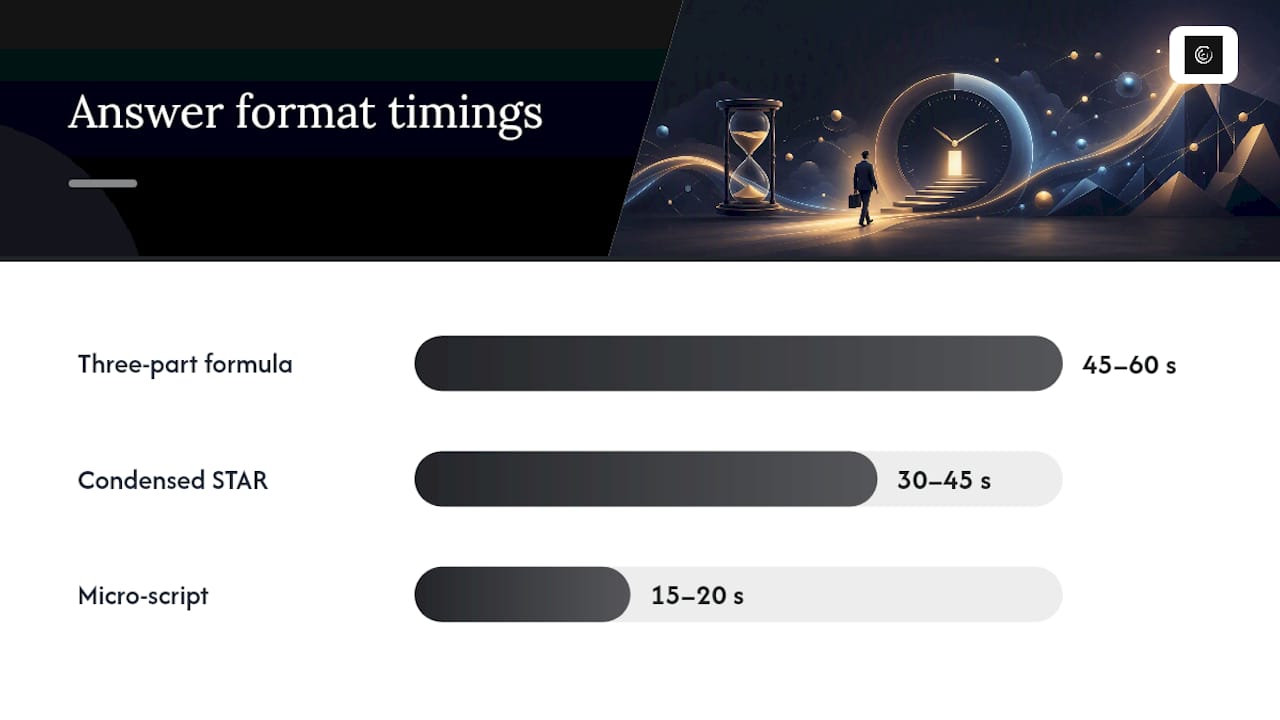
Timing guidance: Record yourself once. If you’re over 65 seconds, cut the situation context first — it’s almost always the least valuable part. If you’re under 20 seconds, you’re probably missing the proof element.
How do you tailor your answer to the job description?
There is no single best answer to this question, and Robert Half’s research makes that explicit: the goal is to articulate fit based on the role’s specific requirements and the employer’s current priorities. That means doing five minutes of prep before every interview.
Tailoring checklist:
- Open the job posting and highlight 2–3 requirements that appear in the first paragraph or are repeated more than once. Those are the priorities.
- For each requirement, identify one piece of your own experience that matches it directly.
- Choose the strongest match and build your proof around it.
- Add one company-specific signal: a recent product launch, a known challenge in the industry, or a value from their About page that you can connect to your answer.
Short tailoring example:
- Job language: “Manage cross-functional stakeholders and deliver projects on time.”
- Matched skill: Cross-functional project management.
- One-line proof: “I coordinated a product launch across four departments and completed projects ahead of schedule.”
- Impact sentence: “Given that you’re scaling your product team, I can bring that same coordination discipline here.”
Quick heuristics by context:
- Remote roles: Emphasize async communication, self-direction, and a specific tool or workflow you’ve used (Notion, Loom, Asana).
- Startups: Lead with range and speed. Mention a time you wore multiple hats or built something from scratch.
- Regulated industries: Highlight compliance awareness, documentation habits, and a track record of zero errors or audits passed.
Five sample answers you can personalize right now
Each script below follows the three-part formula. The brackets are your fill-in points.
1. Experienced hire “I’ve spent [X years] in [field], where I [specific achievement with metric]. In my last role, [one concrete result]. You’re looking for someone who can [role requirement], and that’s exactly where I’ve built my track record.”
Example: “I’ve spent seven years in supply chain, where shortened vendor lead times considerably across a 40-supplier network. You’re scaling operations in a new region, and I know how to build those supplier relationships fast.”
2. Mid-level individual contributor “My strength is [core skill]. I’ve used it to [specific outcome], which freed up [time, budget, or capacity] for my team. I’m ready to bring that same focus to [specific team challenge mentioned in the job post].”
3. Entry-level graduate “I’m early in my career, but I’ve already [project or internship result]. I pick up new tools quickly — I taught myself [tool or skill] in [timeframe] to meet a project deadline. I’m looking for a place where I can grow fast and contribute early.”
4. Career changer “My background is in [previous field], which gave me [transferable skill]. That skill is directly relevant here because [specific connection to the new role]. I’ve already been building toward this transition by [course, project, or certification].”
5. Remote-first candidate “I’ve worked fully remote for [X years] and built a track record of [specific async result]. I use [tool] to keep stakeholders aligned and [habit or system] to stay accountable without daily check-ins. Remote-first teams tend to move faster when everyone owns their own communication, and that’s how I operate.”
What to swap when personalizing:
- Replace the metric with your actual number (even an estimate beats nothing)
- Swap the tool name for the one in the job description
- Change the stakeholder reference to match the team structure in the posting
What strengths can you honestly claim?
Generic adjectives (“I’m a team player,” “I’m detail-oriented”) don’t land. What lands is the same adjective backed by a single concrete example. Here are ten strengths that hold up in most roles, each with a proof prompt to help you build the evidence fast.
- Fast learner. Proof prompt: Name a skill you picked up in under 30 days and used on a real project.
- Process improver. Proof prompt: Describe one workflow you simplified and what changed as a result.
- Client-focused. Proof prompt: Recall a time a client’s situation changed mid-project and how you adapted.
- Deadline-driven. Proof prompt: Name a project that came in on time despite a significant obstacle.
- Data-informed decision maker. Proof prompt: Describe a decision you made by pulling a specific metric, not just instinct.
- Clear communicator. Proof prompt: Think of a time you translated a complex idea for a non-technical audience.
- Cross-functional collaborator. Proof prompt: Name a project that required coordinating people who didn’t report to each other.
- Self-directed. Proof prompt: Recall a time you identified a problem no one asked you to solve and fixed it anyway.
- High-output under pressure. Proof prompt: Describe a week where the workload doubled and what you prioritized.
- Technically adaptable. Proof prompt: Name a tool or system you adopted quickly when a team or employer switched platforms.
The pattern is always the same: claim the strength, then immediately prove it. A strength without evidence is just an opinion about yourself.
What mistakes kill a good answer?
Most weak answers share the same handful of problems. Here’s what to watch for and the one-sentence fix for each.
- Vagueness. Bad: “I’m a hard worker who’s passionate about this field.” Fix: Replace “passionate” with a specific action you took because of that interest.
- Resume recitation. Bad: “As you can see on my resume, I’ve worked at three companies in this space.” Fix: Pick one result from those companies and say what it meant for the team or the business.
- Overselling. Bad: “I’m honestly the best candidate you’ll see for this role.” Fix: Let the evidence make that case. Framing achievements as employer value is more persuasive than claiming superiority outright.
- No employer focus. Bad: “I want this job because it’s a great opportunity for me to grow.” Fix: Flip it: “Here’s what I can contribute to your team in the first 90 days.”
- Too long. Bad: A two-minute monologue covering your entire career. Fix: Time yourself. Cut anything that doesn’t directly support your one strongest proof point.
On delivery: speak at a pace slightly slower than you think you need. Nerves speed people up. A confident, measured pace reads as composure, not hesitation. Eye contact (or camera contact in a video call) matters more than most candidates realize. Looking away while listing your strengths signals uncertainty, even when the words are strong.
A focused practice plan to sharpen your answer
Repetition under time pressure is what actually builds confidence. Here’s a seven-day drill sequence that takes 10–15 minutes a day.
- Day 1: Write your full answer longhand. Don’t time it yet. Just get the three parts on paper.
- Day 2: Read it aloud and record yourself. Note where you slow down, hedge, or lose the thread.
- Day 3: Cut the answer to 60 seconds. Remove context that doesn’t support your proof point.
- Day 4: Deliver the 60-second version three times without looking at notes. Focus on the opening sentence — it sets the tone.
- Day 5: Cut to 30 seconds. Keep only the skill, the metric, and the role connection.
- Day 6: Cut to 15 seconds. This is your micro-script. Practice it until it sounds natural, not rehearsed.
- Day 7: Run a full mock interview. Start with the 60-second version, then practice pivoting to the 15-second version when asked a follow-up.
Timed practice at 45s, 30s, and 15s helps candidates trim to essentials and improves clarity under pressure. The discipline of cutting forces you to identify what actually matters in your answer.
Feedback prompts to use with a friend, mentor, or AI tool:
- “Did my opening sentence make the skill and the role connection clear?”
- “Was there a moment where I lost you or repeated myself?”
- “Did the answer feel like it was about me, or about what I can do for the team?”
For structured AI feedback that goes beyond generic suggestions, a purpose-built practice tool gives you graded responses and targeted drills based on where your answer actually breaks down.
How do you turn accomplishments into employer value?
The gap most candidates miss is the translation step. You know what you did. The interviewer needs to know what it meant for the business. Concrete numbers make claims credible and memorable — a a very high customer satisfaction rating or an quick average response time lands harder than “I’m great with customers.”
The conversion framework:
- Situation: What was the context? (One sentence, no more.)
- Action: What did you specifically do?
- Measurable outcome: What changed, in numbers or named deliverables?
- Employer impact phrasing: Restate the outcome in terms of what it meant for the team, the budget, or the customer.
| Role type | Metric example | Employer impact phrasing |
|---|---|---|
| Customer support | Measurable customer satisfaction improvement | “Customers escalated less, which freed up senior staff time.” |
| Operations | Reduced process steps from 12 to 5 | “The team processed 40% more volume without adding headcount.” |
| Sales | Consistently exceeded sales quota | “Contributed directly to the team hitting its annual revenue target.” |
| Project management | Delivered two weeks ahead of schedule | “Freed up budget for a second phase the client hadn’t expected.” |
| Data/analytics | Cut reporting time by 40% | “Leadership had weekly insights instead of monthly, which changed how they planned.” |
A practical habit: keep a running document — a simple spreadsheet or a notes app — where you log results as they happen. Most people can’t recall their metrics under interview pressure because they never wrote them down. Capture them monthly, and you’ll always have fresh proof ready.
For organizing your job search and keeping track of role-specific requirements alongside your metrics, tools like Arvo’s job hunt assistant can help you stay structured across multiple applications.

Why do metrics make your answer more persuasive?
Numbers do something adjectives can’t: they give the interviewer something to repeat.
The other reason metrics work is that they signal ownership. Candidates who know their numbers were paying attention to outcomes, not just tasks. That’s the difference between someone who did a job and someone who cared whether it worked. Hiring managers pick up on that distinction quickly, and live interview specificity matters more now than it did when resumes were the primary filter.
If you genuinely don’t have a clean number, use a range, a comparison, or a named outcome. “We went from manual to automated” is weaker than a percentage, but it’s still concrete. “I improved things” is not.
How do you identify and communicate your unique value proposition?
Your unique value proposition (UVP) is the one thing you offer that the other candidates in the room probably don’t, or at least don’t offer in the same combination. Finding it takes about 10 minutes of honest self-assessment.
Ask yourself three questions:
- What do colleagues consistently ask me for help with?
- What result am I most proud of, and what made it possible?
- What combination of skills do I have that’s unusual for my field?
The answer to question three is usually where the UVP lives. A software engineer who also has a background in clinical research brings something most engineers don’t. A marketer who can read a P&L and speak fluently to finance has a cross-functional edge. That combination is your differentiator, and it belongs in your answer.
Communicating it is simpler than most people think: name the combination, then give one example of it in action. “I sit at the intersection of data and storytelling — I can pull the numbers and then present them in a way that actually moves a room.” Follow that with a specific instance where that combination produced a result, and you’ve made the case without overselling.
How do you manage nerves and deliver with confidence?
Nerves before an interview are normal. The problem isn’t feeling them — it’s letting them change your delivery. The two most common signs of nerves in an interview answer are rushing and hedging. Both undercut an otherwise strong response.
Three techniques that work:
Slow the opening sentence. The first five words of your answer set the pace for everything that follows. It will feel uncomfortably slow to you and completely normal to the listener.
Anchor to the structure. When you feel lost mid-answer, the three-part formula is your recovery point. You know you need a skill, a proof, and a connection. If you’ve lost the thread, just say the next part. “The result of that was…” pulls you back on track without the listener noticing you drifted.
Reframe the stakes. Most interview anxiety comes from treating the conversation as a test you can fail. It’s closer to a two-way evaluation: you’re also deciding whether this role and team are right for you. Candidates who hold that frame tend to ask better questions, listen more carefully, and come across as more confident — not because they’re performing confidence, but because they’re genuinely engaged rather than just surviving.
Physical preparation matters too. A short walk before the interview, two minutes of slow breathing, and a single practice run of your opening sentence are enough to lower the physiological spike that makes voices shake and minds blank.

How should you adapt your answer for different interview formats?
The core answer stays the same across formats. What changes is how you deliver it and what you emphasize.
Video interviews: Look at the camera, not the screen. Most candidates watch themselves or the interviewer’s face on screen, which reads as avoiding eye contact. Put a sticky note next to your camera as a reminder. Keep your background clean and your audio clear — technical friction distracts from your answer before you’ve said a word.
Panel interviews: Address the person who asked the question, but sweep the room briefly when you hit your key proof point. Each panelist is evaluating you through a different lens (hiring manager, peer, HR), so a result that touches multiple dimensions — speed, quality, and team impact — lands better than one that’s narrowly technical.
Phone screens: You lose all visual cues, so your words carry everything. Slow down slightly more than you would in person. Use the three-part formula tightly — phone screens are often 20–30 minutes total, and the interviewer is deciding whether to move you forward, not whether to hire you. Your goal is one clear, memorable answer, not a comprehensive career summary.
Asynchronous video (recorded responses): Treat it like a phone screen with a camera. You usually get one take or a limited number of retakes, so practice your 45-second version until the opening sentence is automatic. Smile at the start — not because it’s performative, but because it relaxes your voice.
What a recruiter actually listens for in your answer
When I’m listening to a candidate answer this question, I’m running a short mental checklist in real time. Most candidates don’t know what’s on it.
The recruiter’s checklist:
- Did they name a specific skill tied to this role, or did they give me a generic trait?
- Is there a number, a named project, or a concrete outcome — or just adjectives?
- Did they connect their experience to what we’re actually trying to solve?
- Are they speaking clearly and at a pace that signals they’ve thought about this?
- Do they seem to know what this role actually does?
The red flags that kill confidence fast: evasive metrics (“I improved things significantly”), irrelevant stories (“In my first job out of college, I…”), and a complete absence of role knowledge. The corrective action for each is the same: one sentence of specificity. One sentence.
What surprises most candidates is how much weight live signals carry relative to a polished resume. Hiring teams look for clarity, ownership, and initiative as proof that a candidate can create impact from day one. A candidate who stumbles over their own answer — even with a strong resume in front of me — raises a question I can’t ignore: if they can’t explain their own value in 60 seconds, how will they explain a complex project to a client or a new team?
The best answers I’ve heard don’t sound rehearsed. They sound like the candidate has told this story before because they lived it. That’s the target: practiced enough to be clear, natural enough to be believable.
Sharpen your answer faster with Iterationinterview
Reading about the three-part formula is one thing. Delivering it under timed, on-camera pressure is another. Iterationinterview is built for exactly that gap: you paste your answer or an interview transcript, and the platform grades your response, flags where the proof is weak or missing, and gives you targeted drills to fix the specific parts that aren’t landing.
Three steps to use it for this question: paste your current “why should we hire you” answer into the try page, run a ranked mock session to see how your answer scores against the benchmark, then work through the targeted drills the platform surfaces based on your weak spots. The feedback is structured around behavioral answer criteria, not generic writing tips, which means you’re practicing the right things rather than polishing the wrong ones.
Start your first practice session and see where your answer actually stands.
Sources
- How to Answer “Why Should We Hire You?” in an Interview
- Indeed
- Why Should We Hire You? Best Answers for 2026 (With Examples by Role) | JobSprout
- Why Should We Hire You? The 2026 Answer That Beats the Bots | Penbrothers
- Roberthalf