Behavioral Question Practice: A STAR Plan That Works Fast
Behavioral Question Practice: A STAR Plan That Works Fast

Use the STAR method as your backbone, and build eight stories you can tell in 90 to 120 seconds each. That’s the whole plan. Most candidates lose points not because they lack good stories but because they’ve never rehearsed them out loud against a clock, and behavioral interview answers work best when they’re specific stories with stakes, constraints, individual actions, tradeoffs, measurable outcomes, and honest reflection, according to a scoring rubric built for behavioral mock interviews. Reading about STAR doesn’t get you there. Saying your stories out loud, repeatedly, does.
Here’s how to start today:
- Pick three stories that cover teamwork, conflict, and a mistake you fixed. These three alone cover roughly half of what you’ll get asked.
- Set a two-minute timer and answer a random prompt from the question bank below without notes. Recording yourself on your phone works fine.
- Run one follow-up drill immediately after: ask yourself “what was your exact role?” and “what would you do differently?” and answer both in under 20 seconds.
On that first practice run, track three things: whether you claimed clear ownership of the outcome, whether you named a measurable result, and whether you closed with an honest reflection instead of a generic wrap-up line. Those three habits separate a forgettable answer from one an interviewer remembers.
Key Takeaways
Behavioral question practice works when you build eight reusable STAR stories, rehearse them aloud on a timer, and score every answer for ownership, a measurable result, and honest reflection.
| Point | Details |
|---|---|
| Build eight core stories | Cover teamwork, conflict, leadership, problem solving, failure, initiative, time management, and communication. |
| Time your Action and Result | Spend 45 to 60 seconds on Action and 15 to 20 seconds on Result; keep Situation and Task under 35 seconds combined. |
| Say “I,” not “we” | Name your individual contribution even in team stories, since interviewers evaluate personal ownership specifically. |
| Prepare for follow-ups | Rehearse your exact role, your biggest tradeoff, and what you’d change before the interviewer asks. |
| Get objective feedback | Iterationinterview grades timed practice rounds and transcript reviews to flag missing results or weak ownership language automatically. |
Table of Contents
- Practicing Behavioral Interview Questions: What Interviewers Are Really Testing
- How to Structure Answers So They Actually Land
- Common Behavioral Interview Questions by Category, With Sample Answers
- Build Your STAR Practice Worksheet and Drill Schedule
- Mistakes That Sink Good Stories, and How to Fix Them
- Quick-Recall Templates for the Moment You Freeze
- Why Deliberate Repetition Beats Memorized Scripts
- Practice Smarter With Evidence-Based Feedback
- Frequently Asked Questions
- Sources
Practicing Behavioral Interview Questions: What Interviewers Are Really Testing
Behavioral questions ask you to describe something you actually did, not what you’d theoretically do. The logic is simple: past behavior predicts future behavior better than a hypothetical answer ever could. That’s why you’ll hear phrases like “tell me about a time” instead of “what would you do if.”
Interviewers use these prompts to evaluate specific competencies, and each question usually maps to one or two of them:
- Problem solving under ambiguity or incomplete information
- Ownership and accountability when something goes wrong
- Leadership and influence, with or without formal authority
- Communication with technical and nontechnical audiences
- Adaptability when priorities or resources shift midstream
Behavioral interviewing done well also probes for context most candidates skip. A strong answer names the stakes and constraints involved, whether that’s a tight deadline, a limited budget, missing data, or stakeholders who disagreed, according to a behavioral interviewing question bank published by the University of Virginia’s Department of Economics. Skip the constraints and your story sounds like it had no real difficulty to overcome.
The interviewer isn’t grading your grammar. They’re grading your evidence. A polished answer with no specifics (“I’m a great communicator”) tells them nothing. A rougher answer with a real number, a real conflict, and a real outcome tells them everything they need.
How to Structure Answers So They Actually Land
STAR stands for Situation, Task, Action, Result, and it gives your answer a shape an interviewer can follow without effort. The STAR interview response technique works because it forces you to front-load context briefly and spend most of your airtime on what you actually did and what happened because of it.
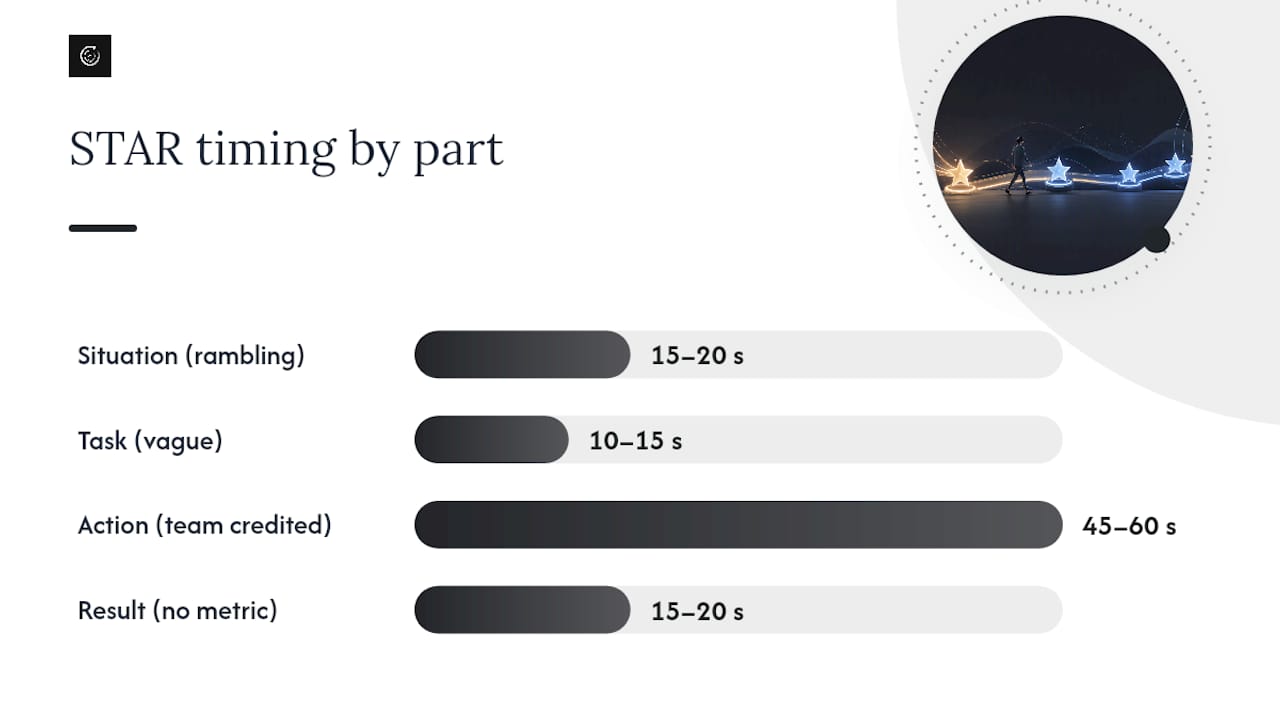
Here’s the timing breakdown for a 90 to 120 second answer:
- Situation (15 to 20 seconds). One or two sentences. Where were you, what was the environment, what made it hard?
- Task (10 to 15 seconds). What specifically were you responsible for? Keep this tight.
- Action (45 to 60 seconds). This is the bulk of your answer. What did you personally do, in what order, and why did you choose that approach over alternatives?
- Result (15 to 20 seconds). What happened, ideally with a number attached, plus one line of reflection.
If Situation and Task eat more than 30 seconds combined, you’re front-loading backstory the interviewer doesn’t need.
Full STAR isn’t the only shape worth knowing. A few tight variations serve different moments:
- PAR (Problem, Action, Result): compresses Situation and Task into one beat. Good when the problem is obvious and doesn’t need much setup.
- CAR (Challenge, Action, Result): nearly identical to PAR, just framed around a challenge instead of a problem. Some interviewers use this language explicitly.
- Micro-STAR (45 to 60 seconds): a compressed version for phone screens or rapid-fire panel rounds where you might get six questions in fifteen minutes.
Here’s a timed example, mapped to the structure: “On my last team, we had a launch date moving up by three weeks with half the QA cycle gone (Situation, 8 seconds). I was responsible for deciding what testing to cut without shipping a broken feature (Task, 10 seconds). I ranked the test suite by user impact, cut the low risk cases, pulled in one extra engineer for the payment flow specifically, and flagged the tradeoff to my manager in writing so it wasn’t a surprise later (Action, 35 seconds). We shipped on time with one minor bug found in week one, not the payment flow, and I learned to flag tradeoffs earlier next time instead of absorbing the risk myself (Result, 15 seconds).” That’s under 70 seconds and hits every beat.
Three delivery habits matter more than most people think. First, use “I,” not “we,” even when the work was collaborative. Even in team projects, interviewers expect you to name your individual contribution clearly, because “we” tells them nothing about what you specifically brought to the table. Second, quantify the result whenever you can, a percentage, a dollar figure, a time saved, a headcount affected. Third, always close with a one-line reflection: what you’d repeat, or what you’d change.
Pro Tip: When a story genuinely was a group effort, say so once (“this was a five-person team push”) and then switch immediately to “I.” “I owned the data migration piece. I flagged the risk to the lead. I rewrote the rollback plan.” One acknowledgment, then all ownership language.
If the interviewer asks a pointed follow-up like “what exactly did you do versus your teammates,” answer with a specific task boundary, not a defensive justification. “I owned the vendor negotiation and the contract language; my colleague owned the technical integration” is a complete, honest answer in one breath.
| STAR Part | Time Target | What Goes Wrong Here |
|---|---|---|
| Situation | 15 to 20 sec | Rambling backstory nobody asked for |
| Task | 10 to 15 sec | Vague responsibility with no clear boundary |
| Action | 45 to 60 sec | Too short, or credited entirely to “the team” |
| Result | 15 to 20 sec | No number, no reflection, trails off |
Common Behavioral Interview Questions by Category, With Sample Answers
Build one solid story per category below, and you’ll cover most of what actually gets asked. Some stories can double up across categories, which we’ll get to at the end of this section.
Teamwork
Interviewers ask teamwork questions to see whether you can collaborate without losing your own contribution in the noise, and whether you handle interpersonal friction constructively.
- “Tell me about a time you worked with a difficult teammate.”
- “Describe a project where you had to collaborate across departments.”
- “Tell me about a time you had to rely on someone else to get your work done.”
- “Give an example of when you helped a struggling teammate.”
- “Describe a time your team disagreed on an approach.”
- “Tell me about a time you had to build trust with a new team quickly.”
Sample STAR answer: “Our design and engineering teams disagreed on a feature’s scope two weeks before launch (Situation). I was asked to mediate and get us to a decision by end of week (Task). I set up a 30 minute working session, had each side list their top three non negotiables, and found that only one item actually conflicted. I proposed a phased release that let both sides ship what they cared about most, just on different timelines (Action). We hit the original launch date, and the phase two features shipped three weeks later with no scope fights. I learned to ask for non negotiables early instead of letting a disagreement run for days (Result).” This proves you can de-escalate conflict without needing authority to force a decision.
Conflict
Conflict questions test emotional control and whether you address disagreement directly instead of avoiding it or escalating it unnecessarily.
- “Tell me about a conflict with a coworker or manager.”
- “Describe a time you disagreed with a decision you had to implement anyway.”
- “Tell me about a time you gave difficult feedback to a peer.”
- “Describe handling a client or customer who was upset.”
- “Tell me about a time you had to say no to a stakeholder.”
- “Give an example of resolving a disagreement without involving a manager.”
Sample STAR answer: “A client pushed back hard on a pricing change my company had already announced (Situation). I was the account contact and needed to keep the relationship intact while holding the line on the new terms (Task). I listened fully before responding, then separated their concern into two parts: the price itself, which I couldn’t change, and the transition timeline, which I could. I negotiated a 60 day grace period with my manager’s approval and presented it as a concession, not a compromise (Action). The client renewed for another year, and I now build in a transition buffer whenever I announce pricing changes (Result).” This shows the interviewer you can hold a firm line while still protecting the relationship.
Leadership
Leadership prompts don’t require a manager title. They test whether you can influence outcomes, motivate others, and take responsibility when things go sideways.
- “Tell me about a time you led a project without formal authority.”
- “Describe a time you motivated a team through a difficult period.”
- “Tell me about a decision you made that others disagreed with.”
- “Give an example of delegating effectively under pressure.”
- “Describe a time you had to give constructive criticism to someone senior to you.”
- “Tell me about mentoring or onboarding a new team member.”
Sample STAR answer: “Our team lost two members mid quarter with a major deliverable still due (Situation). As the most senior remaining contributor, I stepped up to reorganize the work, though I had no formal authority to reassign tasks (Task). I mapped out what absolutely had to ship versus what could slip, presented the plan to our director for buy in, and personally took the highest risk piece myself rather than delegating it (Action). We delivered the core scope on time, and my director asked me to formally lead the next quarter’s planning (Result).” This tells the interviewer you take initiative before someone hands you a title.
Problem Solving
These questions look for structured thinking under ambiguity, not a lucky guess.
- “Tell me about a time you solved a problem with incomplete information.”
- “Describe the most complex problem you’ve had to untangle.”
- “Tell me about a time you found the root cause of a recurring issue.”
- “Give an example of a creative solution you came up with under constraints.”
- “Describe a time data contradicted your initial assumption.”
- “Tell me about a technical or operational bottleneck you removed.”
I was asked to find the root cause before we rolled back a release that had taken three weeks to build (Task). Instead of accepting the assumption, I pulled ticket timestamps against three separate deploys and found the spike actually started two days before the release in question, pointing to a third party API instead. I flagged the vendor issue directly to their support team (Action). We avoided an unnecessary rollback, and the vendor fixed their issue within 48 hours. I learned to check the timeline before trusting the obvious explanation (Result)." This proves you investigate before you act, which matters more to interviewers than being right on the first guess.
Failure and Learning
Interviewers want to see accountability, not a rehearsed non-failure disguised as one.
- “Tell me about a time you failed at something.”
- “Describe a mistake that had real consequences.”
- “Tell me about a time you missed a deadline.”
- “Give an example of feedback that was hard to hear but useful.”
- “Describe a project that didn’t go the way you planned.”
- “Tell me about a time you had to admit you were wrong.”
Sample STAR answer: “I underestimated the testing time for a feature and promised a launch date I couldn’t hit (Situation). I was the one who had committed the date to leadership, so I owned telling them it would slip (Task). I went to my manager the moment I realized the timeline was wrong, not two days before the deadline, with a revised date and the reason for the miss. I also built a buffer into every estimate after that (Action). The feature launched five days later than promised, but leadership appreciated the early warning over a last minute surprise, and my estimates have been accurate since (Result).” Anchoring the result to a metric or observable outcome, like accurate estimates since, carries more weight than a vague claim of having learned a lesson.
Initiative
- “Tell me about a time you identified a problem no one asked you to fix.”
- “Describe something you built or improved without being told to.”
- “Tell me about a time you took on work outside your job description.”
- “Give an example of proposing a new idea that got adopted.”
- “Describe a time you volunteered for something risky or unpopular.”
- “Tell me about automating or simplifying a manual process.”
Sample STAR answer: “Our team spent roughly four hours a week manually compiling a status report nobody had questioned in over a year (Situation). Nobody assigned this to me, but I decided to fix it in my own time (Task). I built a simple dashboard pulling from our existing tools that auto-generated the same report (Action). It cut the weekly time cost to near zero and got adopted by two other teams (Result).” This is a story you can reuse for both initiative and problem solving prompts, just adjust which part of the story you emphasize.
Time Management
- “Tell me about juggling competing priorities.”
- “Describe how you handle a day when everything is urgent.”
- “Tell me about a time you had to say no to protect your workload.”
- “Give an example of missing a deadline and how you handled it.”
- “Describe how you prioritize when your manager isn’t available.”
- “Tell me about a time you had to reprioritize mid-project.”
Communication
- “Tell me about explaining something technical to a non-technical audience.”
- “Describe a time you had to deliver bad news.”
- “Tell me about persuading someone to change their mind.”
- “Give an example of written communication that prevented a problem.”
- “Describe a time you had to communicate up to senior leadership.”
- “Tell me about simplifying a complex idea under time pressure.”
Adaptability and Values
- “Tell me about adjusting to a sudden change in priorities.”
- “Describe working effectively with someone very different from you.”
- “Tell me about a time company values shaped a decision you made.”
- “Give an example of adapting your communication style to a new audience.”
- “Describe a time you had to learn something quickly on the job.”
Notice the overlap across these lists. Your “unassigned dashboard” story above covers initiative and problem solving. A conflict story often doubles as a communication story. Build eight strong stories, not sixteen, and know which two or three angles each one can serve. When you tell a story for a leadership prompt versus a problem-solving prompt, shift which result you emphasize, the team outcome for leadership, the technical fix for problem solving, and tailor the scale of the metric to the role you’re interviewing for. A story about saving four hours a week reads differently to a startup than to an enterprise team managing a million dollar budget, so match your proxy metric to what that audience will find meaningful.
Build Your STAR Practice Worksheet and Drill Schedule
A worksheet works better than a mental outline because it forces specificity. For each story, fill in six fields: the situation, your specific task, the obstacles or constraints involved, the actions you personally took using “I” phrasing, the measurable result, and a one-line reflection. Career centers publish fillable STAR worksheets built for exactly this kind of rehearsal, and practicing each field out loud, not just writing it down, is what actually sticks.
Two schedules work well depending on your timeline:
- 7-day intensive: Days 1 to 2, write out all eight stories on the worksheet. Days 3 to 5, drill two stories per day with a two-minute timer and one follow-up question each. Days 6 to 7, run a full mock interview covering all eight and record yourself.
- 30-day steady plan: Week 1, write and refine your stories. Weeks 2 and 3, drill three random prompts per day, three days a week. Week 4, run two full mock sessions with a friend or coach.
Score each answer against a short rubric: relevance to the question, specificity of detail, clarity of ownership, complexity of the challenge, whether the result was measurable, and whether the reflection was genuine.
- Did I answer the actual question asked, not a story I just wanted to tell?
- Did I name at least one specific number or observable outcome?
- Did I use “I” for my actions, even in a team story?
- Did I close with a real reflection instead of a generic wrap-up line?
Get feedback beyond your own ear whenever possible. A peer mock or a coach catches things you can’t hear yourself, and a targeted AI review of your transcript can flag pacing and specificity gaps across dozens of answers faster than a human reviewer could get through in a week.
Pro Tip: Record every drill on your phone and watch it back once, on mute, just for body language and pacing. You’ll catch filler words and dead air far faster with your eyes than your ears.
Mistakes That Sink Good Stories, and How to Fix Them
The most common failure is spending too long on Situation and Task, then rushing Action and Result, the opposite of the right ratio. Close behind: crediting the team with “we” when the interviewer needs to hear what you specifically did, skipping a measurable result entirely, and ending with no reflection at all.
- Too much backstory before getting to what you actually did
- “We” language that hides your individual contribution
- No number, metric, or observable outcome attached to the result
- No closing reflection, or a generic one like “it taught me teamwork”
- Sounding so rehearsed it stops sounding like a real memory
Advanced candidates go further: they name a real tradeoff they accepted, not just the win. Saying “I chose speed over full test coverage, and here’s why that was the right call given the deadline” shows judgment a clean success story never can. When you don’t have a hard number, use a proxy: team size affected, time saved as “roughly half a day a week,” or the fact that the fix got adopted elsewhere.
Follow-up questions deserve direct, specific answers, not defensiveness. Interviewers probe for your exact role, the biggest tradeoff, and what you’d change, and a candidate willing to say “honestly, I’d loop in legal earlier next time” reads as more credible than one who insists the original plan was flawless.

Pro Tip: If you truly have no number, name the scale instead: “this affected roughly 200 support tickets a month” or “the team was six people across two time zones.” Scale is a legitimate substitute for a percentage.
Quick-Recall Templates for the Moment You Freeze
Memorize the shape, not a script. Adapt each on the fly:
- Conflict: “There was tension between [X] and [Y] over [issue]. I needed to [task]. I [two specific actions]. It resulted in [outcome], and I’d [reflection] next time.”
- Failure: “I missed [what] because [reason]. My job was to [task]. I [corrective action] and told [stakeholder] directly. The result was [outcome], and since then I [changed behavior].”
- Initiative: “Nobody had flagged [problem], so I decided to [action]. It led to [result], adopted by [scope].”
- Leadership: “With [resource/person] missing, I had to [task] without formal authority. I [action]. We hit [result].”
One-line openers that work almost anywhere: “The stakes were high because…” or “Nobody had assigned this, but…” For closers: “The number that mattered was…” or “Looking back, I’d change one thing:…”
Use micro-STAR (45 to 60 seconds) for phone screens and rapid panel rounds. Save full STAR (90 to 120 seconds) for final-round conversations where the interviewer has time to dig in.
Why Deliberate Repetition Beats Memorized Scripts
The candidates who improve fastest aren’t the ones with the best stories. They’re the ones willing to say the same story five different ways until the good version sticks. Memorizing a script actually works against you, because the moment a follow-up question knocks you off the script, you have nothing left. Practicing the underlying facts, the stakes, the action you took, the number that resulted, gives you material flexible enough to survive a real conversation instead of a recitation.
Iteration’s approach to interview practice was built around this exact idea: grading responses against evidence rather than polish, and pointing candidates back to the specific answers that need another pass. Disciplined practice means tracking whether you claimed ownership, whether you attached a real result, and whether your reflection sounded honest rather than rehearsed. Get those three right consistently, and the rest of the interview tends to take care of itself.
Practice Smarter With Evidence-Based Feedback
Reading a question bank only gets you halfway. The gap most candidates hit is objective feedback, someone or something that can tell you honestly whether your Action section was specific enough or your Result actually landed. Iterationinterview closes that gap with timed, on-camera or mic practice interviews graded automatically against the same fundamentals covered in this guide: ownership language, measurable results, and follow-up readiness.

The platform reviews full transcripts, not just single answers, and turns your weakest responses into targeted drills instead of asking you to redo everything from scratch. You get ranked practice rounds with a live leaderboard, which turns solo rehearsal into something closer to a real benchmark, and structured feedback that flags exactly where an answer ran long, lost its “I” language, or skipped the result. That’s a meaningfully different experience from asking a generic chatbot to critique your answer once and call it done, since a dedicated grading system tracks your progress across sessions instead of giving you a one-off reaction.
If you’ve built your eight stories using the worksheet above, the next step is simple: paste a transcript or run a timed practice round and see exactly which STAR beats need work before your next real interview.
Frequently Asked Questions
How many STAR stories should I actually prepare?
Eight is a reliable target. That’s enough to cover teamwork, conflict, leadership, problem solving, failure, initiative, time management, and communication without spreading yourself so thin that no story gets properly rehearsed.
How long should a behavioral interview answer be?
Aim for 90 to 120 seconds for a full STAR answer in a final round, and 45 to 60 seconds for a micro-STAR version in a phone screen. Longer than two minutes and you risk losing the interviewer’s attention before you reach the result.
What if my best example was a team effort, not something I did alone?
Acknowledge the team once, then switch to “I” for the rest of the answer. Interviewers expect you to name your specific contribution even in collaborative work, so say exactly what you owned within the larger effort.
What if I don’t have a hard number for my result?
Use a proxy metric instead: team size affected, time saved, or the fact that your solution got adopted elsewhere. A concrete scale is far more convincing than a vague statement like “it went well.”
How do I practice behavioral interview questions without a partner?
Record yourself on a timer, answer a random prompt from a categorized question bank, then run one follow-up drill on yourself immediately after. A tool that reviews transcripts and grades pacing and specificity, like Iterationinterview, can substitute for a live partner when one isn’t available.
Sources
A few resources are worth bookmarking alongside your own worksheet: