Break Into Quant in 90 Days With a Project First Plan
Break Into Quant in 90 Days With a Project First Plan

The fastest route into quant finance skips the credential panic entirely: pick a seat (researcher, developer, or trader), build 2 to 3 documented projects that prove you can handle the math and the code, then drill interview questions until your reasoning sounds as sharp on camera as it does on paper. Candidates with a solid STEM base can realistically do this in a few months; career changers need more time to build necessary foundations. Start today by choosing your seat and opening a new GitHub repo for project one.
TL;DR:
- Candidates should develop 2 to 3 documented projects demonstrating their math and coding skills tailored to their chosen quant role.
- Building a portfolio with backtest pipelines, option pricers, or research notebooks significantly increases interview chances over traditional internships.
- Preparing for quant interviews requires mastering probability, statistics, linear algebra, and programming languages like Python and SQL, with additional skills for specialized roles.
- A structured 90-day plan focusing on math fundamentals, project building, and mock interviews improves performance and confidence.
- Clear, concise explanations under pressure and impactful presentation of projects are crucial to converting interviews into job offers.
Table of Contents
- What Are the Different Quant Roles and Which One Fits You?
- What Technical Skills Do Quants Actually Need?
- Do You Need a Master’s, PhD, or Can You Self-Study?
- How Do You Build a Portfolio That Proves You Can Do the Work?
- How Do Quant Interviews Actually Work, and How Do You Prepare in 90 Days?
- How Do You Get Interviews: CV, GitHub, and Networking Tactics?
- What Closes the Gap Between a Good Portfolio and a Real Offer?
- What Hiring Managers Actually Scan for in the First 30 Seconds
- Try a focused interview practice tool designed to close the last-mile gap between a strong project portfolio and a confident live interview. Such tools record your practice answers, grade them against structured criteria, and provide targeted drills for specific weak spots your responses reveal, whether that’s rambling through a project deep-dive or losing your train of thought mid-brainteaser.
- Where to Go for Deeper Research
- Sources
What Are the Different Quant Roles and Which One Fits You?
“Quant” covers three distinct jobs, and each one hires differently. Getting this wrong wastes months of preparation on skills a hiring manager never asked for.
A quant researcher builds and tests trading signals or risk models. The work is closer to applied statistics than software engineering, and firms hiring for this seat lean heavily toward candidates with a master’s or PhD in math, physics, or statistics, though a sharp project portfolio increasingly substitutes for the credential in entry roles.
A quant developer builds the infrastructure that runs those models in production. This seat rewards computer science backgrounds and rigorous coding habits over pure theory. C++ shows up far more here than in research seats, especially at firms running low-latency strategies.
A quant trader sits closest to the market, making fast decisions under pressure using models built by others. Mental math speed and risk intuition matter as much as formal math depth.
Match your seat to your strengths:
- Strong theoretical math background and patience for research → researcher
- Strong engineering instincts and love of production code → developer
- Fast under pressure, comfortable with ambiguity → trader
Pick one seat before you write a single line of project code. It changes what you build next.
What Technical Skills Do Quants Actually Need?
Every quant role shares a common floor: probability and statistics, linear algebra, and multivariable calculus. You need to comfortably derive expected values, manipulate covariance matrices, and reason about distributions without reaching for a textbook. Researchers and derivatives-focused developers should add stochastic calculus and numerical PDE methods (finite difference schemes, Monte Carlo simulation) since these underpin option pricing and risk models.
On the programming side, Python is the non-negotiable filter across nearly every quant hiring pipeline, with Pandas and NumPy as the default toolkit for data work. C++ becomes essential specifically for low-latency and high-frequency trading development roles, where microseconds matter. SQL is a quiet requirement almost nobody mentions until the first data pull fails: you will spend real time querying market data from relational databases, and firms expect fluency without being asked.
Build your stack in this order:
- Probability, statistics, and linear algebra to fluency
- Python with Pandas and NumPy, including writing tested, production-style code
- SQL for data access
- Stochastic calculus and numerical methods, if targeting research or pricing roles
- C++, only if targeting low-latency developer roles
Layer in applied finance fundamentals as you go: how options are priced, what drives yield curves, how risk gets measured. You don’t need a trading floor’s worth of jargon, but you need enough to explain why your model’s assumptions make sense.
Pro Tip: Don’t learn stochastic calculus in the abstract. Learn it by building a Black-Scholes pricer in Python. The math sticks when it produces a number you can check against a real option quote.
Do You Need a Master’s, PhD, or Can You Self-Study?
This is where most aspiring quants overspend time and money. A PhD remains common for deep research seats at top funds, but it is not a requirement for most entry-level positions if you can demonstrably do the work through projects and internships. A Master’s in Financial Engineering (MFE) or financial mathematics provides structured skills and often improves placement through recruiting pipelines and alumni networks that self-study simply can’t replicate.
Before committing to a full-time program, run this checklist:
- Does the program publish a placement report naming actual employers, not just “top firms”?
- Does the curriculum match your target seat (heavy stochastic calculus for research, systems and C++ for developer roles)?
- Do current students or recent alumni respond to outreach, and where did they land?
- Is there a part-time or online option that avoids a full career pause?
For career changers who can’t step away from income, a targeted online master’s or the CQF (Certificate in Quantitative Finance) paired with two strong projects can compress the timeline compared to a full-time MFE. If your undergraduate math is shaky, shoring it up with a solid qualification comparison, like reviewing what different math qualifications actually cover, is a cheaper first step than jumping into a graduate program you’re not ready for.
How Do You Build a Portfolio That Proves You Can Do the Work?
Building 2 to 3 applied projects with published, reproducible code is the single most effective accelerator into quant interviews, often outweighing a generic finance internship on a CV.
Three templates cover most seats:
- Backtest pipeline: pull historical price data, implement a signal, and report relevant performance metrics accounting for transaction costs.
- Option pricer: build Black-Scholes and a Monte Carlo pricer, then compare them against market quotes and analyze differences.
- Signal research notebook: test a hypothesis with proper validation rather than relying on a single backtest window.
Format each repo so a busy interviewer understands it in under two minutes: a README with the question you asked, the method, the result, and the caveats. Leading with impact and quantified results, rather than a wall of code, is what separates hireable repos from abandoned side projects.
How Do Quant Interviews Actually Work, and How Do You Prepare in 90 Days?
Quant interviews follow a fairly predictable structure across firms, which makes them easier to prepare for than most candidates assume.
Expect these rounds, roughly in this order:
- Screening: probability brainteasers and mental math, often timed
- Technical/coding round: live coding, usually Python, sometimes with a data structures twist
- Modeling round: pricing, statistics, or a take-home case study
- Project deep-dive: a walk-through of your own portfolio work
- Behavioral/fit round: how you communicate under pressure and work with a team
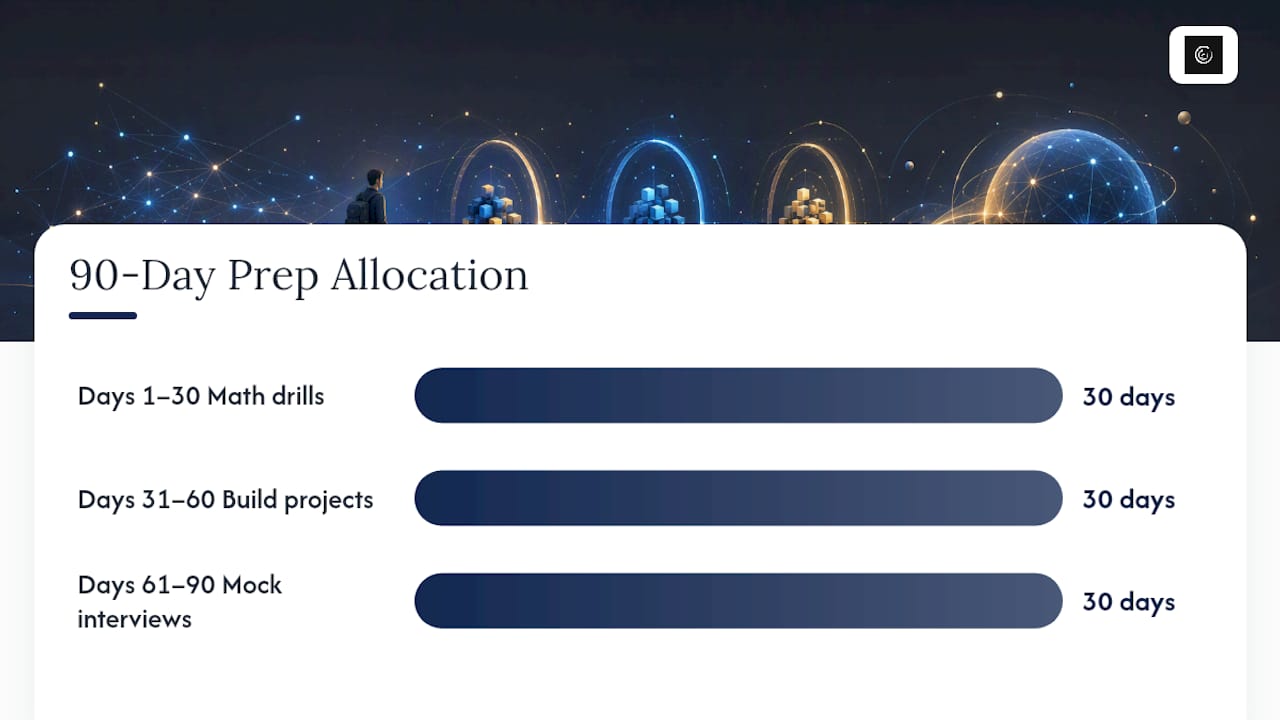
A structured 90-day plan with daily drills and mock interviews is consistently cited as effective preparation. Spend the first 30 days on math fundamentals and daily brainteaser practice. Use days 30 to 60 to build your projects and start weekly mock coding rounds. Reserve the final 30 days almost entirely for mock interviews, project deep-dives, and refining how you explain your reasoning out loud.
Pro Tip: Practice narrating your thought process even when you’re wrong. Interviewers care less about a perfect answer than watching you recover cleanly from a mistake.
How Do You Get Interviews: CV, GitHub, and Networking Tactics?
Your CV should lead with impact, not job titles: “Built a backtesting pipeline achieving a 1.4 Sharpe ratio net of transaction costs” beats “Analyzed financial data” every time.
- Pin your best two or three repos at the top of your GitHub profile
- Write READMEs that state the question, method, and result in the first three lines
- Include tests and clear instructions so the code actually runs for a stranger
- Send short, specific outreach messages referencing a person’s actual work, not a generic “I’d love to learn more”
Internships and insight days remain a genuinely strong pipeline into quant roles, and smaller proprietary trading firms often hire on demonstrated skill over pedigree. Job boards focused on finance roles and internships in specific markets are worth checking regularly, since many quant openings never make it to the big aggregators.
What Closes the Gap Between a Good Portfolio and a Real Offer?
A strong project portfolio gets you the interview. What gets you the offer is how you sound explaining it under pressure, and that’s the piece most candidates never practice deliberately.
Interview practice that records, transcribes, and scores your explanations, then prescribes targeted drills, addresses the exact last-mile problem candidates face: clear, concise reasoning delivered live, not written calmly at home. This slots directly into the final 30 days of a 90-day plan, right alongside mock coding rounds and project deep-dives from practical pair-programming interview scripts.
The gap between “I understand this model” and “I can defend this model to a skeptical interviewer in 90 seconds” is where most quant candidates lose the offer. Structured feedback on the delivery, not just the content, is what closes it.
What Hiring Managers Actually Scan for in the First 30 Seconds
A hiring manager skims for impact-first bullets, a GitHub link that actually works, and one project explained with real numbers instead of buzzwords. Red flags that stall a candidate fast: unreadable code with no README, vague claims of “experience with machine learning” backed by nothing reproducible, and answers that wander instead of landing on a conclusion.
Try a focused interview practice tool designed to close the last-mile gap between a strong project portfolio and a confident live interview. Such tools record your practice answers, grade them against structured criteria, and provide targeted drills for specific weak spots your responses reveal, whether that’s rambling through a project deep-dive or losing your train of thought mid-brainteaser.

Instead of guessing which parts of your delivery need work, you get a transcript-based review that shows exactly where a response lost focus and a rewrite that tightens it. Pair that with the worked interview questions and sample answers to build muscle memory for the behavioral round that always follows the technical one. If you’re within your final 30 days before quant interviews start, try a practice round and see what your own answers look like scored against a real rubric.
Where to Go for Deeper Research
For readers who want to verify program specifics or dig into role definitions further, these sources cover the ground this guide draws from:
- Quantitative Finance career overview, Oxford University Careers Service
- Career paths in quantitative finance, Johns Hopkins Engineering for Professionals
- Practical guide to breaking into quant finance, Quantt
- Quant careers guide: researcher, developer, trader, Finseats
Sources
- Quantitative Finance | Oxford University Careers Service
- 7 career paths in quantitative finance | Johns Hopkins EP
- How to Break Into Quant Finance: A Practical Guide (2026) | Quantt