Nail Culture Fit Interview Answers: 75 Second STAR Drill for Candidates
Nail Culture Fit Interview Answers: 75 Second STAR Drill for Candidates

Answer culture-fit questions with a short STAR story that shows one specific behavior, then close with a candidate question that tests whether the company actually lives its stated values. The STAR method (Situation, Task, Action, Result) keeps the story tight; the follow-up question does the real diagnostic work. In the first 60 seconds: pick the one story that matches what the role actually needs, then land on a measurable result before you run out of time.
TL;DR:
- Stronger culture-fit answers use the STAR method to highlight specific behavior and measurable outcomes rather than vague statements.
- Tailor responses by researching the company’s recent blogs, employee feedback, and observed practices to match your stories to actual cultural signals.
- Practice timed, recorded rehearsals of key questions to improve pacing, clarity, and authenticity, avoiding vague or overstretched stories.
- When unsure about company culture, ask diagnostic questions during the interview to uncover actual practices instead of relying solely on assumptions or slogans.
- Asking targeted questions about team disagreements, decision-making, and recent changes reveals whether the culture is genuinely aligned and adaptable.
Table of Contents
- Sample Culture-Fit Interview Questions and Model Answers
- How to Research Company Culture and Tailor Your Answers
- Using the STAR Method Under Real Interview Time Limits
- Red Flags in Interviewer Answers and Questions That Reveal the Truth
- Practice Drills That Actually Improve Your Culture-Fit Answers
- Culture Fit vs. Culture Add: What the Difference Actually Means
- Why Culture-Fit Questions Matter Beyond the Interview
- How to Personalize Your Answers Without Sounding Rehearsed
- Balancing Honesty With a Strategic Answer
- What to Do When You’re Not Sure About the Company’s Culture
- Questions That Actually Tell You Whether a Culture Is Real
- From Generic to Specific: A Quick Before and After
- Practice Your Culture-Fit Answers Before the Interview, Not During It
- Sources
Sample Culture-Fit Interview Questions and Model Answers
Every culture-fit question is really asking one of four things: how you work, how you handle people, how you take feedback, or why you’d stay. Below are the questions that show up most often across hiring guides, grouped by what the interviewer is actually probing for. Each model answer runs 50 to 90 words, which is roughly the length you can deliver in 45 to 75 seconds without rushing.
Work-style questions
-
“Describe your ideal work environment.” The interviewer wants to know if your default operating mode (quiet and heads-down vs. collaborative and loud) matches the team’s actual rhythm, not the one listed in the job ad. Sample answer: “I do my best problem-solving in blocks of uninterrupted time, but I check in with my team daily so nobody’s blocked on me. At my last job, I set a standing 15-minute sync instead of ad hoc interruptions, which cut context-switching for the whole team.” Tailoring tip: match the environment you describe to what you found in step three of the research section below, not to what sounds impressive.
-
“How do you prioritize when everything feels urgent?” This tests whether your decision-making process fits a fast-moving team or a more structured one. Sample answer: “I rank tasks by what blocks other people versus what only blocks me, and I flag trade-offs early instead of silently deprioritizing. When our roadmap shifted mid-sprint last year, I told my manager the same day which two features would slip, and we adjusted scope together instead of missing the deadline.” Tailoring tip: name a real prioritization method (RICE, MoSCoW, or your own system) if you use one.
-
“Tell me about a time you worked independently versus on a team.” Sample answer: “I led a research project solo for three weeks, then pulled in two teammates for the synthesis phase because fresh eyes caught gaps I’d missed. The final report shaped a pricing decision that increased trial conversions by double digits the following quarter.” Tailoring tip: pick a story where the switch from solo to team work was a deliberate choice, not a forced one.
Teamwork and conflict questions
-
“Tell me about a disagreement with a coworker and how you handled it.” Interviewers use this to gauge conflict style: avoidant, aggressive, or collaborative. Sample answer: “A colleague and I disagreed on which metric defined success for a launch. Instead of escalating, I asked what evidence would change his mind, then we ran a small test to settle it. The data supported his approach, and I adopted it, which built trust for the next three projects we ran together.” Tailoring tip: pick a disagreement you lost gracefully. It reads as more honest than one you won.
-
“Describe a time you had to collaborate with someone whose working style clashed with yours.” Sample answer: “A teammate preferred detailed written specs while I default to quick verbal syncs. We agreed on a hybrid: a five-minute call followed by a two-line written recap. That small adjustment cut our revision cycles roughly in half over the next two months.” Tailoring tip: end with what changed going forward, not just how the conflict resolved.
-
“How do you handle a teammate who isn’t pulling their weight?” Sample answer: “I address it directly and privately first, framing it around shared goals rather than blame. Last year I noticed a teammate missing deadlines and learned in a one-on-one that he was overloaded on another project. We restructured the handoff, and the missed deadlines stopped.” Tailoring tip: show curiosity before judgment. Interviewers watch for this specifically.
Feedback and management-style questions
-
“How do you like to receive feedback?” Hiring managers want explicit statements about working-style preferences rather than a vague “I’m open to feedback.” Sample answer: “I prefer specific, timely feedback over a formal review months later. I ask my manager for a quick note after major deliverables so I can adjust before the pattern repeats. That habit shaved weeks off my ramp-up in my current role.” Tailoring tip: name the cadence you actually want, not the one you think sounds professional.
-
“Tell me about a time you gave difficult feedback to a peer or manager.” Sample answer: “I told my manager that a process change was slowing down our team, backed by two weeks of ticket data. I framed it as a shared problem, not a complaint, and we piloted an alternative that reduced turnaround time noticeably.” Tailoring tip: always mention the evidence you brought, not just the conversation.
-
“What kind of management style helps you do your best work?” Sample answer: “I do well with managers who set clear outcomes and then get out of the way on process. In my last role, my manager and I agreed on weekly checkpoints instead of daily oversight, and that autonomy is when I shipped my strongest work.” Tailoring tip: research the manager’s actual style on LinkedIn or Glassdoor before you guess.
Motivation and adaptability questions
-
“Why do you want to work here specifically?” Sample answer: “Your last two product launches solved a problem I’ve hit personally, and your engineering blog shows a team that ships fast and iterates in public. I want to work somewhere that treats failed experiments as data, not a setback.” Tailoring tip: cite something specific and recent. Generic enthusiasm is the single most common failure mode here.
-
“Tell me about a time you had to adapt quickly to a change in direction.” Sample answer: “Our project scope changed two weeks before launch when a competitor shipped a similar feature. I reprioritized the remaining sprint around differentiation instead of parity, and we launched a version that outperformed our original plan on user engagement.” Tailoring tip: pick a change you didn’t choose. It shows real adaptability, not just flexibility on paper.
-
“What does a healthy team culture look like to you?” Sample answer: “It’s a team where people disagree openly in meetings but back each other publicly afterward. At my last company, our weekly retro surfaced friction early instead of letting it fester, and that habit alone prevented two projects from derailing.” Tailoring tip: describe a mechanism (a ritual, a norm), not just an adjective like “supportive.”
-
“Describe a time you disagreed with a company decision. What did you do?” Sample answer: “I disagreed with a policy that removed remote flexibility for my team. I raised the concern with data on our output under the old policy, and while the decision didn’t fully reverse, leadership adjusted the rollout timeline based on the feedback.” Tailoring tip: this question tests whether you can disagree without becoming disengaged. Show both.
How to Research Company Culture and Tailor Your Answers
The careers page tells you what a company wants you to believe about itself. The better signals live elsewhere: recent LinkedIn posts from employees (not the official company page), Glassdoor reviews filtered to the last 12 months, engineering or product blogs, and the bios of people on the team you’d join. A pattern of weekly ship announcements suggests comfort with ambiguity; a pattern of detailed retro posts suggests a real feedback culture, not just a slogan about one.
Translating what you find into an answer means mapping stated values to observable behavior, not repeating the value word for word. If a company says it values “ownership,” look for evidence: do employees mention shipping features solo, or does every post credit a large team? Match your story to the version you actually find.
A six-step checklist before any culture-fit interview:
- Read the last three months of company blog posts or product announcements.
- Search employee names on LinkedIn for how they describe the team, not just their title.
- Scan recent Glassdoor reviews for repeated phrases, good or bad.
- Note the interviewer’s title and likely priorities (a hiring manager cares differently than a peer).
- Pick two STAR stories that fit the patterns you found, not the ones you always default to.
- Draft one diagnostic question per interview round, not a generic “what’s the culture like.”
Pro Tip: Search “[company name] engineering blog” or “[company name] retro” before every interview. Companies that write publicly about how they work hand you free evidence you can quote back to them.
Using the STAR Method Under Real Interview Time Limits
The STAR method works because it forces a story into a shape interviewers can follow without effort. Applied to culture-fit questions, it also stops you from drifting into generic statements about being “a team player,” which is the single most common failure mode candidates fall into.
For a 60 to 90 second answer, a timed template looks like this:
- Situation (10 to 15 seconds): One sentence of context. Skip the backstory.
- Task (5 to 10 seconds): What you specifically owned, not what your team owned.
- Action (20 to 30 seconds): The two or three concrete steps you took, said in order.
- Result (15 to 25 seconds): A measurable outcome, or the closest honest approximation you have.
Choosing the right result matters more than most candidates assume. A vague “it worked out well” adds nothing; a specific number, even a rough one like “cut review time by about a third,” gives the interviewer something to remember you by. If you don’t have a hard metric, use a comparison instead: faster than before, fewer errors than the prior process, adopted by more of the team than expected.
For shorter 30 to 45 second answers, compress by stating the result first, then backfilling just enough action and context to make it credible. This front-loading technique keeps interviewer attention even when you have to cut detail. Avoid phrases like “I’m a natural leader” or “I always go above and beyond” with no story attached. They read as filler, and experienced interviewers tune them out immediately.
Statistic worth building your prep around: Gallup’s research on employee turnover finds that a large share of voluntary departures are preventable, and culture misalignment is a leading driver. A well-built STAR story isn’t just interview polish. It’s the mechanism that helps both sides avoid a mismatch that would surface six months into the job anyway.
Red Flags in Interviewer Answers and Questions That Reveal the Truth
Culture-fit interviews run both directions. How an interviewer answers your questions reveals more about the actual culture than anything on the careers page, and a meandering or uncertain response is often the clearest signal you’ll get before an offer.
Watch for these patterns:
- Generic answers that could apply to any company (“we work hard and have fun”) with no specific example attached.
- Evasiveness when asked about turnover, team size changes, or recent departures.
- Defensiveness if you ask a direct question about how decisions get made or reversed.
Four questions that tend to surface real practices instead of talking points:
- “What would you change about the culture here if you could?” A thoughtful, specific answer is a strong green flag; a deflection is not.
- “Can you walk me through how the last major decision on this team got made?”
- “What does a bad week look like for this team, and how does it usually get resolved?”
- “How has this role or team changed in the last year?”
If an answer raises concern, don’t drop it. Try: “That’s helpful. Can you say more about how that played out the last time it happened?” It keeps the conversation open without sounding confrontational.
Practice Drills That Actually Improve Your Culture-Fit Answers
Reading model answers helps you understand the shape of a good response. It does not build the muscle memory to deliver one under pressure, which is where most preparation quietly falls apart.
Three drills worth running before any culture-fit interview:
- Timed STAR rehearsals. Set a 75-second timer and answer three questions from the list above out loud, not in your head. Silent rehearsal hides your filler words.
- Recorded mock interviews with focused feedback. Recording forces you to hear your own pacing and catch the “ums” you don’t notice while speaking. Practicing under the same constraints you’ll face, whether that’s phone, video, or in person, closes the gap between rehearsal and the real thing.
- Targeted drills for your weakest question type. If teamwork stories feel shakier than work-style ones, drill only those until the gap closes.
The most common mistakes candidates make, in order of frequency: vague claims with no story attached, stories with no measurable result, and answers that run long because there’s no timing discipline built in. All three show up constantly in career-advice research on cultural fit interviews, and all three are fixable with repetition.
This is exactly where structured, scored practice earns its place. Paste a past answer into Iteration, get a scored review against the STAR structure, and run targeted drills on whichever component (situation, action, or result) is dragging your score down.

Pro Tip: Record yourself answering the same culture-fit question a week apart without listening to the first recording beforehand. The difference in pacing and filler words tells you more than any checklist.
Culture Fit vs. Culture Add: What the Difference Actually Means
Culture fit asks whether you’ll mesh with how a team already operates. Culture add asks whether you bring something the team doesn’t already have. The distinction matters because hiring purely for fit tends to produce teams that think alike, while culture add brings perspectives that improve problem-solving and reduce blind spots.
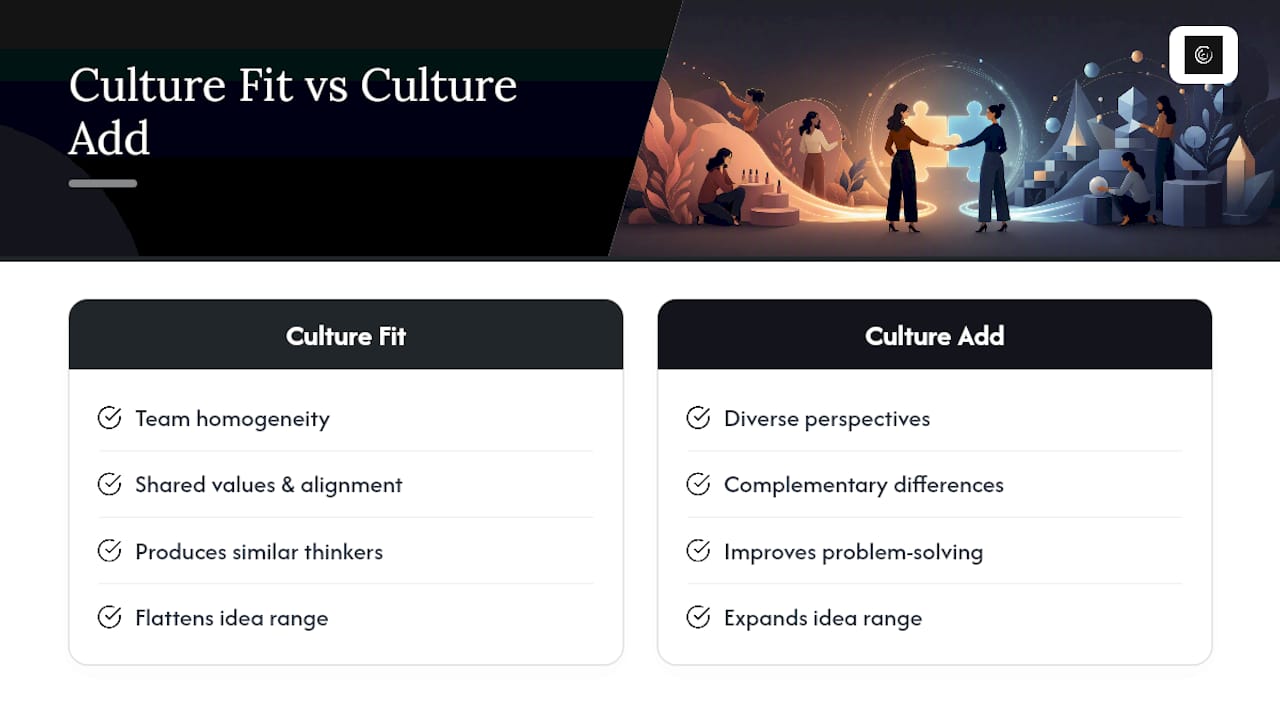
Culture fit is about shared values: how decisions get made, how conflict gets handled, what “good work” looks like day to day. Culture add is about complementary difference: a background, working style, or perspective that’s currently underrepresented on the team. A company that only screens for fit risks hiring the same personality on repeat, which flattens the range of ideas a team can generate.
For candidates, this distinction changes how you frame an answer. If a question is clearly about fit (“how do you handle ambiguity”), answer with alignment: show you operate the way the team already does. If a question opens space for add (“what would you bring that we don’t already have”), answer with contrast: name a genuinely different experience, industry background, or working style, and explain how it complements rather than clashes with the team.
Most interviewers won’t label which type of question they’re asking. Listen for the framing. “Tell me how you’d fit in” is a fit question. “Tell me what you’d bring” is an add question. Answering fit questions with add framing, or the reverse, is a subtle mismatch that experienced interviewers notice even when they can’t name why the answer felt slightly off.
Why Culture-Fit Questions Matter Beyond the Interview
Culture-fit questions exist because misalignment is expensive, and not just in the abstract sense companies use to justify asking them. Gallup’s research on voluntary turnover finds that culture misalignment is a top driver of departures that could have been prevented with better hiring decisions in the first place.
From the hiring side, a bad culture-fit hire costs far more than a slow interview process: recruiting spend, onboarding time, the productivity dip while a manager backfills the role, and the morale hit to a team that has to absorb the gap. That’s why companies keep asking these questions even when candidates find them frustratingly vague.
From your side as a candidate, the incentive is symmetric. Taking a job that doesn’t match how you actually work doesn’t just risk your performance review. It risks burnout, disengagement, and the kind of quiet resentment that builds when you’re constantly working against your own grain. A culture-fit interview that goes well in both directions is a genuine signal you’re walking into a role you can sustain, not just one you can survive the first six months.
This is also why the diagnostic questions covered earlier aren’t a nice-to-have add-on to your prep. They’re doing the same risk-reduction work for you that the company’s questions are doing for them. Treating the interview as a two-way evaluation, rather than a test you’re trying to pass, tends to produce both better answers and a better final decision either way.
How to Personalize Your Answers Without Sounding Rehearsed
The fastest way to sound generic is to answer with what you think the company wants to hear instead of what’s actually true about how you work. Interviewers who’ve sat through hundreds of interviews can tell the difference, and they specifically favor candidates who name real preferences over ones who default to safe, agreeable answers.
Start by identifying your actual non-negotiables before you walk into any interview: do you need autonomy or structure, fast iteration or careful planning, direct feedback or a softer delivery? Write these down honestly, not aspirationally. Then, when a question touches one of these areas, answer from that real preference and back it with a story where that preference showed up and helped, not just theoretically.
Personalization also means varying your language to match how you’d actually describe yourself to a friend, not how a career guide phrases things. If you don’t naturally say “I’m a self-starter,” don’t use it in an interview either. Replace it with what that actually looks like for you: “I usually pick up the next task before someone assigns it” is more specific and more believable.
The stories you choose matter as much as the phrasing. Pick a moment that genuinely shaped how you approach your work now, even if it’s a smaller or less flashy example than the “biggest project of my career” you’re tempted to reach for. A specific, slightly modest story beats a big, vague one every time, because specificity is what reads as authentic under questioning.
Balancing Honesty With a Strategic Answer
Authenticity and strategy aren’t opposites in a culture-fit interview. The tension people feel usually comes from a false choice: either “say exactly what I think” or “say what gets me the offer.” Neither works well on its own.
The better approach is selective honesty: choose the true stories and preferences that also happen to align with what you know about the role, rather than inventing preferences you don’t actually hold. If you genuinely prefer structured feedback and the company runs weekly one-on-ones, say so directly. If you prefer autonomy and the company clearly manages closely, that’s useful information for you too, not just a mismatch to paper over.
Where strategy legitimately comes in is selection and framing, not fabrication. You have dozens of true stories about how you work. Choosing the one that’s both honest and relevant to what you researched about the company isn’t spin. It’s simply picking the right true example for the room you’re in.
The risk of over-strategizing shows up later, not in the interview itself. Candidates who present a fully optimized version of themselves to get an offer often find the job doesn’t match what they presented, and that gap becomes exhausting within a few months. The Gallup data on preventable turnover applies here too: a hire built on performance rather than fit tends to unwind faster than one built on a genuinely accurate mutual read.
A simple test before you answer: would you be comfortable if your actual manager, three months in, saw exactly what you said in this interview? If yes, you’ve found the right balance.
What to Do When You’re Not Sure About the Company’s Culture
Not every company makes its culture legible from the outside. Startups without an engineering blog, smaller companies with thin Glassdoor coverage, or roles at companies going through visible change all leave you with less to work with than the research checklist above assumes.
When that’s the case, shift your strategy from matching to asking. Instead of guessing at values and hoping your answer lands, lead with a question of your own before or during your answer: “Before I answer, can I ask how your team typically handles disagreement over priorities?” This isn’t evasive. It’s the same diagnostic instinct covered earlier, just deployed in real time instead of saved for the end.
You can also use a “yes, and” technique once the interviewer describes something about the culture. Affirm what they said, then add a short example of why that quality matters to you personally. It shows you’re listening and adapting in real time, which reads as more genuine than a pre-loaded answer that ignores what they just told you.
When you truly have no read on the culture, default to answers grounded in universal professional values rather than company-specific guesses: clear communication, taking ownership of mistakes, giving credit where it’s due. These rarely clash with any real culture, and they buy you time to gather more signal through the questions you ask later in the same conversation.
Questions That Actually Tell You Whether a Culture Is Real
Most candidates ask “what’s the culture like here?” and get a scripted answer in return. The better move is asking questions that force a specific response instead of a slogan.
- “What’s a recent decision the team disagreed on, and how did you resolve it?” This exposes whether disagreement is handled openly or avoided.
- “How does the team handle it when someone misses a deadline or drops the ball?” The answer reveals whether mistakes get addressed constructively or quietly resented.
- “What’s changed about how the team works in the last year?” Static, unchanged answers can suggest a team that isn’t adapting; thoughtful change usually signals a healthier one.
- “What would make someone unsuccessful in this role in the first six months?” This surfaces the unwritten expectations no job description mentions.
The value in these questions isn’t just the information you get. It’s watching how comfortably the interviewer answers. Confident, specific responses suggest a culture people can articulate because it’s real. Hesitant or contradictory answers across different interviewers in your process are worth noting, especially if you’re deciding between competing offers.
From Generic to Specific: A Quick Before and After
A candidate once described a common problem: showing up with a technically sound answer that said nothing memorable. Before: asked about ideal work environment, they answered “I like a collaborative, fast-paced culture,” with no story and no research behind it. It matched a hundred other candidates’ answers word for word.
After tailoring the approach, the answer changed shape entirely. They researched the company’s engineering blog, found a pattern of weekly releases, and reframed their answer around a specific project where fast iteration under ambiguity had actually worked for them, closing with a question about how the team handled failed releases. The interviewer’s response to that question, detailed and unhesitating, became the strongest signal in the whole process that the culture matched the pitch.
The outcome wasn’t just a stronger interview. It led to a genuinely better mutual-fit conversation, the kind that de-risks a decision for both sides instead of papering over it. The takeaway worth applying today: specificity plus a real question beats polish every time.
— Iteration
Practice Your Culture-Fit Answers Before the Interview, Not During It
Iteration turns culture-fit prep from guesswork into something you can measure: paste an answer, get a scored review against the STAR structure, and see exactly which part, situation, action, or result, is costing you points.

Candidates use it three main ways. Some paste a past interview transcript and get a full review of where their culture-fit answers ran too vague or too long. Others rehearse a single tricky question, like the “tell me about a disagreement” prompt, and run it through targeted drills until the pacing feels natural. And some use the ranked practice games to see how their answer quality stacks up before walking into a real interview, rather than finding out for the first time in the room.
Compared to typing a question into a general chatbot and hoping the feedback sticks, Iteration’s structured interview grading is built specifically around what interviewers score, not generic writing advice. If you’ve got an answer you’re unsure about, paste it into Iteration and see what actually landed before your next interview does the judging for you.
Sources
- Uncovering cultural fit: 6 interview tips for hiring managers — SHRM Arizona
- Questions to ask during interview — Wharton Online Insights
- How to show culture fit in an interview — Glassdoor