Follow Up Smart: 3 Messages After an Interview With Sample Emails
Follow Up Smart: 3 Messages After an Interview With Sample Emails

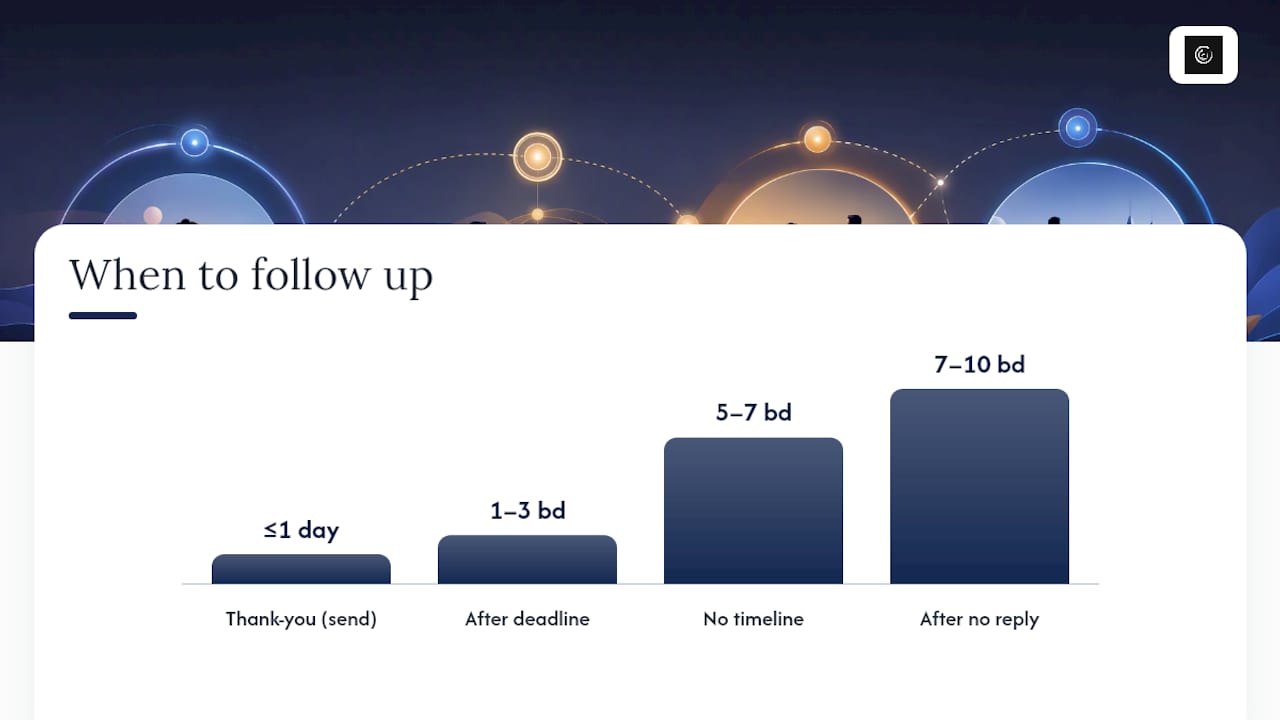
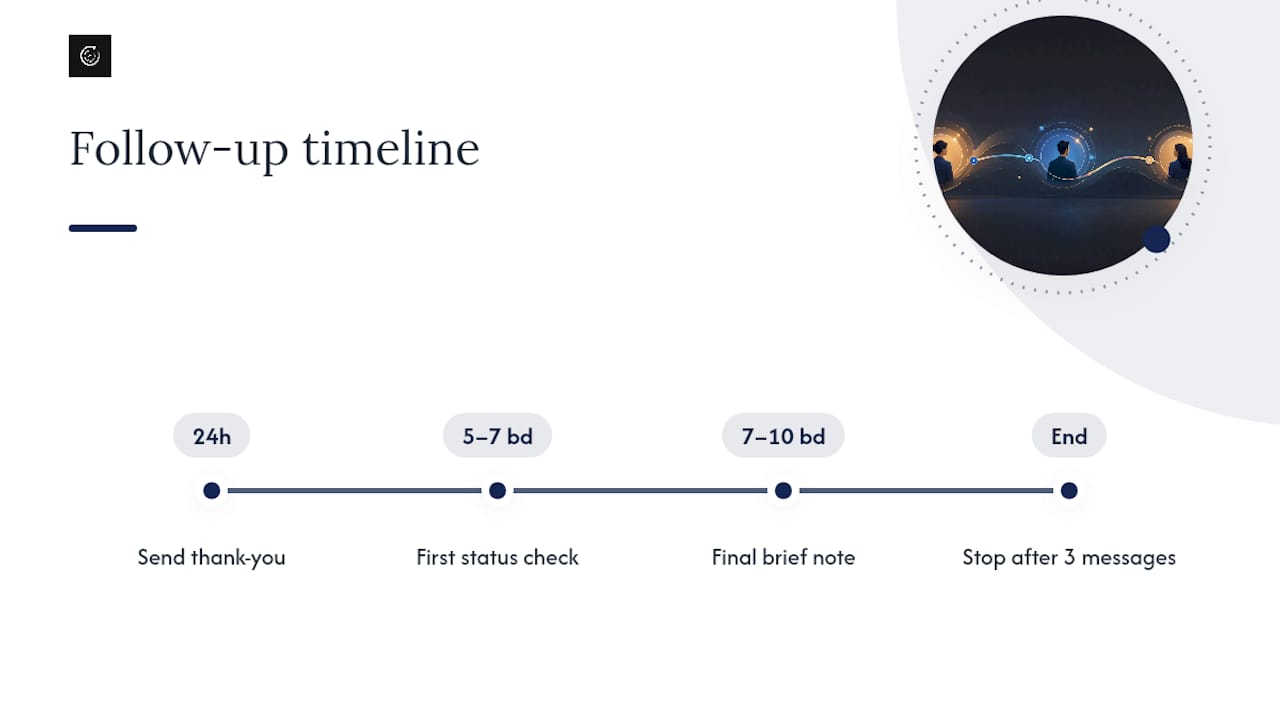
Send a short, personalized thank-you email within 24 hours of your interview, ideally the same day. If the interviewer gave you a decision timeline, wait for it to pass before checking in; if not, wait 5 to 7 business days. Cap your outreach at three total messages: the thank-you, one status check, and one final brief note.
TL;DR:
- Send a thank-you email within 24 hours, keeping it brief and referencing a specific detail to reinforce your fit.
- Wait 1 to 3 days after the indicated decision date or 5 to 7 days if no timeline was given before sending a polite status check.
- Personalize follow-up messages for panel interviews by referencing individual conversations and send separate notes to each interviewer.
- Avoid multiple follow-ups, over-apologizing, typos, or aggressive messaging, which can harm your chances more than delayed responses.
- Use brief, specific, and professional communications tailored to the interview format and avoid social media or generic templates.
Table of Contents
- When Should You Follow Up After an Interview?
- What Should a Thank-You Email After an Interview Say?
- How Do You Politely Check on Your Application Status?
- How Do You Follow Up After a Panel Interview?
- What Follow-Up Mistakes Hurt Your Chances?
- Does Interview Format Change Your Follow-Up Approach?
- When Should You Use LinkedIn or a Handwritten Note Instead of Email?
- What If the Interviewer Never Gave You a Timeline?
- How Do You Show Interest Without Sounding Desperate?
- Iteration’s Perspective: How Practiced Answers Sharpen Every Follow-Up
- Sharpen the Answer, and the Follow-Up Writes Itself
- Sources
When Should You Follow Up After an Interview?
Timing is the single easiest thing to get wrong, and it’s the part hiring managers notice most. The rules aren’t complicated, but they only work if you actually follow them instead of winging it based on how anxious you feel that day.
Send your thank-you within 24 hours, same day if possible. This isn’t just etiquette. It keeps your name and your best answers fresh in the interviewer’s head while they’re still comparing candidates. Swarthmore’s Career Center recommends sending it the same day and keeping it under 200 words, since most interviewers are reading these on their phones between meetings.
After that, the clock depends entirely on what the interviewer told you.
- They gave you a timeline (“We’ll decide by Friday”): wait until that date passes, then give it 1 to 3 more business days before you send a status check. Companies run behind schedule constantly, so jumping in the day after their deadline reads as impatient rather than diligent.
- They gave you no timeline at all: wait 5 to 7 business days, then send one polite check in. UF’s Career Journalism College guidance treats this window as the standard default when nothing else was said.
- You’ve sent a status check and still heard nothing: wait another 7 to 10 business days, then send one final, brief note. After that, stop.
That’s three messages total, maximum: thank-you, status check, final check-in. Hiring processes stall for reasons that have nothing to do with you, budget freezes, an executive on vacation, a reorg, and repeated emails don’t speed any of that up. They just make you the candidate the recruiter dreads seeing in their inbox.
Set a calendar reminder the moment you leave the interview. If the interviewer said “we’ll follow up in two weeks,” put a reminder on day 16, not day 13. Guessing at timing from memory is how people end up emailing three days early out of nerves, which is the exact behavior that makes a promising candidate look uncertain of their own value.
One more distinction worth internalizing: a status check is not a follow-up email after interview no response in the aggressive sense some job-search advice implies. It’s one polite paragraph, not a campaign. If you’re tracking multiple applications at once, a simple spreadsheet with interview dates and stated timelines does more for your sanity than any script.
What Should a Thank-You Email After an Interview Say?
The structure barely changes no matter the role: thank you, one specific reference, a line reinforcing fit, a short close. What changes is the tone and length depending on how far along you are in the process.
Subject lines that work without trying too hard:
- “Thank you, [Your Name]”
- “Great speaking with you today”
- “Following up on our conversation about [role/team]”
Keep the body under 150 to 200 words. Grammarly’s guidance on post-interview thank-you emails is blunt about this: recruiters skim, and a note that reads like a cover letter defeats its own purpose. Reference one specific detail from the conversation rather than restating your résumé; a generic “I enjoyed learning about the role” gets deleted mentally the second it’s read.
Here are four templates built around interview type and tone. Adjust the bracketed details, but keep the shape.
1. Short version (phone screen)
Subject: Thank you, [Interviewer Name]
Hi [Name],
Thanks for taking the time to talk through the [role title] opening today. I especially appreciated hearing about [specific detail, e.g., “the team’s shift toward client-facing analytics”], and it confirmed this is exactly the kind of work I want to be doing next.
Happy to answer anything further or share more detail on [specific project]. Looking forward to next steps.
Best, [Your Name]
2. Detailed version (final round)
Subject: Great speaking with you and the team today
Hi [Name],
Thank you for the thorough conversation about the [role title] position. Your point about [specific detail, e.g., “balancing speed with data accuracy on the reporting team”] stuck with me, it’s the exact tension I dealt with at [previous company], and I’d love the chance to bring that experience here.
If it’s helpful, I’m glad to send a short writeup on how I handled a similar challenge. Thanks again for your time.
Best, [Your Name]
3. Informal version (startups, casual teams)
Subject: Thanks for today!
Hi [Name],
Really enjoyed the conversation, especially digging into [specific detail]. It’s rare to find a team thinking about the problem that way, and I’m even more excited about the role now than I was going in.
Let me know if you need anything else from me in the meantime.
[Your Name]
4. Formal version (senior or executive roles)
Subject: Thank you for the opportunity to meet today
Dear [Name],
Thank you for the opportunity to discuss the [role title] position and for your insight into [specific detail, e.g., “the organization’s priorities for the next fiscal year”]. The scope of the role aligns closely with my experience leading [relevant accomplishment], and I remain very interested in contributing to the team.
Please let me know if there is any additional information I can provide.
Sincerely, [Your Name]
If you stumbled on a question during the interview, this is your one real shot at damage control. Add a single sentence, not a paragraph, clarifying your point. Something like: “On the question about [topic], I want to add that I actually led that process end to end, not just supported it.” One sentence. Move on.
Pro Tip: Pick the one detail from the conversation that made you think “I hadn’t considered it that way.” That’s almost always the most memorable line you can put in a thank-you, because it proves you were listening rather than reciting a script.
How Do You Politely Check on Your Application Status?
If you’ve waited out the timeline and still haven’t heard anything, a status check is the appropriate next move, not silence, and not a phone call to the front desk.
Contact the recruiter first if you have their information. Recruiters manage the pipeline and generally expect these check-ins; going straight to the hiring manager can come across as bypassing the process, especially at larger companies. If you only interviewed with the hiring manager directly, they’re your contact by default.
Timing follows the same rules as the intro: 1 to 3 business days after a stated deadline passes, or 5 to 7 business days after the interview if no deadline was given.
The message itself should be one paragraph. No preamble, no over-explaining:
Subject: Checking in on [Role Title] application
Hi [Name],
I wanted to check in on the timeline for the [role title] position following our conversation on [date]. I remain very interested in the opportunity and I’m happy to provide any additional information that would help with your decision. Thanks again for your time.
Best, [Your Name]
That’s the whole email. Resist the urge to add a second paragraph justifying why you’re following up, you don’t need permission to ask a simple question.
- If you get a real answer (timeline extended, decision pending), wait it out again.
- If you get silence after this one status check, send exactly one more brief note 7 to 10 business days later.
- If that also goes unanswered, treat the role as closed and put your energy into other applications. The follow-up guidance from PluckTalent makes the same point: past a certain number of unanswered messages, additional outreach reads as pressure rather than interest.
How Do You Follow Up After a Panel Interview?
Panel interviews create a temptation to write one message and BCC everyone. Don’t. Harvard Law School’s job search toolkit recommends sending separate, individualized notes to each interviewer whenever you have their contact information, because a note that references something specific to that one conversation reads as effort, while a duplicate group message reads as a template.
The efficient way to do this: write one solid core paragraph covering your general thanks and interest, then swap in one personalized sentence per recipient based on what that specific person asked or said. If one interviewer grilled you on a technical scenario and another focused on team culture, each gets a line that matches their part of the conversation.
If you don’t have everyone’s email:
- Send your note to whoever coordinated the interview (usually the recruiter or hiring manager) and ask them to pass along your thanks to the rest of the panel.
- Mention each interviewer by name in that message so the gesture still feels specific rather than generic.
- Don’t chase down email addresses through LinkedIn or guesswork; it can come across as more invasive than resourceful.
Four interviewers means four short emails, not one long one. It takes maybe fifteen extra minutes and it’s the difference between “did they even remember who I talked to” and a panel that walks into the debrief already leaning your way.
What Follow-Up Mistakes Hurt Your Chances?
Most follow-up damage isn’t from doing too little. It’s from doing too much, or doing it sloppily.
- Don’t email daily. One thank-you, one status check, one final note. A fourth message rarely helps and often gets you quietly filed as high-maintenance.
- Don’t over-apologize. If you’re late sending the thank-you or need to correct something you said, one sentence covers it. A paragraph of apology draws more attention to the mistake than the mistake itself ever would.
- Don’t skip the proofread. Wrong interviewer name, wrong job title, or a leftover placeholder bracket from a template is an instant credibility hit. Read it once for content, once specifically for names and titles.
- Don’t post about your application status publicly. Tagging a company on social media or messaging multiple employees at once about your candidacy reads as pressure tactics, not enthusiasm.
- Don’t reuse a generic template word for word across every interview. Recruiters compare notes more than candidates expect, and a copy-paste note with the wrong company name is a real, recurring failure mode.
Pro Tip: If you catch a typo after hitting send, don’t send a correction email. Let it go. A follow-up email just to fix a typo draws far more attention to the error than the typo itself ever would.
Does Interview Format Change Your Follow-Up Approach?
Somewhat, mostly in length and tone rather than substance.
Phone or video interviews, especially first-round screens, call for a shorter thank-you. Indeed’s guidance on post-interview follow-ups notes that brief follow-ups perform best for phone screens specifically, since these conversations are usually shorter and less detailed to begin with. Three to four sentences is plenty: thanks, one specific reference, a line about interest, done.
In-person interviews, particularly final rounds or ones that ran long, can support a slightly more detailed note. You had more material to draw from, so referencing a specific whiteboard exercise, a tour of the office, or a longer conversation with a particular team member feels earned rather than padded. Even then, stay under 200 words.
Virtual interviews carry one extra consideration: technical hiccups. If your video froze or there was an audio lag during the call, you can acknowledge it briefly in the thank-you (“Sorry about the audio glitch around the halfway mark, I want to make sure my answer about [topic] came through clearly”) but keep it to one sentence and move straight into your actual point.
Multi-stage processes that mix formats, phone screen, then video, then in-person, deserve a thank-you after every single stage, not just the final one. Each round is a separate touchpoint, and skipping the thank-you after an earlier round because you know more rounds are coming reads as a missed opportunity rather than an efficiency.
When Should You Use LinkedIn or a Handwritten Note Instead of Email?
Email remains the default for a reason: it’s fast, expected, and easy to track. But a couple of alternate channels have real, specific use cases.
LinkedIn messages work well as a light-touch supplement, not a replacement, for your email thank-you. If you connect with an interviewer on LinkedIn right after the interview, a short note (“Great talking with you today, looking forward to staying in touch”) reinforces the relationship without duplicating your full thank-you email. It’s particularly useful when you want to keep a connection alive even if this specific role doesn’t work out.
Handwritten notes carry weight in a narrow set of situations: executive-level roles, smaller companies with a more personal culture, or industries (some legal, academic, and nonprofit settings) where a physical gesture still reads as thoughtful rather than old-fashioned. The catch is speed. A mailed note can take days to arrive, well past your 24-hour email window, so it should supplement, not substitute for, the email thank-you.
What doesn’t work: following up through a company’s general “contact us” form, messaging random employees who weren’t part of your interview, or commenting on a company’s social posts to get attention. These read as workarounds rather than professionalism, and they can actively count against you with a hiring team already weighing judgment and communication skills.
What If the Interviewer Never Gave You a Timeline?
This happens more than job-search advice usually admits, plenty of interviewers simply forget to say “we’ll let you know by X,” especially at smaller companies without a formal process. It doesn’t mean anything is wrong; it just means you default to the standard window.
Without a stated timeline, wait 5 to 7 business days from the interview date before sending your status check. If you truly have no sense of the process length, it’s fair to ask directly in the thank-you email itself: a single added sentence like “Could you share what the timeline looks like for next steps?” gets you the information without a separate message later.
If you asked and still got no answer, treat 5 to 7 business days as your default anyway. Send one status check using the same one-paragraph template covered earlier. If that also goes unanswered, wait another 7 to 10 business days and send one final, brief note. After that point, silence is itself the answer, and continuing to email past your third message rarely changes the outcome.
How Do You Show Interest Without Sounding Desperate?
The line between “engaged candidate” and “candidate I’m slightly worried about” is thinner than most people think, and it’s almost entirely about frequency and tone, not enthusiasm itself.
Specificity reads as genuine interest. Vague eagerness reads as anxiety. “I’m very excited about this opportunity” says nothing a hiring manager hasn’t read fifty times that week. “I’ve been thinking about how I’d approach the reporting backlog you mentioned” says you were actually listening and already picturing yourself doing the job.
Frequency matters more than wording. Sticking to the three-message limit, thank-you, one status check, one final note, is itself a signal of professionalism. Going quiet and reliable between those messages says more about how you’d behave as an employee than any line you could write.
Avoid framing that centers your own anxiety: “I know you’re probably busy but I just wanted to check because I’ve been really nervous about this” puts your discomfort on the interviewer’s desk instead of your qualifications. Keep the focus on them and the role, not your waiting experience.
Iteration’s Perspective: How Practiced Answers Sharpen Every Follow-Up
Most advice on follow-ups focuses on wording. The bigger lever is what happens before the interview even ends: whether you can actually name the one detail worth referencing.
Candidates who’ve rehearsed their answers under real conditions, not just read about them, tend to walk out of an interview with a clear sense of which moment landed and which one they’d rewrite. That clarity is what makes a thank-you email tight instead of generic. Iteration’s own transcript reviews consistently show the same pattern: candidates who can point to a specific exchange write shorter, sharper follow-ups, because they’re not fishing for something to say. They already know what mattered.
— Iteration
Sharpen the Answer, and the Follow-Up Writes Itself
A follow-up email is only as strong as the interview behind it. If you’re scrambling to remember which detail impressed the interviewer, that’s usually a sign your answers weren’t tight enough to leave a clear impression in the first place.
Iteration grades your practice interviews the way an actual hiring panel would, flagging vague answers, weak framing, and moments where you talked around a point instead of landing it. Import a past transcript or run a fresh timed practice round, and the platform’s worked answer examples help you build the kind of specific, concrete responses that naturally give you something real to reference later, in the interview itself and in the thank-you email that follows it. Instead of guessing what to write at 11 p.m. the night after your interview, you walk out already knowing your best moment.
Start a free practice round and see exactly where your answers need tightening before your next interview, not after.
Sources
- How to Write a Thank-You Email After an Interview in 2026 (With Examples) – Career Center | Swarthmore College
- Follow-Up Email After an Interview (Examples and Template) | Indeed
- Thank-You Email After an Interview: Steps and Templates | Grammarly
- How to Follow Up After an Interview - UF CJC Online