Raise Clarity 15 Points With AI Interview Feedback for Job Seekers
Raise Clarity 15 Points With AI Interview Feedback for Job Seekers

Use an AI interview-practice platform to paste a past answer or run a timed mock question, and you get instant scores, plain-language rationale, and targeted drills built around your weak spots. Do this once right now with a single behavioral answer before reading further. Iterate on that feedback and clarity, structure, and confidence scores climb within a few practice sessions.
TL;DR:
- AI scoring is reliable for measuring structure, clarity, pacing, and filler words, with evidence showing strong agreement with human annotations.
- Improving your answer involves analyzing the rationale, fixing one weakness at a time, and consistently resubmitting to track progress.
- Regular practice scheduled around specific weaknesses, such as filler words or action details, can produce measurable gains within a few weeks.
- Combining automated AI feedback with occasional human input provides a balanced approach to polishing answers and reading tone.
- Focus on translating feedback into concrete behaviors, retesting, and tracking trends over multiple sessions to ensure meaningful interview improvements.
Table of Contents
- What AI Interview Feedback Actually Measures
- How Do You Turn AI Feedback Into a Better Answer?
- What Practice Schedule Actually Moves the Needle?
- What Do Your Scores and Rationales Actually Mean?
- Where AI Feedback Falls Short
- How to Request Interview Feedback Effectively From Human Interviewers
- What Kinds of Feedback Do Interviews Usually Generate?
- Balancing AI Feedback With Human Feedback
- Turning Feedback Into Better Interviews Going Forward
- Iteration’s Perspective: Why Evidence Beats Guesswork Here
- Try Iteration’s AI-Driven Interview Practice Today
- Sources
What AI Interview Feedback Actually Measures
AI grading breaks a spoken or written answer into components a human reviewer would eyeball but rarely quantifies. Most platforms score along a similar set of dimensions:
- Structure, usually mapped to STAR (Situation, Task, Action, Result), checking whether each part is present and proportioned correctly.
- Clarity, flagging vague language, unclear pronouns, or answers that never state the point.
- Brevity, measuring whether the setup eats time that should go to the action and result.
- Filler words and pacing, counting “um,” “like,” and dead air that erode perceived confidence.
- Confidence signals, drawn from word choice, hedging language, and sentence assertiveness.
- Role fit, comparing vocabulary and examples against the target job’s competencies.
The evidence behind these metrics is stronger than most job seekers assume. Rubric-guided evaluation using large language models can produce STAR-component scores that show measurable agreement with human annotations, according to an open-source evaluation project testing this approach against trained scorers. That agreement is what makes automated feedback trustworthy enough to act on, rather than a black box guess.
The practice itself pays off, too. Parakeet AI’s data shows candidates who train with real-time AI interview assistants see roughly a 40% higher chance of receiving an offer and about a 20 percentage point lift in interview evaluation scores.
Here’s what that looks like on paper. An answer that opens with “I was on a team and things were kind of chaotic” scores low on clarity and structure. Rewritten as “Our team missed two consecutive sprint deadlines because QA wasn’t looped in early,” the same answer picks up points on specificity and STAR setup, because it names the situation instead of gesturing at it.
How Do You Turn AI Feedback Into a Better Answer?
Getting a score is the easy part. The gains come from what you do in the ten minutes after.
- Read the rationale before the score. The number tells you how far off you are; the rationale tells you why, and rewriting from a number alone usually fixes the wrong thing.
- Isolate one weakness at a time. If the platform flags weak “action” detail and long setup, fix the setup first. Chasing every flag at once produces a messy rewrite that solves nothing well.
- Rewrite with a single edit target. Add a number to the result, cut the setup to two sentences, or swap “we optimized the workflow” for “we cut ticket resolution time from three days to one.”
- Resubmit and compare scores side by side. Confirm the specific dimension moved before touching anything else.
A few edits are worth trying immediately: attach a measurable result where the original answer trailed off (“and it worked out well” becomes “which cut onboarding time by half”), shorten the situation setup to one sentence, and replace internal jargon with plain language a stranger could follow.
Pro Tip: Don’t memorize the rewritten version word for word. Practice the improved structure out loud with a slightly different example each time, so it comes out sounding like you thinking on your feet, not a script you’re reciting.
What Practice Schedule Actually Moves the Needle?
Random practice produces random improvement. A schedule mapped to your actual weak points produces measurable movement in a couple of weeks.
Match the drill to the flaw:
- Heavy filler-word count → timed 90-second answer drills where you’re penalized for every “um” or “so.”
- Weak STAR action detail → rewrite the same story five times, changing only the action sentence, until specificity becomes automatic.
- Low confidence or camera avoidance → on-camera mock rounds, even short ones, since avoidance never fixes discomfort.
A workable cadence: three short AI mock sessions a week at 20 to 30 minutes each, rotating question categories (behavioral, technical, situational) so you’re not just getting good at one story. In the final week before a real interview, add one human mock session, since career center guidance treats AI practice as a strong complement to human feedback, not a replacement for it.
Set a concrete target instead of a vague one: raise your average clarity score by 15 points, or cut filler-word count in half within two weeks. Iteration’s ranked practice format works well here because it forces variety through a rotating leaderboard instead of letting you drill the same comfortable question on repeat. Candidates who train this way regularly see the offer-rate lift noted above, largely because repeated, varied reps expose blind spots a single mock never would.
What Do Your Scores and Rationales Actually Mean?
A 62 on structure doesn’t mean you failed. It means the answer has real pieces but they’re out of proportion, usually a bloated setup and a thin result. Treat each score as a distance to close, not a grade to feel bad about.
- A low brevity score usually means the setup ran long. Try capping it at 15 to 20 seconds of spoken time.
- A low action score almost always means the result lacks a number. Add one, even an estimate.
- A low confidence score often traces back to hedging phrases like “I think” or “sort of,” not the substance of the answer.
- A small score bump (2 to 5 points) after one rewrite is normal progress. A jump of 15 or more usually means the previous version had a structural gap, not just weak wording.
Trust the AI signal for structure, pacing, and filler words since these are objective and countable. For read on tone, humor, or whether an answer will land with a specific interviewer’s personality, get a human gut check. AI is precise on mechanics and blind to chemistry.
Where AI Feedback Falls Short
AI grading is strong on mechanics and weak on the human parts of an interview. It can’t gauge whether your delivery would land with a specific hiring manager’s style, and it can miss interpersonal chemistry entirely. Scoring can also shift between audio-only submissions and text transcripts of the same answer, since tone and pacing carry information a transcript strips out.
A few precautions keep this in check:
- Keep a human reviewer, mentor, or peer in the loop periodically, not just for the final polish.
- Watch for calibration drift. If the same answer scores meaningfully differently across sessions, treat the recent score with skepticism.
- Avoid pasting sensitive personal data such as employer names, salary figures, or client details into any AI tool.
- Check your target employer’s AI-use policy before relying on live AI assistance during an actual interview, since some companies restrict it.
Humanly’s breakdown of AI interview scoring makes the case that transparent rationale and regular human calibration are what keep automated scoring fair rather than just fast.
Pro Tip: Keep a simple log of your scores across sessions, even a basic spreadsheet. If the same answer scores a 70 one week and an 85 the next with no real change, that’s a calibration flag worth noting, not a sign you suddenly got better.
How to Request Interview Feedback Effectively From Human Interviewers
AI scoring handles volume and mechanics, but a live interviewer sees things no algorithm catches, so it’s worth asking them for input too. Timing and framing both matter more than most candidates think.
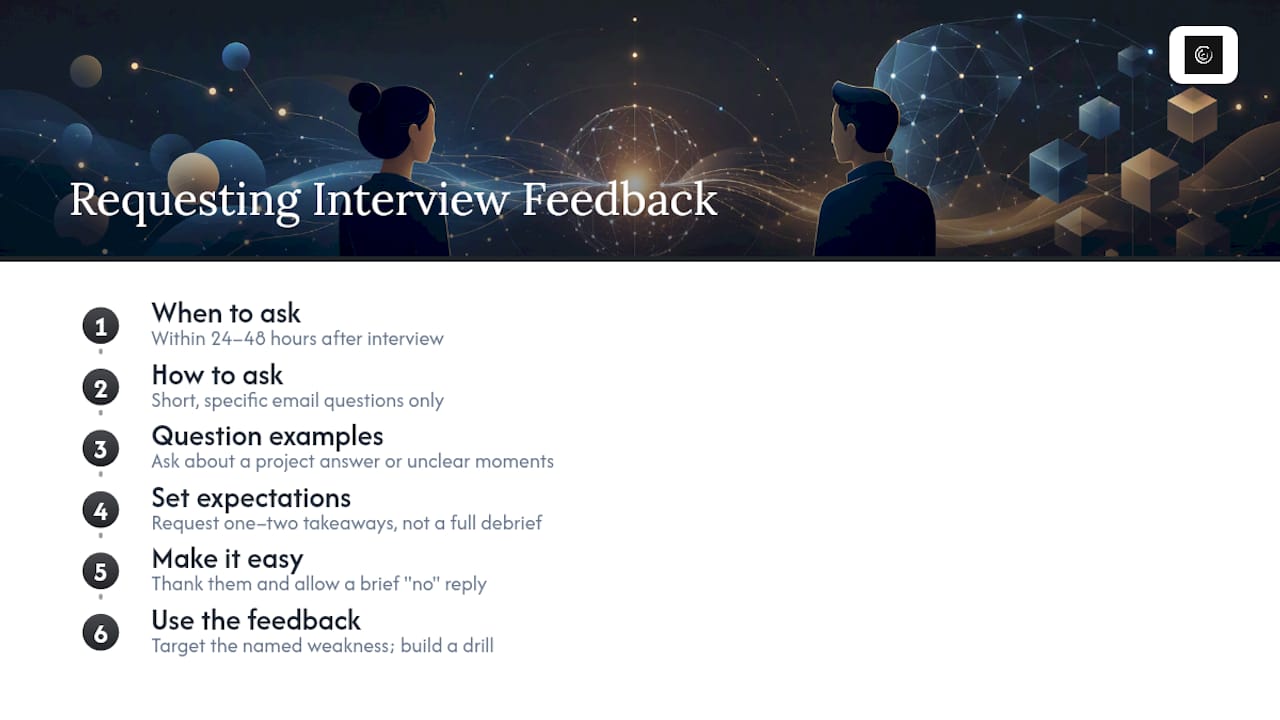
Ask within 24 to 48 hours of the interview, while the conversation is still fresh for the interviewer. A short, specific email works better than a vague one: instead of “how did I do,” ask “what could I have added to my answer about the project conflict” or “was there a moment where my answer felt unclear.” Specific questions get specific answers; open-ended ones get polite silence or a generic reply.
Keep the request brief, thank them for their time, and make it easy to say no to a long response. Many interviewers won’t give detailed feedback due to legal or HR policy, especially after a rejection, so frame the ask as a request for one or two takeaways rather than a full debrief.
If you get feedback, treat it the same way you’d treat an AI rationale: identify the one specific weakness named, and build a drill around it rather than trying to overhaul everything at once. A human comment like “your answer felt rehearsed” maps directly onto the confidence and naturalness metrics an AI platform already tracks, which makes it easy to fold into the same practice routine.
What Kinds of Feedback Do Interviews Usually Generate?
Feedback after an interview tends to fall into a few recurring buckets, whether it comes from a person or a platform.
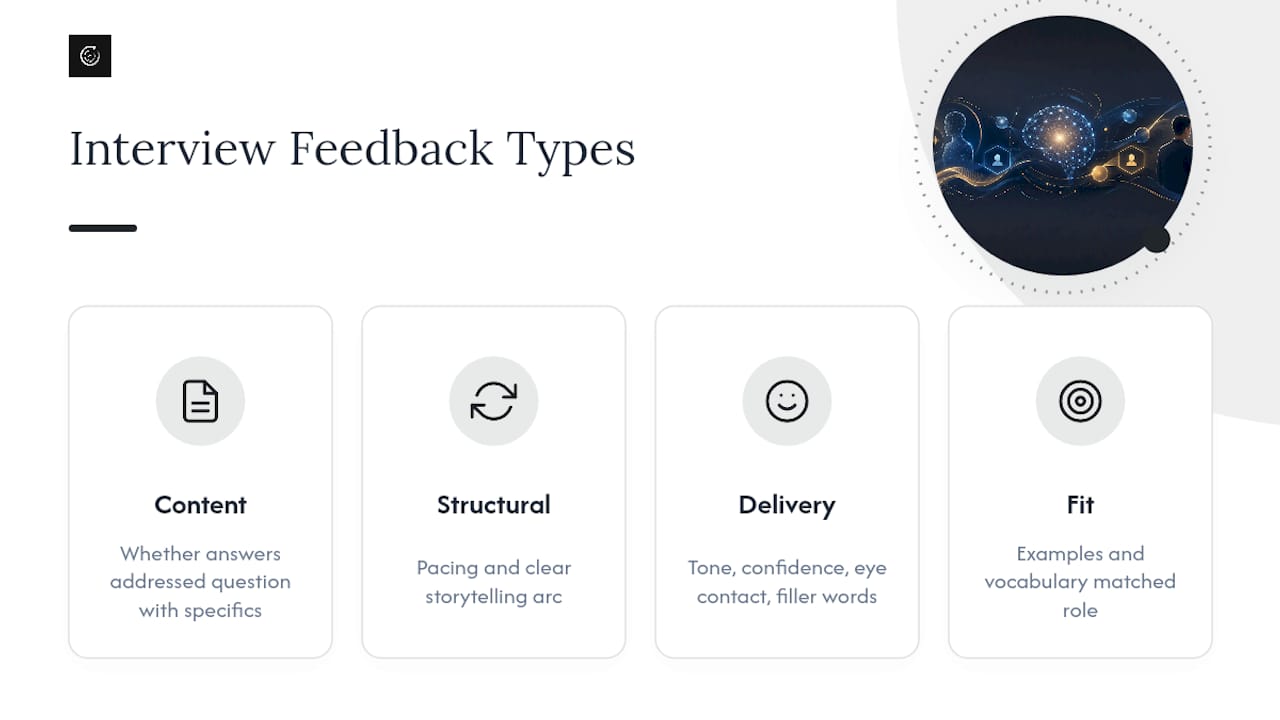
Content feedback addresses whether your answers actually answered the question and included enough specific detail, usually the most common critique. Structural feedback flags pacing, disorganized storytelling, or answers that ramble without a clear arc. Delivery feedback covers tone, confidence, eye contact, and filler words, the mechanical layer that AI platforms measure especially well. Fit feedback speaks to whether your examples and vocabulary matched the role and the company’s stated priorities.
Rejections rarely come with detailed feedback attached, which is exactly why proactive practice matters more than waiting on a post-interview note that may never arrive. An industry explainer on AI mock interviews points out that AI is particularly good at catching the delivery and structural categories, the blind spots candidates rarely notice about themselves without a recording to review.
Balancing AI Feedback With Human Feedback
Neither source should carry the full weight alone. AI gives you speed, consistency, and blunt honesty about mechanics; a human gives you judgment about nuance, tone, and whether an answer would actually persuade a specific person in a specific room.
The most effective approach blends fast AI cycles for volume with targeted human checks for the parts a rubric can’t fully capture. Run the bulk of your reps through an AI platform, since it’s available at any hour and never gets tired of hearing the same story five times. Save human feedback, whether from a mentor, career counselor, or a friend who interviews well, for the final pass before a real interview or after a major structural rewrite.
Weight AI signals heavily for structure, pacing, and filler words. Weight human signals heavily for tone, humor, and whether an answer feels authentic rather than rehearsed. When the two disagree, that’s usually the most useful information of all: it tells you exactly where mechanical correctness and human perception have drifted apart.
Turning Feedback Into Better Interviews Going Forward
Feedback that doesn’t change your next interview was wasted. The gap between “I got useful notes” and “I got better” is entirely about what you do in the days after.
Start by translating each piece of feedback into a specific behavior, not a vague resolution. “Be more confident” isn’t actionable. “Cut hedging phrases and land the result sentence with a number” is. Pull two or three recurring themes across your last several practice sessions, since a pattern that shows up three times matters more than a one-off comment.
Rehearse the fix in context, not in isolation. If your weak spot is rambling setups, don’t just practice shortening setups in the abstract, run full answers under a timer so the fix holds up under real pressure. Retest the same question type a week later to confirm the change stuck rather than assuming one good rewrite means the habit is fixed.
Track trend lines, not single sessions. One low score after a long day means little. A metric that stays flat across five sessions means the drill isn’t working and needs to change.
Iteration’s Perspective: Why Evidence Beats Guesswork Here
We built Iteration around a simple frustration with generic AI feedback: a general-purpose chatbot will tell you an answer “sounds good,” which is close to useless. Grading needs to be granular, and drills need to target the exact dimension that’s actually weak, not the one you assume is weak.
Iteration grades responses across structure, clarity, and delivery, then generates drills tied to your specific patterns rather than generic interview tips. The ranked practice format adds a layer most tools skip: competitive repetition against a leaderboard, which pushes volume without letting practice get stale.
If you’re starting today, the workflow is simple: paste one past answer, run a timed mock question, then set two targeted drills based on whatever the rationale flags first. Iterate weekly, not daily. Structural change needs repetition to stick, not a single frantic session the night before an interview.
— Iteration
Try Iteration’s AI-Driven Interview Practice Today
Iteration turns the workflow this article just walked through into one place instead of five browser tabs. Paste a past answer or run a timed mock, and you get instant scores, plain-language rationale, and targeted drills built around your specific weak spots, plus transcript-based reviews if you’ve already interviewed and want a rewrite.
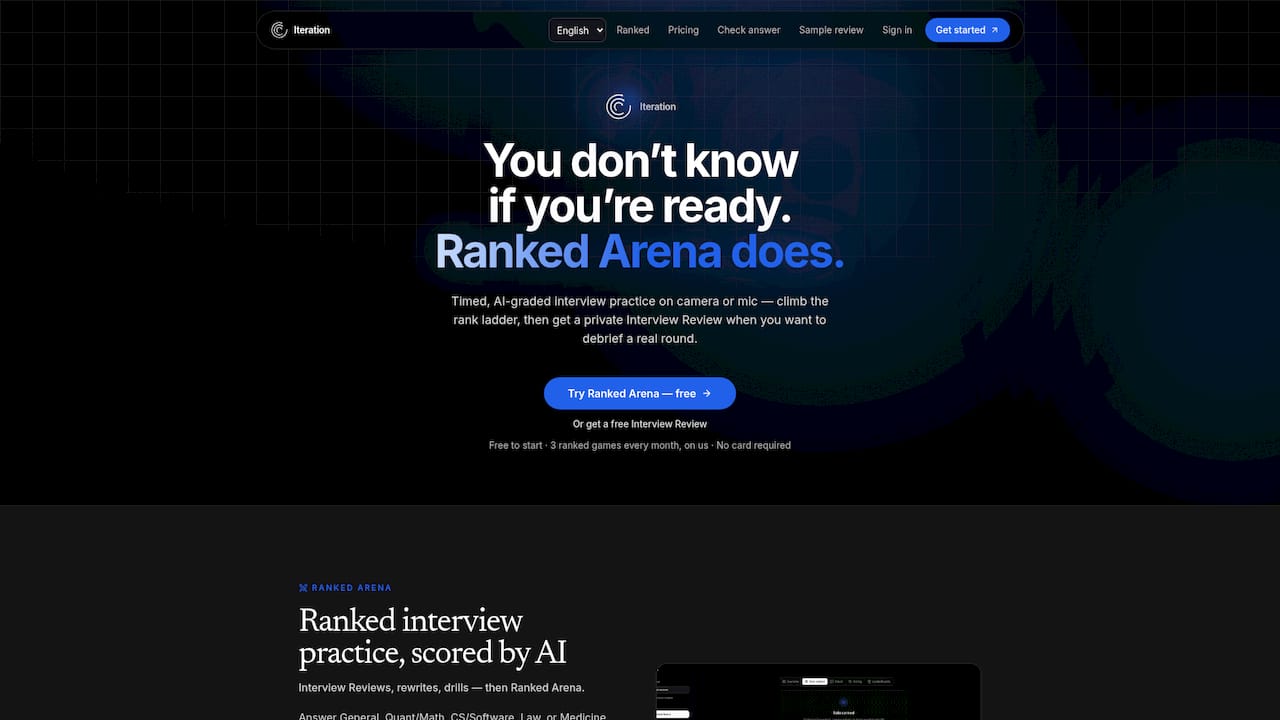
The ranked practice games add a live leaderboard so repetition doesn’t get boring, and the platform’s approach differs from a general chatbot in ways worth understanding if you’ve only ever compared it to ChatGPT for feedback. A free tier gives you limited monthly practice to test the workflow, and the Pro and Ultra plans open up deeper analysis and more rounds for anyone prepping for a real interview soon.
Paste your next answer in and see what lands before your next interview, not after it.
Sources
- Real-time AI interview assistants: 40% more job offers — Parakeet AI blog
- Tips for using AI to prepare for job interviews — Toppel Career Center (University of Miami)
- AI interview scoring: How it works and how to keep it fair — Humanly
- evaluating-llms-as-behavioural-interviewers — GitHub project