Practice to 60 Seconds: Measure Interview Answer Length
Practice to 60 Seconds: Measure Interview Answer Length
Most interview answers should land between 30 and 90 seconds. Behavioral stories work best at 60 to 90 seconds, and you should reserve up to two minutes only for genuinely complex narratives. A former Disney recruiter puts it simply: conciseness is the number one habit that separates strong candidates from the rest, and at a conversational pace of 150 to 180 words per minute, that means most answers should run 75 to 270 words.
TL;DR:
- Most interview answers should be between 30 and 90 seconds, with behavioral stories ideally lasting 60 to 90 seconds for clarity and impact.
- Structuring responses using the STAR framework helps prioritize the most relevant details within the time limit, especially focusing on the action and result.
- Practicing answers with timed recordings and AI feedback improves pacing, ensuring answers stay concise and confident rather than overly long or rushed.
- Candidates should tailor their answer length based on question type, giving brief, fact-focused responses to factual questions and longer stories only when warranted.
- Cutting early and stopping mid-answer when necessary demonstrates control and confidence, preventing rambling and maintaining interviewer engagement.
Table of Contents
- What Is the Ideal Interview Answer Length?
- Timing Cheat Sheet: Seconds, Words, and When to Use Each
- Recommended Answer Length by Question Type
- How to Structure Answers That Fit Your Time Budget
- Practice Drills to Calibrate Your Timing
- Fixing Answers That Run Too Long or Too Short
- Sample Answers at 30, 60, 90, and 120 Seconds
- Why Iteration Treats Answer Timing as a Measurable Skill
- Practice Your Timing With Iteration
- Sources
What Is the Ideal Interview Answer Length?
The honest answer depends on the question, but the guardrails are consistent across career resources. Indeed’s interviewing guidance puts the full range at 30 seconds to four minutes depending on complexity, with 60 to 90 seconds covering the majority of standard questions. That range isn’t arbitrary. It maps to how interviewers actually listen: they’re scanning for a clear point, one or two pieces of evidence, and a wrap. Once you cross the two-minute mark without a clear structure, you’re not adding information anymore. You’re testing their patience.
The industry term for this skill is “response calibration,” though most job seekers just call it “not rambling.” Whatever you call it, the mechanics are the same: you have a fixed window of attention, and every extra sentence past the point where your answer is complete works against you rather than for you.
Here’s what surprises a lot of candidates: the fix isn’t talking faster. It’s cutting earlier. A 45-second answer delivered at a normal pace with a clean structure reads as more confident than a 90-second answer crammed with qualifiers, backtracking, and “so yeah, I guess” filler. Length and confidence aren’t the same axis, and conflating them is the single biggest reason smart candidates undersell themselves.
Timing Cheat Sheet: Seconds, Words, and When to Use Each
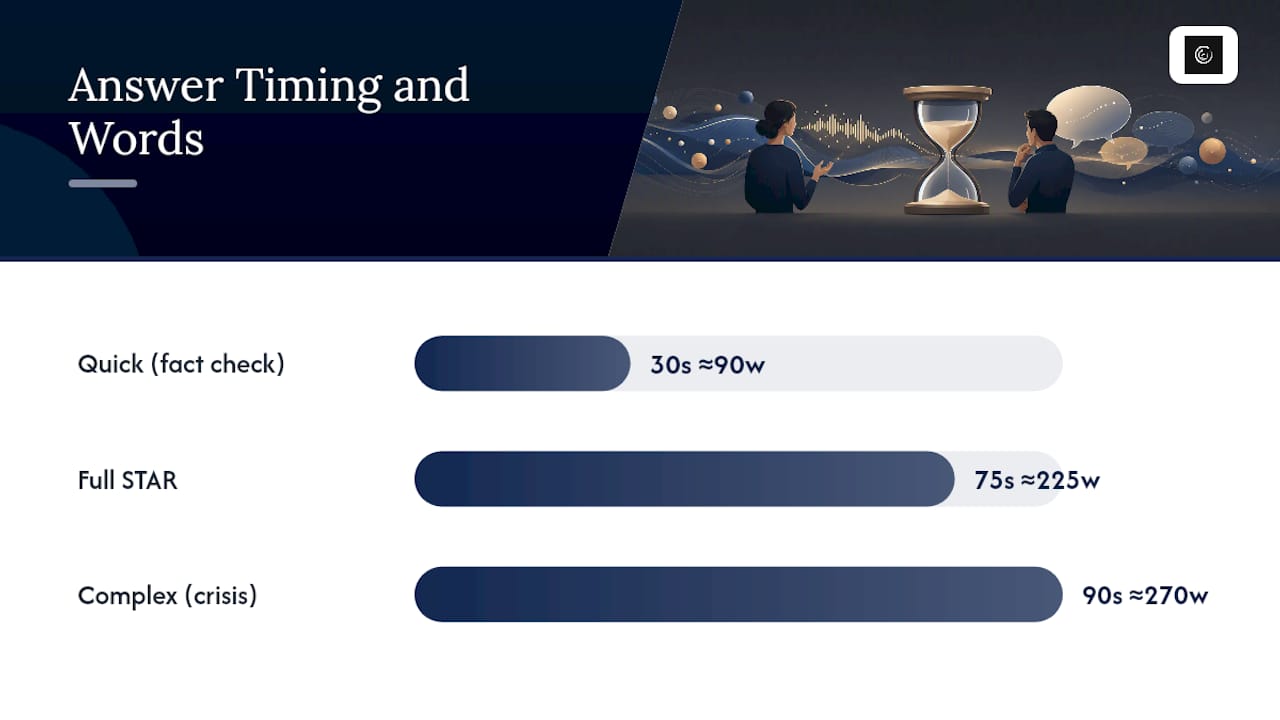
Once you know your speaking pace, converting time into an approximate word count can help practice. Typical conversational pace guides can be used to estimate how many words fit into different time spans, which align with different interview answer types, from quick clarifications to full behavioral stories and complex narratives.
Statistic Callout: A former Disney recruiter’s rule of thumb is roughly one minute per answer. Treat that one minute as your default setting, not your ceiling. If a question genuinely needs more room, you’ll know because the interviewer leans in rather than starts glancing at their notes.
A few quick rules for matching band to moment:
- Use the 30 second band for anything that’s really a fact check, like “did you manage a team?” or “are you open to relocating?”
- Default to 60 to 90 seconds for anything with the word “tell me about a time” in it.
- Only stretch past 90 seconds when the question explicitly asks for a full story with stakes, like a failure, a pivot, or a crisis you managed.
- Never open with throat-clearing (“That’s a great question, let me think about that”) since it eats into your allotted time before you’ve said anything.
- If you’re not sure which band applies, default short. It’s easier to add detail on request than to claw back an interviewer’s attention once it’s drifted.
The math here matters more than it seems. A 90 second answer at 180 words per minute is 270 words, roughly the length of this section so far. That’s enough room for a full STAR story with a real number at the end, but not enough room to wander through backstory nobody asked for. Once you internalize the word count, you stop needing to watch a clock mid-answer, because you can feel the length of 270 words in your mouth the same way you can feel the length of a paragraph on a page.
Recommended Answer Length by Question Type
Not every question deserves the same amount of airtime, and treating them all the same is where a lot of candidates lose points without realizing it. Here’s how to calibrate by category:
-
Background and warm-up questions (“Tell me about yourself,” “Walk me through your resume”). Keep these to 30 to 60 seconds. The interviewer is orienting themselves, not evaluating depth yet. Hit your current role, one relevant highlight, and why you’re here. Anything longer starts to feel like a monologue before the interview has even started.
-
Behavioral questions using STAR (“Tell me about a time you…”). Target 45 to 90 seconds. This is the band where structure earns you the most. Situation and Task should take maybe 15 seconds combined, Action gets the bulk of your time at 30 to 45 seconds, and Result closes it out with a specific number or outcome in 10 to 15 seconds.
-
“Why us” and motivation questions (“Why this company,” “Why this role”). Stay in the 30 to 60 second range. These questions reward specificity over length. Naming one thing about the company’s product, mission, or team that you’ve actually researched beats three vague sentences about “growth opportunities.”
-
Deep narrative or complex scenario questions (“Tell me about your biggest failure,” “Describe a time you led through a crisis”). This is where 60 to 120 seconds is appropriate, and occasionally the full range up to two minutes that specialty interview guides describe for extended narratives. These stories have more moving parts: a setback, a decision, a course correction, a lesson. Give them room, but still land on a clean summary sentence rather than trailing off.
-
Rapid clarifying or logistics questions (“Are you authorized to work here,” “What’s your notice period”). These deserve 10 to 30 seconds, full stop. Padding a factual answer with justification you weren’t asked for reads as nervous, not thorough.
A quick gut check for behavioral answers specifically:
- If your Situation and Task setup is running past 20 seconds, you’re over explaining context nobody needs yet.
- If you can’t name a specific number, percentage, or outcome in your Result, your story isn’t finished, it just stopped.
- If you find yourself saying “and then” more than twice, you’ve drifted from a story into a timeline.
- Two minutes should be the exception you reach for once or twice in an entire interview, not your default setting for anything meaty.
Why does structure matter more for some question types than others? Background and logistics questions are fact retrieval. There’s no arc, so extra time just means extra words around the same fact. Behavioral and narrative questions are fundamentally stories, and stories need a beginning, middle, and end to land. The time budget forces you to prioritize which details actually move the plot forward, which is exactly the discipline interviewers are quietly grading you on.
How to Structure Answers That Fit Your Time Budget
The STAR framework (Situation, Task, Action, Result) gets recommended constantly, but most people use it wrong. They spend 40 seconds setting the scene and then rush the Result in five seconds, which is backward. The Result is the part that actually proves you’re good at your job.
Here’s the compressed version that fits inside a 60 to 90 second window:
- Situation and Task (10 to 15 seconds combined): One sentence. “Our team was two weeks from a launch and lost our lead engineer.” That’s it. Don’t narrate the org chart.
- Action (30 to 45 seconds): This is your real estate. What did you specifically do? Not “we collaborated,” but “I split the remaining scope into three chunks and personally took the integration piece.”
- Result (15 to 20 seconds): A number, a comparison, or a concrete outcome. “We shipped on time, and the feature had zero critical bugs in the first month.”
Try what’s sometimes called the “one-minute first pass”: deliver the compressed 60 second version of your story first, every time, regardless of how meaty the material is. Then stop talking. If the interviewer wants more, they’ll ask, and now you get to look thoughtful and thorough on request instead of exhausting them upfront.
This connects directly to a tactic career coaches call the expandable answer: give a concise, complete primary answer, then explicitly offer more. A line like “I can go deeper on the technical side of that if it’s useful” does two things at once. It signals you have more depth in reserve without forcing the interviewer to sit through it, and it hands control of the pacing back to them.

Prioritizing facts matters as much as trimming words. Before you answer, silently rank the two or three details that actually prove your point, and cut everything else, even if it’s true and even if it’s interesting. A detail that doesn’t support your main claim is a tax on the interviewer’s attention.
Pro Tip: After your compressed answer, try a closing line like “Happy to walk through more detail on any part of that.” It leaves the ball in the recruiter’s court instead of you guessing whether you said enough.
Practice Drills to Calibrate Your Timing
Reading about the 60 second rule and actually hitting 60 seconds under interview pressure are two different skills. Practicing with timed recordings is the most direct way to close that gap, and it works in three progressive stages.
- Stopwatch recap. Pick one behavioral question, set a timer, and answer out loud without notes. Don’t aim for perfect, just record the raw time. Most people are surprised to find their “quick answer” runs 2 minutes 15 seconds on the first try.
- Camera practice. Repeat the same question on video, but this time with a 90 second cap. Watching the playback shows you exactly where you drifted, usually in the Situation and Task setup, almost never in the Result.
- Mock interview rounds. Run through five or six questions back to back in a simulated session, ideally with feedback on each one, so you’re practicing pacing across an entire interview rather than one isolated answer.
Here’s how time converts to a target word count you can actually write toward while drafting your practice bullets:
A structured tool like Iteration’s daily practice questions can shortcut stage two and three by giving you instant feedback on pacing and structure instead of guessing at it alone in front of a mirror. The advantage of practicing on camera or mic with automated review is that it catches the habits you can’t hear in your own head, like trailing off mid-sentence or repeating a phrase when you’re buying time to think.
Track your progress the same way you’d track any skill: pick two or three questions and re-run them over a week. Your target isn’t a single perfect take, it’s consistency. If your Tuesday answer runs 58 seconds and your Friday answer on the same question runs 95 seconds, you don’t have a timing problem, you have a structure problem, because your content isn’t repeatable yet. Consistency across multiple attempts is the real checkpoint, not any single fast run.
Fixing Answers That Run Too Long or Too Short
Rambling has a recognizable shape once you know what to look for: you start repeating a phrase, the interviewer’s eye contact drops to their notes, or you catch yourself saying “so, yeah” as a stall tactic. The moment you notice any of those signs, stop mid-thought rather than finishing the sentence you started.
The recovery script is short and works almost every time: “So to sum that up, the key outcome was [result]. Happy to go into more detail on any part of that.” It closes the loop, gives the interviewer a clean landing point, and hands the pacing decision back to them instead of you deciding unilaterally to keep talking.
Running too short has its own fix, and it’s the opposite instinct. If you answer in 15 seconds and the room goes quiet, don’t panic and start free-associating. Add one specific, prepared example: “For instance, on my last project that looked like…” A single concrete detail almost always fills the gap better than three vague sentences bolted onto the end.
A few habits that keep both problems from happening in the first place:
- Take one breath before answering. It costs you two seconds and buys you a beat to structure your response instead of launching into it raw.
- Silently count “Situation, Action, Result” as a checklist while you talk, so you notice if you’re still on Situation at the 40 second mark.
- If you catch yourself mid-ramble, a simple “let me tighten that up” buys you permission to compress on the spot without it sounding like an apology.
- Watch for the interviewer starting to write something down mid-answer. That’s often your cue to wrap the current point rather than open a new one.
Pro Tip: If you genuinely don’t know whether you’ve said enough, ask directly: “Does that answer your question, or would it help to go deeper on any part?” It reads as confident, not uncertain, because you’re managing the conversation instead of just filling silence.
Sample Answers at 30, 60, 90, and 120 Seconds
These are meant as templates you rebuild in your own words, not scripts to memorize word for word. Practicing from bullet points instead of a fixed script keeps your delivery natural and lets you adjust on the fly when the interviewer’s actual question differs slightly from what you rehearsed.
-
30 seconds (~80 words), clarifying question: “Are you open to relocating?” “Yes, I’m open to relocating, particularly for a role like this one. I’ve relocated once before for a job in Chicago, so I know what the transition involves, and I’d be ready to move within a few weeks of an offer.”
-
60 seconds (~160 words), behavioral: “Tell me about a time you missed a deadline.” “Last year I was leading a client deliverable and underestimated how long a third-party integration would take. About a week before the deadline, I realized we’d miss it by two days. I flagged it to my manager immediately with a revised timeline and two options: ship on time with reduced scope, or ship two days late with full scope. The client chose the two-day delay. Afterward, I built a buffer into every project plan for third-party dependencies specifically, and we haven’t missed a deadline on a similar integration since.”
-
90 seconds (~250 words), behavioral with full STAR: “Tell me about a time you handled competing priorities.” For a fully worked version of this exact answer structure, see how to handle competing priorities and tight deadlines.
-
120 seconds (~320 words), complex narrative: “Why are you leaving your current job?” This is one of the trickiest lengths to get right because it invites both context and diplomacy. A full worked example, including how to frame a departure without sounding negative, is covered in how to answer why you are leaving your current job.
A few notes on adjusting these by role. Technical roles often tolerate slightly longer Action sections since the interviewer wants to hear your reasoning process, not just the outcome. If you’re prepping for a pair-programming style technical interview, scripts built specifically for that format show how much longer the “thinking out loud” portion is expected to run compared to a standard behavioral answer. Sales and client-facing roles tend to reward tighter Results with a hard number attached, since that’s the currency of the role itself.
Why Iteration Treats Answer Timing as a Measurable Skill
Most interview advice treats length as a matter of feel: talk until it seems like enough, then stop. We think that’s backward. Timing is one of the few interview skills you can actually measure objectively, the same way you’d measure a mile run or a typing test, and skills that can be measured can be practiced with precision instead of guesswork.
That’s the premise behind how Iteration structures practice rounds. When you run a timed answer against a real question and get it graded, you’re not just getting a vague “good job” or “too long.” You’re seeing exactly where your Situation and Task setup ran three times longer than it needed to, or where your Result faded out without a number attached. That specificity is what turns a vague sense of “I ramble sometimes” into a fixable habit.
There’s a memory benefit here too that people underestimate. An answer you’ve timed and compressed five times sticks in a different way than one you’ve only thought about. You’re not recalling a paragraph anymore, you’re recalling a rhythm, and rhythm survives interview nerves far better than memorized text does. If you want a library of already-structured examples to practice against, our worked interview answers are built around exactly this kind of timed, repeatable structure.
— Iteration
Practice Your Timing With Iteration
Reading about the 60 second rule won’t fix a habit of running three minutes on every behavioral question. You need to hear yourself do it, get graded on it, and do it again. Iterationinterview is built for exactly that gap: timed, on-camera or mic practice rounds with AI grading that tells you specifically where an answer ran long, where it needed a stronger Result, and how it compares to your own past attempts.

Unlike a generic chatbot that just gives you feedback in text, Iteration grades the actual delivery, meaning the pacing, the structure, and the timing together, not just whether the words sound right on a transcript. If you want to see that difference directly, our comparison against ChatGPT for interview feedback breaks down what timed, graded practice catches that a text-only review misses. Start with a free round to see where your current answers land, and check the pricing page if you want deeper drills and more rounds once you’ve felt the difference. Head to Iteration’s try page and paste in your last interview transcript or record a fresh answer to get your first timing readout today.
Sources
The timing guidance in this article draws on a handful of trusted career resources, each addressing a different piece of the puzzle:
- No. 1 interview tip from former Disney recruiter: ‘Conciseness is key’ — CNBC
- How Long Should Interview Answers Be? (Indeed)
- How long should a strong interview answer be? — ResidencyAdviser
- Are your interview answers too long? Use expandable answers — JobSearchAndInterviewCoach