Practice Your Phone Screen in 60 Minutes With Timed Drills
Practice Your Phone Screen in 60 Minutes With Timed Drills

Rehearse the 10 highest-probability phone-screen questions out loud, record at least one full run-through, and book one mock call with a person or an AI tool using these free career resources and templates. Budget about 60 minutes per prep session. Do that once or twice before the call and you should notice a real jump in how clear, concise, and confident you sound, even if the questions surprise you.
TL;DR:
- Rehearsing common questions out loud and recording at least one run-through can significantly improve clarity, confidence, and answer timing.
- Preparing a one-page cheat sheet with your key answers, metrics, salary range, and questions is essential for quick referencing during the call.
- Self-recording, live mock calls, and AI practice sessions each reveal different answering flaws, making combined use the most effective strategy.
- Confirm logistics, test equipment, and prepare your environment in the last 10 minutes before the interview to ensure a smooth experience.
- Using measurable, iterative practice helps track actual improvements in filler words, answer structure, and pacing instead of relying on vague confidence.
Table of Contents
- What Happens During a Phone Screen and What Recruiters Are Really Checking
- What Are the Most Common Phone-Screen Questions?
- How Do You Prepare for a Phone Screen in 60 Minutes?
- Which Practice Method Actually Improves Your Phone-Screen Performance?
- How Do You Handle Logistics and the Salary Question?
- What Should You Do in the Last 10 Minutes Before the Call?
- Why We Built Iteration Around Measurable Practice
- Try a Ranked Practice Session Before Your Next Call
- Sources
What Happens During a Phone Screen and What Recruiters Are Really Checking
A phone screen usually runs 20 to 30 minutes, and it’s rarely the hiring manager on the other end. It’s almost always a recruiter, and their job is narrower than you’d think. They aren’t deciding whether to hire you. They’re deciding whether you’re worth another 30 minutes of someone else’s time. Indeed’s career guide frames the phone screen as the first human filter after your resume clears an initial review, and university career centers describe the same 15 to 30 minute window as a check on basic fit before anyone invests more time.
Three things get evaluated on that call:
- Fit on paper, confirmed in real time. Does your story match your resume? Can you explain gaps or transitions without stumbling?
- Deal-breakers. Salary range, location or remote flexibility, notice period, visa status. If these don’t line up, the process usually stops here.
- How you communicate. Are you organized? Do you ramble? Can you answer a direct question directly?
Candidates who treat this as a formality, rather than a real interview, are the ones who get filtered out before they ever meet the hiring manager.
What Are the Most Common Phone-Screen Questions?
Most phone screens pull from a short, predictable list. If you rehearse these out loud, timing yourself, you’ll sound less like you’re reciting and more like you’re simply confident. Career guides recommend keeping most answers in the 60 to 90 second range, long enough to show substance, short enough to respect the recruiter’s clock.
-
“Tell me about yourself.” The recruiter wants a 60 second career summary, not your life story. Template: current role and one relevant strength, one or two career highlights with a number attached, then why you’re looking now. Keep it chronological and end on the present.
-
“Why this role?” They’re checking whether you actually read the job description. Name one or two specifics from the posting and tie them to something you’ve done before.
-
“What are your salary expectations?” Give a researched range, not a single number, and ask what’s budgeted if the recruiter hasn’t shared it yet.
-
“What’s your notice period, and are you open to relocating or remote work?” Answer directly. Vague answers here read as a red flag, not modesty.
-
“Tell me about a time you solved a difficult problem.” This is a STAR question. Situation, Task, Action, Result, in that order, and don’t skip the result. Pick one story and rehearse it until the numbers come out naturally.
-
“What’s your greatest strength?” Pair the strength with a specific example, not just an adjective.
-
“What’s a weakness you’re working on?” Name something real and show the fix in progress. Skip the fake weakness (“I work too hard”).
-
“Why are you leaving your current job?” Stay forward-looking. Talk about what you’re moving toward, not what you’re escaping.
-
“What do you know about our company?” One or two sentences on what they do and why it’s relevant to you, not a recited mission statement.
-
“Do you have any questions for us?” Always say yes. Two or three prepared questions about the role or next steps signal genuine interest.
Pro Tip: Practice these out loud, not silently in your head. Silent rehearsal feels smooth because you skip over the awkward transitions; speaking catches them before the recruiter does.
For deeper templates on trickier prompts, like behavioral follow-ups or curveball questions, a library of worked answers can save you from freezing mid-call.
How Do You Prepare for a Phone Screen in 60 Minutes?
You don’t need a week. You need one focused hour and a single page of notes you can glance at without sounding like you’re reading a script.
Here’s a workable breakdown:
- 10 minutes: Reread the job description and highlight the three requirements they’ll probably ask about.
- 10 minutes: Look up the company’s recent news, product, or funding status. One relevant detail is enough.
- 10 minutes: Say your “tell me about yourself” answer out loud twice.
- 15 minutes: Rehearse one STAR story until the numbers come out smoothly.
- 10 minutes: Set your salary range and write it down so you don’t improvise under pressure.
- 5 minutes: Write three questions to ask the recruiter.
Your cheat sheet should fit on one page: a 60-second opener, three to five accomplishment bullets with metrics attached, your salary range, and three to five questions. Kickresume’s phone interview guide recommends this exact structure, and it works because it’s scannable in the two seconds of silence after a hard question.
Use short cues and bolded numbers, not full sentences. A cheat sheet full of paragraphs is useless when you’re talking and reading at the same time. Bullets, bold the metrics, and leave white space.
Which Practice Method Actually Improves Your Phone-Screen Performance?
Three formats work, and each catches a different problem.
Self-recording. Record yourself answering five to ten questions, then listen back. This is the fastest way to catch filler words, a flat tone, or a pace that’s too fast to follow. Scroops’ guide on phone interview practice points out that recordings surface issues you’d never notice mid-conversation, because you’re too busy talking to hear yourself.
Live mock calls. Ask a friend, mentor, or career coach to run a 15-minute mock and give you one or two specific critiques afterward. This format catches things recordings miss, like whether your answers actually land with a real listener.
AI practice sessions. Structured AI mocks give you consistent, on-demand repetition without scheduling anyone else’s calendar, plus measurable feedback on filler words, pacing, and whether your answers actually followed STAR structure. Iteration’s ranked practice format is built around this, scoring answers and flagging the specific habits worth fixing next.
- Run one recorded self-review, one live mock, and one AI session per week if you have time.
- Track three numbers across sessions: filler words per minute, average answer length, and how often you close with a clear result.
Pro Tip: Pull the transcript from your last practice session and highlight every “um” and “like.” That single exercise usually cuts filler words in half by your next attempt.
How Do You Handle Logistics and the Salary Question?
Confirm the time zone and who’s calling whom at least a day ahead. Ten to 15 minutes before the call, test your phone signal or headset, and have water and your notes within reach.
When compensation comes up: ask for the role’s budgeted range first. If pressed for a number, give a researched range and anchor toward the higher end while signaling flexibility. Indeed’s guidance on compensation questions recommends this exact framing over naming a single low figure, which tends to anchor the entire negotiation downward.
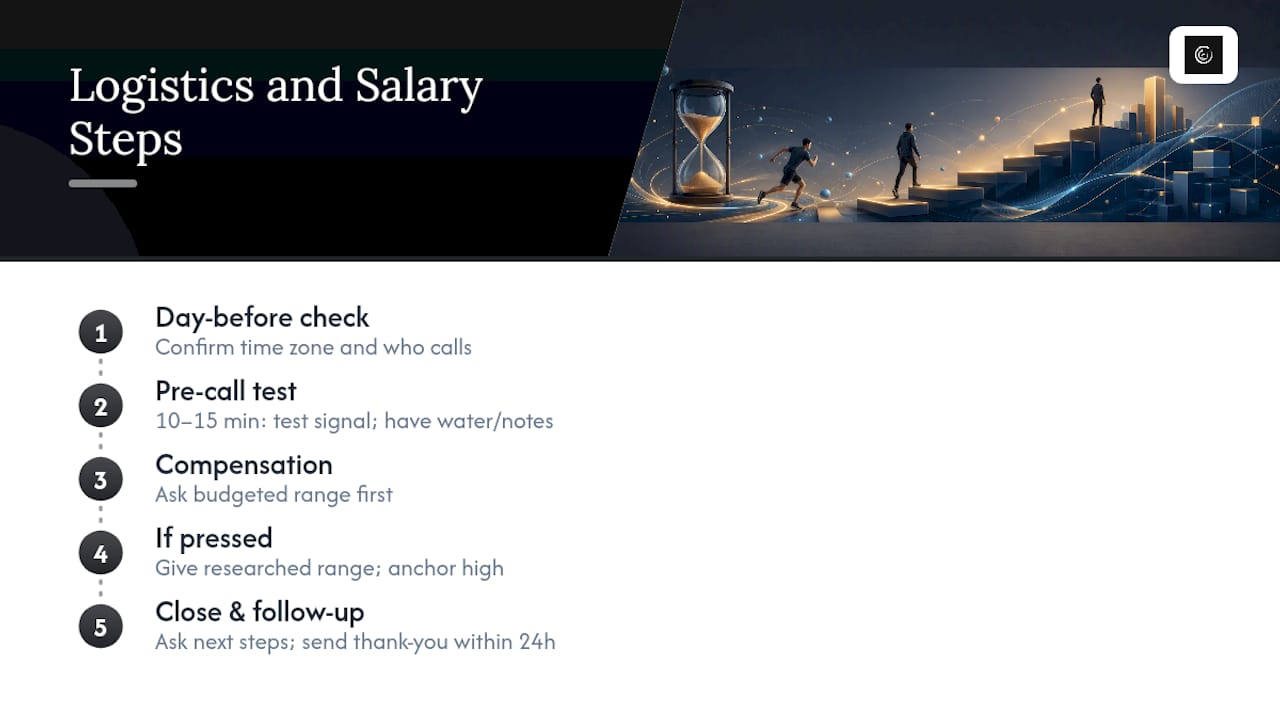
Close the call by asking what the next step looks like and when you should expect to hear back. Send a short thank you note within 24 hours, referencing one specific thing you discussed. That single detail is what makes a follow-up email memorable instead of generic.
What Should You Do in the Last 10 Minutes Before the Call?
- Charge your phone and find a quiet room. Put your phone on Do Not Disturb so a text notification doesn’t derail your train of thought.
- Set your cheat sheet in front of you, printed or on a second screen, along with water.
- If you go silent on a question, pause two or three seconds, then buy time: “That’s a great question. Do you mean X or Y specifically?”
- If the call gets rescheduled, respond within a few hours, confirm the new time and time zone, and thank them for the flexibility.
Why We Built Iteration Around Measurable Practice
Most interview advice tells you what to say. It rarely tells you whether what you said actually worked. Iteration was built on the idea that vague confidence isn’t the goal, measurable improvement is. Reducing filler words, tightening your opener, and calibrating how you phrase a salary range are all things you can track across sessions, not just feel. Run small, frequent practice sessions rather than one long cram, and your vocal stamina and clarity build the same way any repeated skill does.
— Iteration
Try a Ranked Practice Session Before Your Next Call
Iteration turns phone-screen prep into something you can actually measure instead of guess at. Timed voice practice, AI grading on every response, and a full transcript review mean you find out exactly where an answer ran long, went flat, or missed the result statement, not just that it “felt off.”

If you’ve got a call this week, start with a free ranked practice session and see where your current answers actually stand. Want worked examples first? The interview question library has templates for the exact prompts covered above, including how to handle a tough feedback question if it comes up. Either way, the next 20 minutes of practice beats another hour of reading advice.
Sources
- How to Prepare for a Phone Interview: 7 Steps + Questions | Kickresume Blog
- How to Practice Phone Interview Skills Effectively — Scroops