Cut to a 75 Second Answer: Win Product Manager Behavioral Interviews
Cut to a 75 Second Answer: Win Product Manager Behavioral Interviews

Build 5 to 7 decision-first stories, map each one to the STAR+D structure, and drill them under timed conditions until the decision surfaces in the first 15 seconds. That is what separates offers from rejections in 2026 PM loops. Start today: pick your strongest story, cut it to a 75-second answer that leads with the decision, and practice it out loud once before you read another section.
TL;DR:
- Candidates must present decision-first stories with clear alternatives and criteria, emphasizing quantifiable outcomes within 75 seconds for best impact.
- Behavioral signals, especially judgment and leadership, now weigh more heavily than functional knowledge, requiring stories across eight key categories.
- Practicing with timed recordings, structured drills, and AI feedback improves delivery, ensures decision visibility early, and reinforces honest, concise answers.
- It is crucial to tailor stories to the company’s product focus and role context, avoiding generic answers and highlighting experience with bias toward the target role.
- Success depends on honest reflection, avoiding vague outcomes, and demonstrating consistent leadership and decision-making patterns across multiple stories.
Table of Contents
- What to Expect in a Product Manager Behavioral Interview
- Core Behavioral Question Categories Every PM Must Cover
- Answer Frameworks: STAR, STAR+D, and SPSIL
- Six Worked Answers With Line-by-Line Breakdowns
- How to Build a Story Bank of 5 to 7 Reusable Examples
- Delivering the Answer: Pacing, Phrasing, and Follow-Ups
- Leadership Questions: Making Trust Signals Visible
- A 4-Week Practice Plan and Drills That Actually Work
- Where AI-Powered Practice Fits Into This Plan
- Researching the Company and Role Before You Walk In
- Common Pitfalls and Red Flags in Behavioral Answers
- Handling Curveball and Unexpected Behavioral Questions
- Why Judgment Beat Storytelling in 2026 Hiring
- Get Feedback on Your PM Stories Before the Real Interview
- Sources
What to Expect in a Product Manager Behavioral Interview
Most PM loops now run four rounds, and behavioral signals show up in every single one of them, not just a dedicated “culture fit” slot. A typical structure runs recruiter screen, hiring manager case study, an execution and metrics deep dive, and a cross-functional or leadership panel. That four-round shape reportedly closes about nine business days faster than longer loops while surfacing the same hiring signal, which is why more companies have converged on it.
Here is the part most candidates miss: hiring committees no longer treat behavioral and functional rounds as separate buckets. Reviewers increasingly expect at least two behavioral data points across different interviewers before they’ll move a candidate forward, so a strong answer in round two won’t save a weak one in round four.
Panels are scoring against a rubric, whether or not they say so out loud. The common dimensions include:
- Product sense — do you reason from user problems to solutions, or from features backward?
- Execution honesty — do you admit what you measured and what you’d change, or just narrate a win?
- Strategic judgment — can you weigh trade-offs and explain why you picked one path over another?
- Cross-functional pull — do engineers, designers, and sales actually want to work with you again?
- AI product literacy — do you understand how AI features change discovery, delivery, and risk?
This is the real shift behind the “product manager behavioral interview” search term itself. Hiring panels in 2026 weight behavioral signals, especially judgment and leadership, more heavily than raw functional trivia for anyone above entry level. A candidate who can recite a frameworks glossary but can’t narrate one real trade-off decision will lose to someone with fewer credentials and better stories.
Expect the recruiter screen to test motivation and basic fit, the hiring manager round to probe one or two meaty behavioral stories in depth, the execution round to stress-test your metrics and honesty, and the panel round to check whether your leadership instincts hold up under multiple angles.
Core Behavioral Question Categories Every PM Must Cover
You don’t need fifty stories. You need coverage across eight categories, because that’s roughly what any competent interviewer will sample from across a four-round loop. Map your existing experience against this list before you write a single new story.
- Influence without authority — getting an engineering lead, a designer, or a VP of sales to change direction when you have no formal power over them.
- Conflict resolution — a disagreement with a stakeholder, peer PM, or engineering counterpart that you had to resolve without escalating everything to your manager.
- Failure and learning — a launch, feature, or bet that didn’t work, and what you changed as a result.
- Decision under uncertainty — a call you made with incomplete data, and how you managed the risk.
- Prioritization under pressure — trimming scope, sequencing a roadmap, or saying no to a loud stakeholder.
- Product launch or measurable impact — a shipped feature with a before/after number attached to it.
- Data-driven pivots — a moment where the data contradicted your assumption and you changed course.
- Stakeholder management — keeping a difficult executive, customer, or cross-functional partner aligned over time.
Sample prompts you should expect for each:
- Influence without authority: “Tell me about a time you had to convince someone without formal authority over you.” “Describe a decision where engineering disagreed with your prioritization.” “How did you get buy-in from a stakeholder who didn’t report to you?”
- Conflict resolution: “Tell me about a conflict with a peer or stakeholder.” “Describe a time you disagreed with your manager’s direction.” “How did you handle a disagreement that got personal?”
- Failure and learning: “Tell me about a product that failed.” “Describe a decision you’d make differently today.” “What’s the biggest mistake you’ve made as a PM?”
- Decision under uncertainty: “Tell me about a decision you made with incomplete data.” “Describe a bet you took that could have gone either way.” “How do you decide when you don’t have enough signal?”
- Prioritization under pressure: “How do you handle competing priorities and tight deadlines?” “Describe a time you had to cut scope near a deadline.” “Tell me about a roadmap trade-off you had to defend.”
- Product launch and impact: “Walk me through a launch you owned end to end.” “Tell me about a feature you shipped and its measurable outcome.” “Describe your proudest launch and why.”
- Data-driven pivots: “Tell me about a time data changed your mind.” “Describe a metric that surprised you and what you did next.” “How did you validate or kill an assumption with data?”
- Stakeholder management: “Tell me about managing a difficult stakeholder.” “How do you keep an executive sponsor aligned over a long project?” “Describe a time you had to manage up.”
Each category exists on the rubric because it maps to a specific worry the hiring manager has about you. Influence and stakeholder questions test whether you can operate without a title doing the work for you. Failure and data-pivot questions test intellectual honesty; a candidate who has never been wrong is either inexperienced or not telling the truth. Prioritization questions test whether you can disappoint people without losing them. If you want detailed guidance on two of the highest-frequency prompts specifically, the breakdowns on handling competing priorities and talking about a time you failed are worth reading before you draft your own answers.
Answer Frameworks: STAR, STAR+D, and SPSIL
STAR (Situation, Task, Action, Result) is fine for entry-level screens. It falls apart for senior PM roles because it never forces you to explain why you chose the action you took over the other options on the table. An interviewer scoring for strategic judgment cannot tell from a pure STAR answer whether you made a good decision or got lucky.
That’s why practitioner guidance now points toward STAR+D, which bolts a Decision Rationale layer onto the classic structure. The idea is simple: state the alternatives you considered and the criteria you used to pick one, early in the answer, instead of burying that reasoning at the end or skipping it entirely. SPSIL (Situation, Problem, Solution, Impact, Learning) is a close cousin that some coaches prefer for its explicit “Learning” close, which forces you to name what you’d do differently.
Here’s a memorizable micro-template that blends both:
- Decision — one sentence naming the call you made.
- Context — two sentences of setup, no more.
- Alternatives — what else you considered and rejected.
- Criteria — the two or three factors that actually drove the choice.
- Action — what you and your team did.
- Result — the number that proves it worked, or didn’t.
- Lesson — what you’d change or repeat.
Front-load the decision and the result. Interview panels report that candidates who lead with the decision and quantify impact are easier to score and more likely to get a hire recommendation than candidates who bury the outcome under three minutes of setup.
Pro Tip: Say the word “decision” out loud in your first sentence. “The decision I made was to cut the feature two weeks before launch” scores higher than “So this was a really interesting situation where…” even though both answers might contain the same facts.
Six Worked Answers With Line-by-Line Breakdowns
Short, annotated examples teach more than another framework diagram. Here are six compressed answers across the highest-value categories, with the reasoning behind each choice called out.
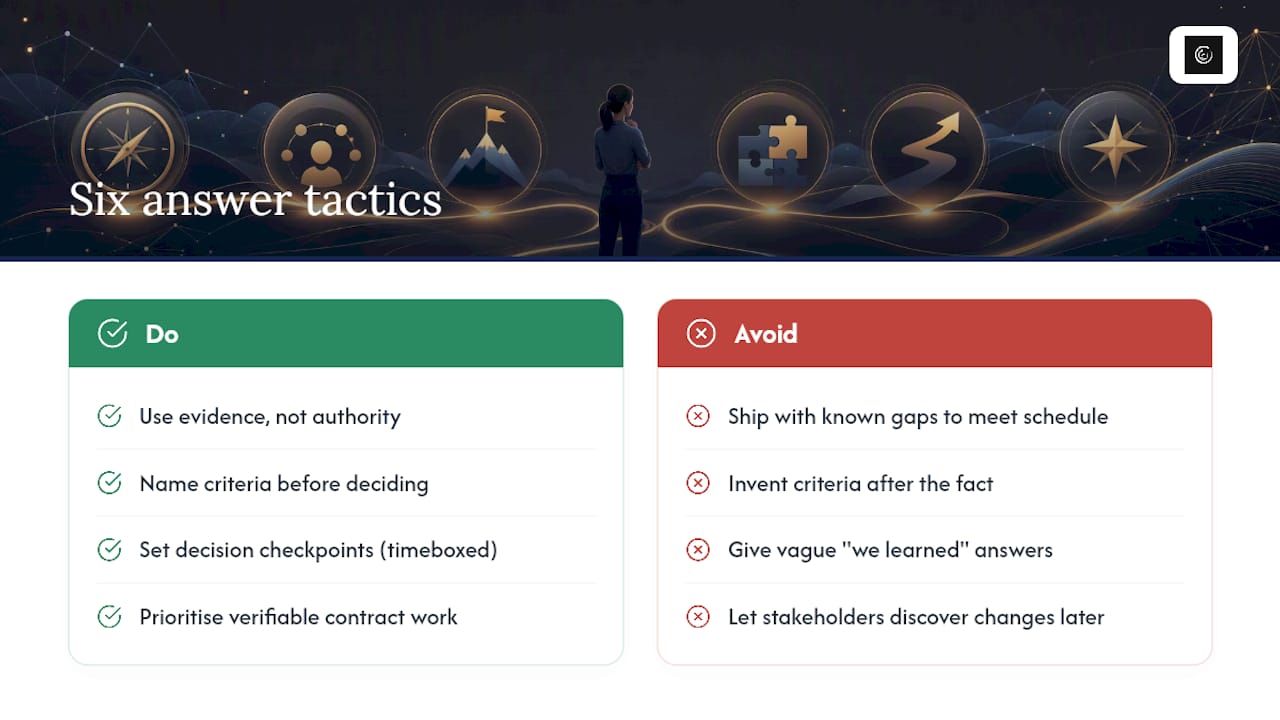
1. Influence without authority. “I decided to delay a launch by one sprint over engineering’s objection. I’d considered shipping on schedule with a known accessibility gap, or cutting a secondary feature to buy time. I chose the delay because our compliance exposure outweighed the sprint-velocity hit. Engineering agreed once I showed the legal risk memo, not just my opinion. We shipped clean, and the delay never came up again in retros.” Decision leads. Alternatives named. Criteria explicit (compliance risk vs. velocity). Evidence, not authority, won the argument.
2. Conflict resolution. “A senior engineer and I disagreed on whether to build a custom notification service or use a vendor. I picked the vendor for time-to-market, even though he wanted to build. We agreed on a six-month cost review as the tiebreaker instead of arguing indefinitely. At six months, vendor costs had crossed our build estimate, so we revisited and built in-house. He respected that I set a real decision point instead of just overruling him.” Notice the criteria was pre-agreed, not invented after the fact. That’s a maturity signal.
3. Failure and learning. “I shipped a recommendation feature that assumed users wanted more personalization. I’d tested two other framings and picked personalization because early survey data favored it. The survey sample turned out to skew toward power users, not the broader base. I rebuilt the sampling method for every test after that.” One weak version of this same story: “We had a feature that didn’t do great, but we learned a lot and moved on.” That sentence has no decision, no number, and no lesson. It tells the interviewer nothing.
4. Data-driven pivot. “I was convinced our churn was priced-driven. The data showed onboarding drop-off was actually three times larger than pricing complaints. I killed the pricing project I’d already pitched to leadership and reallocated the team to onboarding. Ninety-day retention improved measurably. Killing my own pitch was the hardest part, not the pivot itself.”
5. Prioritization under pressure. “Two stakeholders wanted conflicting features for the same release. I chose the one tied to a signed enterprise contract over the one tied to internal analytics goals, because contract revenue was verifiable and time-bound. I told the losing stakeholder directly, in person, with the reasoning, rather than letting them find out from the roadmap doc.”
6. Stakeholder management. “My exec sponsor kept requesting scope changes mid-sprint. I set a standing biweekly review specifically to route his requests into planning instead of into the current sprint. That cut mid-sprint scope changes to near zero within two cycles and he still felt heard because he had a dedicated channel.” Execution honesty shows up here — naming what you measured and what you’d still change is what separates a credible candidate from a polished storyteller.
How to Build a Story Bank of 5 to 7 Reusable Examples
A tight story bank beats a sprawling one. Career guidance built specifically for PMs converges on five to seven versatile stories as the sweet spot: enough to cover every category above without spending weeks memorizing dozens of near-duplicate anecdotes.
- Audit your last two years of work and list every project with a real decision point, not just a task you executed.
- Score each candidate story for three things: does it have a genuine decision, a measurable result, and coverage of a category you’re missing?
- Cut anything without a number. If you can’t quantify the result, either dig for the metric or drop the story.
- Document each story on one page using this template: Decision headline, Context (two sentences max), Alternatives considered, Criteria used, Actions taken, Metric result, Lesson learned.
- Tag each story with 2 to 3 categories it can serve. The onboarding-pivot story above works for data-driven pivots, prioritization, and even failure and learning if the pricing pitch angle gets more airtime.
- Rehearse each story two ways — a 75-second version and a 3-minute version — so you can adapt to how much room the interviewer gives you.
The re-mapping skill matters more than most candidates realize. A single strong story, told with a different emphasis, can answer “tell me about a failure,” “tell me about a data-driven decision,” and “tell me about a hard prioritization call” depending on which paragraph you lead with. That’s the actual efficiency gain of a small story bank over a large one.
Delivering the Answer: Pacing, Phrasing, and Follow-Ups
Say the decision in your first sentence. Everything else is support for that opening line, not a replacement for it. Keep context to two sentences. Use “I” when describing your specific contribution and “we” when describing team execution. Mixing the two without care makes interviewers unsure what you actually did versus what the team did around you.
- Target 75 seconds for a first pass at any behavioral answer.
- Never exceed 2 to 3 minutes, even for your best story.
- If you’re running long, cut context and alternatives first. Never cut the result or the lesson.
- Quantify the result with a real number whenever you have one, even an estimate (“roughly 15%” beats “significantly”).
- When a follow-up probes a weak spot, answer directly rather than pivoting to a stronger story. Interviewers remember dodges more than they remember one honest gap.
Timed recording during practice is not optional if you want to hit these targets consistently. Coaching sources that study PM prep specifically find that timed recordings and stress-testing follow-up questions build more interviewer confidence than memorized scripts, because the candidate sounds prepared rather than rehearsed.
Pro Tip: Record yourself answering the same story three times over three days. If the runtime varies by more than 20 seconds each time, you’re improvising instead of executing a rehearsed structure. Tighten the middle, not the ending.
Leadership Questions: Making Trust Signals Visible
Leadership prompts test four things at once: clarity under pressure, composure when challenged, empathy toward people who disagree with you, and your actual conflict-resolution instinct, not just your conflict-resolution vocabulary. “Tell me about a time you led a team through a hard decision” is really asking, “will people trust this person when it’s hard, not just when it’s easy?”

Pick leadership stories that reveal the same instinct twice, not one heroic outlier. Interviewers explicitly look for consistent patterns across multiple stories rather than a single dramatic rescue mission, because one great story could be luck and three consistent ones can’t be.
Here’s an annotated example:
“A designer and an engineer disagreed publicly about scope in a team meeting. I considered letting them resolve it themselves or stepping in immediately. I chose to pause the meeting, take the disagreement offline, and bring both perspectives back with a proposed compromise the next day. The criteria I used: public escalation was damaging team trust faster than the actual scope disagreement mattered. Both engineers later told me they respected that I didn’t force a decision in the room. That pattern shows up again in how I run every contentious meeting since.”
Notice the follow-up signal built into the last line. It preempts the interviewer’s next question, “do you always handle it this way,” by answering it before they ask. For a longer treatment of this category, the breakdown on leading a team through conflict walks through three more variations.
- Leadership stories should show empathy toward the person you disagreed with, not just your own reasoning.
- Composure means describing the tense moment calmly, not performing calm while describing chaos.
- Always name the follow-up behavior change, not just the resolution.
A 4-Week Practice Plan and Drills That Actually Work
Give yourself four weeks if you can, two at minimum. Compressing the plan below into two weeks means doubling up weeks one and two.
- Week one, story harvest. Draft all 5 to 7 stories using the documentation template from the story bank section. Don’t polish language yet, just get the decisions, criteria, and metrics on paper.
- Week two, record and refine. Record each story at 75 seconds. Cut ruthlessly. Re-record until the decision lands in the first sentence every time.
- Week three, peer mocks. Run at least three mock sessions with a peer who asks real follow-ups, not just the prompt. Note where you got defensive or vague.
- Week four, hiring-committee-style stress test. Simulate the panel round specifically: rapid-fire follow-ups, “what if this had failed,” and requests to quantify results you didn’t originally plan to quantify.
Specific drills worth repeating throughout:
- The 75-second decision-first drill: answer any prompt in exactly 75 seconds, decision in sentence one.
- The alternative-criteria drill: for any story, name two alternatives you didn’t choose and the specific criteria that ruled them out.
- The metrics defense drill: have a partner challenge your number (“how do you know that 4% drop was caused by your change?”) and practice answering without getting flustered.
- The “what if this failed” stress test: for your best story, answer as if the outcome had been negative. This is the single most revealing drill for execution honesty.
Track three things every session: total answer time, a clarity score from your practice partner (1 to 5), and whether decision rationale appeared in the first 20 seconds. A free question generator can help you pull fresh prompts for peer mocks so you’re not just reusing the same five questions every week.
Where AI-Powered Practice Fits Into This Plan
Everything above depends on honest feedback, and that’s the part most candidates skip because it’s uncomfortable to get. Reviewers increasingly use AI-assisted transcription and tagging to flag missing answer components during real interviews, though humans still make the actual hiring call. Practicing with a similar layer of structured feedback before the real thing closes that gap early.
An AI-powered platform can grade recorded or typed answers against categories like decision clarity, named alternatives, stated criteria, and presence of real metrics before the two-minute mark. Instead of guessing whether your onboarding-pivot story actually leads with the decision, you get a structured review that tells you exactly where it drifts into context or skips the criteria entirely.
The targeted drills work off your own weak spots rather than a generic question list, and the ranked practice mode with a live leaderboard adds pressure that a solo rehearsal in front of a mirror never quite replicates. If you already have one story drafted, import it and see where it actually lands.
Researching the Company and Role Before You Walk In
Generic stories read as generic, and interviewers can tell within thirty seconds. The fix isn’t rewriting your stories from scratch for every company; it’s choosing which existing story to lead with based on what the role actually needs.
Start with the job posting itself and underline every verb, not just the nouns. “Own a roadmap across three teams” signals a cross-functional pull question is coming. “Drive experimentation velocity” signals a data-driven pivot story will land better than a pure leadership one.
Read the company’s recent product launches or blog posts for the specific problems they say they’re solving. If a fintech company just wrote about fraud detection, your data-driven pivot story about catching a bad assumption early will resonate more than your prioritization story about a marketing deadline, even if both are equally strong.
Check whether the role is a first PM hire on a team, a replacement, or a growth hire on an established team. A first hire wants to hear about ambiguity and building process from nothing. A replacement wants to hear that you won’t repeat whatever went wrong before, which you can’t know directly, so lean on stories about earning trust quickly in a new team.
Match your STAR+D criteria language to the company’s stated values when it’s genuinely true. Don’t force it. A forced value-drop reads worse than no mention at all.
Common Pitfalls and Red Flags in Behavioral Answers
The most common failure isn’t a bad story. It’s a good story told badly. Watch for these patterns in your own rehearsal recordings.
Leading with context instead of decision. Ninety seconds of backstory before you get to what you actually decided reads as either disorganized thinking or an attempt to bury a weak decision under detail.
No real alternatives. If your answer implies there was only ever one option, interviewers correctly read that as either a lack of self-awareness or a fabricated retelling. Every real decision had at least one credible alternative.
Vague outcomes. “It went really well” is a red flag phrase. If you don’t have a number, say the honest qualitative version (“we didn’t formally measure it, but support tickets dropped noticeably”) rather than inventing false precision.
Team-washing your own contribution. Overusing “we” throughout an entire answer makes it impossible for an interviewer to score you individually. Say “I” for the parts you personally owned.
No lesson or unchanged behavior. If your failure story ends without a specific behavior change, it signals you either didn’t learn anything or aren’t being fully honest about the mistake.
Rehearsed but robotic delivery. Ironically, over-scripting reads as poorly as under-preparing. The fix is practicing the structure, not memorizing exact words.
Handling Curveball and Unexpected Behavioral Questions
Every candidate eventually gets a question they didn’t prep for directly. The move is not to force-fit a prepared story where it doesn’t belong.
First, buy two seconds by repeating the question back in your own words. “So you’re asking about a time I had to change direction based on pushback from someone senior to me” both confirms you understood correctly and gives you a beat to select the right story.
Second, pull from your story bank by category, not by exact phrasing. A curveball like “tell me about a time you were wrong about something important” is really a failure-and-learning prompt wearing a different outfit. If you’ve tagged your stories by category the way the story bank section describes, you can match faster under pressure.
Third, if genuinely nothing fits, say so honestly rather than stretching a mediocre story to cover it. “I don’t have a perfect example of that exact scenario, but here’s the closest situation I’ve faced” is a stronger answer than a forced, awkward fit. Interviewers respect the honesty more than they penalize the imperfect match.
Fourth, when the follow-up genuinely stumps you, it’s fine to think out loud briefly: “Let me think about that for a second” beats filling dead air with filler words. Composure under an unexpected question is itself part of what’s being scored.
Why Judgment Beat Storytelling in 2026 Hiring
The shift toward judgment-focused hiring isn’t a fad panels will abandon next cycle. It reflects a real problem companies had with the old model: polished STAR answers were easy to coach and easy to fake, but they told hiring managers almost nothing about whether a candidate would make good calls under real pressure. Adding a decision rationale layer fixes that, because alternatives and criteria are much harder to fabricate convincingly on the spot than a satisfying narrative arc.
Practicing decision-first stories beats memorizing scripts because memorization breaks under follow-up questions, while genuine understanding of your own reasoning holds up no matter which angle the interviewer probes. Start with one story, track it honestly, and let the feedback loop do the rest.
— Iteration
Get Feedback on Your PM Stories Before the Real Interview
Iteration is the fastest way to find out whether your story actually leads with a decision or just sounds like it does. Every recorded or transcript-based answer gets graded against the same categories this guide walks through: decision clarity, named alternatives, stated criteria, and whether a real metric shows up early enough to count.

Some platforms offer targeted drills built around specific gaps, plus ranked practice modes with live leaderboards to add pressure beyond solo rehearsals. Import your onboarding-pivot answer or your last conflict-resolution story right now and see exactly where it drifts off structure. Start with the free interview review on your strongest story, or browse worked answer examples first if you want to see the target format before you record your own.
Sources
- Cracking Product Management Behavioral Interviews
- PM Interview Behavioral Questions 2026 | Johnny Mai
- Product Manager Interview Questions 2026: 60 That Matter - KORE1
- The Best Product Manager Interview Prep to Land the Offer