The SOAR Method Interview Framework, Explained With Examples
The SOAR Method Interview Framework, Explained With Examples

SOAR is a four-part interview framework, Situation, Obstacle, Action, Result, that structures your answer around a real challenge instead of a routine task. It works because it forces you to name what got in your way and what you did about it, which is exactly the evidence hiring managers say they can’t get from generic answers.
- Situation: the context, role, and timeframe
- Obstacle: the specific challenge or high stakes involved
- Action: the decisions you made and trade-offs you weighed
- Result: the measurable outcome, plus a takeaway
A borrowable opener: “In my last role, our biggest client threatened to walk over a missed deadline. Here’s how I turned that into our strongest renewal that year.”
Key Takeaways
The SOAR method works because naming an obstacle, not just a task, is what lets interviewers see your judgment and measurable impact.
| Point | Details |
|---|---|
| SOAR structure | Situation, Obstacle (or Objective), Action, Result, with Action carrying most of the answer’s weight. |
| Obstacle beats Task | Naming a real challenge signals judgment and strategic thinking, not just assignment completion. |
| Match framework to level | Use STAR for execution-focused, mid-level questions; use SOAR for leadership and ambiguous, high-stakes ones. |
| Quantify or proxy Results | Use a percentage or dollar figure when possible, or a qualitative proxy like retention or satisfaction when it’s not. |
| Practice with feedback | Iterationinterview scores each SOAR element individually so you can drill your weakest part before the real interview. |
Table of Contents
- What Makes the SOAR Interview Method Different From STAR?
- How Do You Write Each Part of a SOAR Answer?
- Should You Use SOAR or STAR for This Question?
- How Do You Build and Practice SOAR Stories Fast?
- What Do Strong SOAR Answers Actually Sound Like?
- What Mistakes Wreck a SOAR Answer?
- How Can You Sharpen SOAR Answers With AI Feedback?
- How Does SOAR Compare to CAR, PAR, and STARL?
- How Do You Adapt SOAR for Phone, Video, and Panel Interviews?
- How Do You Show Soft Skills Inside a SOAR Answer?
- How Do SOAR Answers Change by Industry or Role?
- Why Obstacles Reveal More Than Tasks Ever Could
- Practice Your SOAR Stories With Real Feedback
- Frequently Asked Questions About the SOAR Interview Method
- Sources
What Makes the SOAR Interview Method Different From STAR?
SOAR shares its bones with STAR, but the second letter does the real work. STAR asks about your “Task,” which is often just what you were assigned. SOAR asks about your “Obstacle” (or, in some versions, “Objective”), which is what stood in your way. That one swap moves the story from “here’s what I was told to do” to “here’s the problem I solved.”
Use “Obstacle” when the story centers on a concrete blocker, a budget cut, a broken process, an angry client. Use “Objective” when there wasn’t a single obstacle so much as an ambitious goal you had to architect a path toward, like launching a new market. According to The Interview Guys, the SOAR method emphasizes challenges specifically to showcase problem-solving and impact, which is why it tends to land better with interviewers asking strategic or leadership-behavior questions.
- STAR sentence: “My task was to onboard 12 new hires in Q3.”
- SOAR sentence: “Our team was down two managers heading into our busiest onboarding quarter ever.”
If the interviewer asks “tell me about a time you led through ambiguity” or “describe a strategic decision you made,” that’s your signal to reach for SOAR.
How Do You Write Each Part of a SOAR Answer?
Each element has a job. Do it well, and the whole answer runs 90 to 120 seconds and sounds rehearsed without sounding robotic.
- Situation: One to two sentences. Name your role, the timeframe, and just enough context to orient the listener, nothing more. Aim for 10 to 15 percent of your total answer here.
- Obstacle: Name the actual challenge, what was at stake, and any real constraints (budget, headcount, deadline). Pick obstacles with genuine stakes, not minor inconveniences.
- Action: This is where most of your answer should live. Explain the options you considered, why you picked one path over another, and who you brought in. Interviewers are grading your judgment here, not your task list.
- Result: Quantify it. Percent improved, dollars saved, time cut, customers retained. Close with a one-line lesson or what you’d do differently next time.
Pro Tip: If you don’t have a hard number, use a proxy. “Client satisfaction scores rose” or “the team hit every deadline for the rest of the quarter” both signal impact without a spreadsheet behind them.
A common failure mode is spending 45 seconds on Situation and 10 on Result. Flip that ratio. The interviewer already knows what a “busy retail season” looks like; they don’t know what you decided to do about the short-staffed one you’re describing, or what happened because of your choice.
Should You Use SOAR or STAR for This Question?
The framework you pick should match the question and your level, not personal preference.
- Use STAR when: the role is mid-level and execution-focused, and the interviewer wants to know how you completed something you were assigned. Think “tell me about a project you managed.”
- Use SOAR when: the question touches leadership, ambiguity, or a high-stakes problem where judgment matters more than task completion. Think “tell me about a time you had to make a hard call with incomplete information.”
- Decision rule: ask yourself whether your answer should emphasize the assignment itself (STAR) or the challenge and your initiative in facing it (SOAR).
CV140’s comparison puts it plainly: for many mid-level roles, STAR is the safer, simpler choice, while SOAR better signals leadership and strategic judgment for senior and high-responsibility positions. If you’re interviewing for your first management role or a step up in scope, lean SOAR even on questions that could technically go either way. It’s a chance to show you already think like the next level.
How Do You Build and Practice SOAR Stories Fast?
You don’t need 20 stories. You need 5 to 7 that cover different skills, and you need to rehearse them until they come out clean under pressure.
- Inventory your experience: list every project, conflict, or initiative from the last 2 to 3 years where something went sideways and you fixed it.
- Map each one to S/O/A/R: write one line per element. If you can’t fill in the Obstacle line, it’s probably a STAR story, not a SOAR one.
- Pick your metric: decide now what number or proxy you’ll cite for Result. Don’t leave it vague until you’re in the room.
- Script a 2-minute version, then cut it: write the full answer, then trim ruthlessly until it lands at 90 to 120 seconds spoken aloud.
- Time yourself out loud: reading in your head always feels shorter than it sounds.
Pro Tip: Record yourself on your phone and watch it back once. You’ll catch filler words and a bloated Situation section faster than any amount of silent rereading.
For the drilling itself, Brock University’s career center recommends practicing with timed runs and structured feedback rather than just running through the story in your head. Before you call a story ready, check it against three things: does it show a real decision point, does it end with a number or a clear proxy, and does it sound different enough from your other stories that an interviewer won’t mix them up.
What Do Strong SOAR Answers Actually Sound Like?
Seeing the structure in action makes it easier to copy. Here are two compact examples at different career stages.
Mid-level example (question: “Tell me about a time you improved a process”):
Senior example (question: “Tell me about a tough leadership decision”):
Notice the senior example spends more of its Action section on trade-offs and negotiation, not just tasks completed.
What Mistakes Wreck a SOAR Answer?
Most SOAR answers fail in one of three predictable places, and each has a quick fix.
- Situation runs too long: if you’re 30 seconds in and still setting the scene, stop. Trim to role, timeframe, and one line of context.
- Results stay vague: “it went well” or “the team was happy” tells the interviewer nothing. Use a percentage, a dollar figure, or a specific qualitative outcome (“we retained the account through the next renewal cycle”) instead.
- Action becomes a task list: narrating every step you took (I emailed the team, then I scheduled a meeting, then I sent a follow up) buries your judgment under logistics. Cut to the decision: what were the options, and why did you choose the one you did.
If you catch yourself doing any of these while rehearsing, don’t rewrite the whole story. Fix the one weak element and run it again.
How Can You Sharpen SOAR Answers With AI Feedback?
Rehearsing alone only gets you so far, since it’s hard to hear your own vague Results or bloated Situation. Iteration’s platform scores your SOAR answers element by element, flagging exactly where a response goes soft, whether that’s a Situation that runs too long or a Result with no number attached.
- Paste a full answer or transcript and get scored feedback on each SOAR component
- Run targeted drills aimed specifically at your weakest element
- Re-submit the same story and compare your score against the earlier version
… The loop is simple: submit, see what landed, drill the gap, repeat.
How Does SOAR Compare to CAR, PAR, and STARL?
SOAR isn’t the only alternative to STAR, and knowing where it fits among the others helps you pick the right tool for the right question.
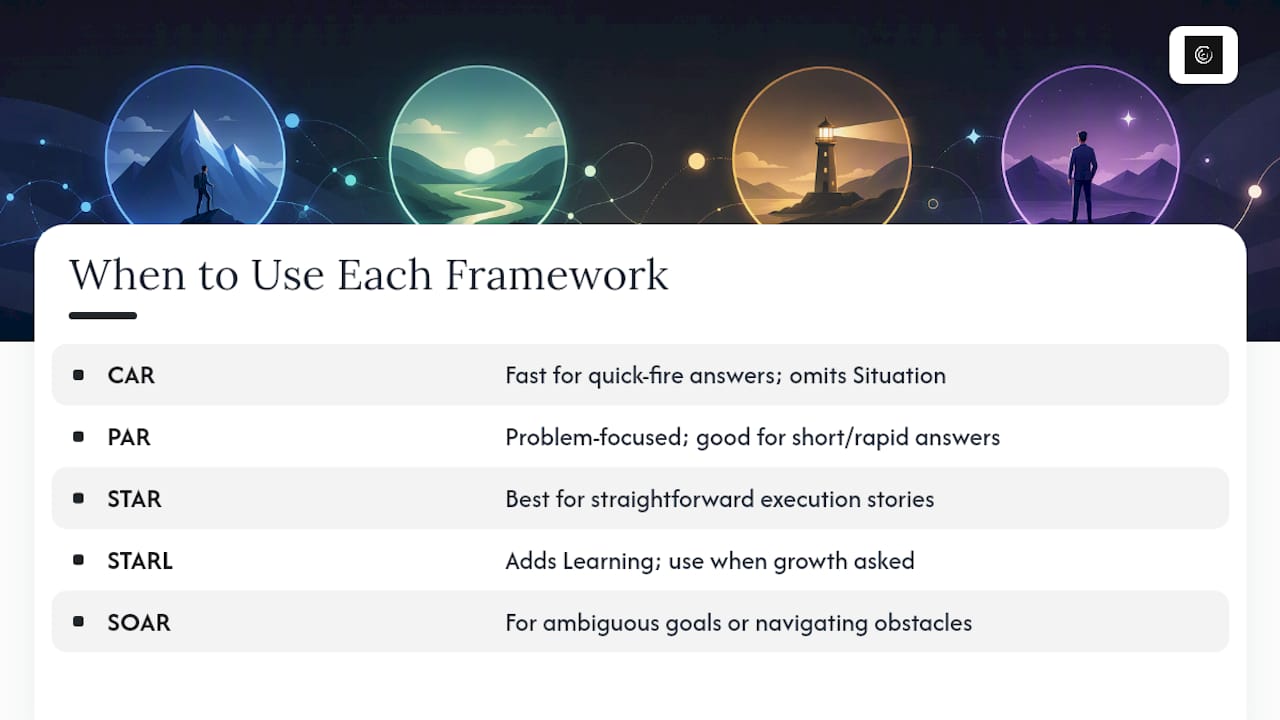
CAR (Challenge, Action, Result) is essentially SOAR without the explicit Situation step. It’s fast and works well for quick-fire interview formats where you need to get to the point in under a minute, but it can leave interviewers without enough context to fully credit your work.
PAR (Problem, Action, Result) is the closest cousin to SOAR. According to a guide from the University of Wyoming’s Haub School, PAR structures concise answers around a problem rather than a broader situation, and it’s especially useful when you need a tight response for a short-answer application form or a rapid-fire panel round rather than a full spoken narrative. Compared to SOAR, PAR skips the strategic framing of “Objective” and jumps straight to the problem, which makes it slightly less suited to leadership stories where the goal itself was ambiguous.
STARL adds a fifth element, Learning, onto the classic STAR structure. It’s a good fit when the interviewer explicitly asks what you’d do differently, but SOAR already builds a takeaway into a strong Result section, so the two frameworks often produce nearly identical answers in practice.
The practical rule: PAR and CAR for speed, STAR for straightforward execution stories, STARL when growth mindset is the explicit ask, and SOAR when the story is about navigating a real obstacle or ambiguous goal.
How Do You Adapt SOAR for Phone, Video, and Panel Interviews?
The structure of SOAR doesn’t change across formats, but your delivery should.
On a phone screen, the interviewer can’t see your face, so your pacing and word choice carry all the signal. Keep Situation especially tight since there’s no body language to fill dead air, and consider numbering your points verbally (“first, the obstacle was…”) so the listener can follow without visual cues.
On video, watch your pacing against the platform’s slight lag. Pause a half-second longer than feels natural between your Obstacle and Action sections so you don’t talk over a delayed response, and keep a printed one-line cue card just off-screen with your key metric for each story.
In a panel interview, multiple people are grading you simultaneously, and different panelists often care about different SOAR elements. A technical panelist may lean into your Action; a hiring manager may care most about Result. Address your answer to the person who asked, but glance around the room during your Result, since that’s the sentence everyone remembers.
Across all three formats, the biggest adaptation is trimming further, not padding. A 120 second answer that works fine in person can feel long on a laggy video call or a crowded panel where five people are watching the clock.
How Do You Show Soft Skills Inside a SOAR Answer?
Soft skills land best when they show up as evidence inside the Action section, not as a claim tacked onto the end. Saying “I’m a strong communicator” adds nothing. Describing how you got a skeptical stakeholder on board during your Action section proves it.
If the strength you want to highlight is collaboration, make sure your Action names who you brought in and how you handled disagreement, not just that you “worked with the team.” If it’s adaptability, let your Obstacle show a plan that had to change, and your Action show how fast you pivoted. If it’s communication itself, the Result is often the best place for it: “I presented the fix to leadership, which led to it being adopted company-wide.”

The mistake to avoid is bolting a soft skill onto your answer as a label (“this shows my leadership”) instead of letting the story demonstrate it. Interviewers trained on behavioral formats will notice the difference immediately, and the labeled version tends to read as less credible than the one that lets the details speak.
How Do SOAR Answers Change by Industry or Role?
The bones of SOAR stay identical across fields, but what counts as a strong Obstacle and Result shifts.
In sales, obstacles often center on a stalled deal or a competitor undercutting price, and results should hit revenue, close rate, or retention numbers directly. In healthcare or clinical roles, obstacles frequently involve resource constraints or patient safety risk, and results are often better framed as outcomes and compliance rather than dollars, patient wait times reduced, error rates lowered. In software engineering, the strongest obstacles involve technical debt, scaling limits, or a production incident, with results measured in uptime, latency, or deployment frequency. In nonprofit or education roles, obstacles usually involve limited budget or staffing, and results should tie to program reach or measurable community impact rather than pure financials.
The one constant: pick the metric your specific industry already uses to judge success, and put it in your Result. A sales SOAR story without a revenue or pipeline number will fall flat, just as a nonprofit story that leads with profit margin will feel off-key. Match your Result to what your interviewer already measures every day.
Why Obstacles Reveal More Than Tasks Ever Could
Naming an obstacle forces you to reveal judgment, not just competence. Anyone can list what they were assigned; fewer people can explain what almost went wrong and how they read the situation. Practicing that distinction repeatedly, and getting feedback on where the story still runs thin, is what turns a good story into a reliable one.
Practice Your SOAR Stories With Real Feedback
Reading about SOAR is one thing. Hearing exactly where your Result goes vague or your Situation runs long is another, and that’s the gap most interview prep never closes. Iterationinterview scores your answers element by element, on the actual words you’d say in the room, then hands you a targeted drill for whichever part of the story is weakest.

Paste in a SOAR story you’re working on, whether it’s the mid-level fulfillment example or your own leadership pivot, and see how it scores across Situation, Obstacle, Action, and Result before you walk into the real interview. You can try it directly with any answer you’re already rehearsing, compare your score after a drill cycle, and know which story to lead with instead of guessing.
Frequently Asked Questions About the SOAR Interview Method
What does SOAR stand for in an interview? SOAR stands for Situation, Obstacle (sometimes Objective), Action, and Result. It’s a behavioral interview framework built to highlight problem-solving and measurable impact.
Is SOAR better than STAR? Neither is universally better. STAR tends to suit mid-level, execution-focused questions, while SOAR better showcases leadership and judgment for senior or ambiguous situations.
How long should a SOAR answer be? Aim for 90 to 120 seconds spoken aloud, with Situation taking roughly 10 to 15 percent of that time and Action taking the largest share.
What’s the difference between Obstacle and Objective in SOAR? Obstacle fits stories with a clear blocker, a budget cut or an angry client. Objective fits stories built around an ambitious goal without one single obstacle, like launching a new product line.
Can I use SOAR if I don’t have exact numbers for my Result? Yes. Use a qualitative proxy tied to business impact, like a renewal, an adoption rate, or a satisfaction improvement, when you don’t have a hard percentage or dollar figure.
Sources
- The SOAR Method: A Strategic Framework for Behavioral Interview Questions That Makes STAR Look Outdated - The Interview Guys
- A definitive guide to the PAR method with examples
- SOAR Technique for Job Interviews - CareerZone Brock University
- STAR vs SOAR Method: Which CV Framework Should You Use? | CV140