STAR Method Examples for Every Kind of Behavioral Interview
STAR Method Examples for Every Kind of Behavioral Interview

STAR stands for Situation, Task, Action, Result. The Action section should take the most time in your answer because that is what interviewers actually judge: not what happened to you, but what you did about it.
Here’s a ready-to-adapt example, weighted the right way:
- Situation/Task (one sentence): “Our support team was missing its response-time target by 40%, and I was asked to fix it.”
- Action (the bulk of your answer): “I audited our ticket queue, found that 60% of delays came from misrouted tickets, built a tagging system in our helpdesk tool, and trained the team on it over two weeks.”
- Result: “Average response time dropped from 14 hours to 6 hours within a month, and the fix became the team’s standard process.”
Pro Tip: Start your answer with the Result’s stakes in mind, not the backstory. If you can’t explain in one sentence why the situation mattered, cut it down further.
Key Takeaways
The strongest STAR answers spend roughly 60% of their time on Action, name a personal decision point, and close with a quantified Result.
| Point | Details |
|---|---|
| Weight Action heaviest | Aim for roughly 10% Situation, 10% Task, 60% Action, 20% Result in a 90 to 120 second answer. |
| Quantify every Result | Add a percentage, dollar figure, or time saved; use a specific qualitative outcome only when no number exists. |
| Prepare five to seven stories | Cover conflict, failure, leadership, persuasion, initiative, pressure, and a major accomplishment. |
| Fix “we” language | Replace group verbs with “I” statements to make your personal contribution clear. |
| Practice with graded feedback | Iterationinterview highlights the exact sentence where your Action or Result section goes vague, then drills that weak spot. |
Table of Contents
- What Situation, Task, Action, and Result Actually Mean
- Making Action and Result Sound Like You Actually Did Something
- Eight Stories Worth Preparing Before Any Interview
- Six STAR Examples You Can Adapt Right Now
- Adapting a Prepared Story to a Question You Didn’t Expect
- Practicing Until Your Timing and Wording Hold Up
- Building a Practice Routine That Actually Sticks
- Tailoring STAR Answers to the Job You’re Actually Interviewing For
- Delivering STAR Answers on a Video or Phone Call
- When a Question Doesn’t Fit the STAR Structure
- Weak vs. Strong: The Same Story, Two Ways
- What Fast, Honest Feedback Does for Your STAR Answers
- Practice Your STAR Answers With Immediate, Specific Feedback
- Sources
What Situation, Task, Action, and Result Actually Mean
Situation sets the scene: where you were, what team, what context. Task names your specific responsibility or the problem you were asked to solve. Action is the sequence of decisions and steps you personally took. Result is the measurable outcome, plus what you learned.
The time split matters more than most candidates realize. A rough allocation that works well in a 90 to 120 second answer looks like this:
- Situation: 10% of your answer
- Task: 10%
- Action: 60%
- Result: 20%
That weighting isn’t arbitrary. The STAR framework exists specifically because interviewers use the Action portion to evaluate execution and decision-making — it’s the only part of the story that’s actually about you, not your circumstances. Most candidates do the opposite: they spend 45 seconds setting up the Situation and then rush a vague Action in ten seconds. Trim the backstory to what’s needed to understand the stakes. Everything else, including team politics or company history, gets cut.
Making Action and Result Sound Like You Actually Did Something
Vague actions kill good stories. “I worked with the team to improve the process” tells an interviewer nothing about what you contributed. Strong Action sections read like a sequence of decisions, not a summary of activity.
Here’s how to fix a weak Action section, step by step:
- Replace group verbs with personal ones. Swap “we decided” for “I proposed” or “I identified.” If three people worked on it, name your specific slice.
- Break the action into a short sequence. First I did X, then Y, then Z. Chronology makes the answer easy to follow and proves you weren’t improvising.
- Name a decision point. What did you consider and reject? Interviewers read judgment into trade-offs more than into outcomes, since showing sequencing and trade-offs is what separates a strong Action section from a generic one.
- Attach a number to the Result. Percentage change, dollar amount, time saved, headcount affected. If you truly can’t quantify it, describe the qualitative shift specifically (a client renewal, a policy adoption, a promotion).
- Add one sentence of reflection. What would you do differently, or what did this teach you about your own working style?
Pro Tip: If your Action section doesn’t include at least one number or one specific tool/method name, it’s still too vague. “I built a tracking spreadsheet” beats “I improved our tracking.”
Eight Stories Worth Preparing Before Any Interview
You don’t need a new story for every question. You need five to seven flexible ones that map to most competencies asked. Career-center guidance consistently points to a small set of versatile stories rather than a new invention for each prompt, since the same accomplishment can usually answer several different questions with a small reframe.
Prepare one story for each of these:
- Conflict — disagreement with a coworker, manager, or client you resolved productively
- Failure — a mistake you owned and what changed afterward
- Leadership — a time you guided others without necessarily having the title
- Persuasion — convincing a skeptical stakeholder or team to change direction
- Initiative — something you started without being asked
- Pressure — a tight deadline or high-stakes moment you handled
- Adaptation — adjusting to a sudden change in scope, tools, or team
- Major accomplishment — your single best measurable win
For each one, pick the metric before the interview, not during it. If you don’t have a number, decide now what qualitative evidence you’ll use instead.
Six STAR Examples You Can Adapt Right Now
1. Leadership (early career)
Situation/Task: As a junior analyst, I noticed our weekly reporting process took each team member roughly three hours, with no one owning the fix.
Action: I mapped where time was lost, proposed a shared template to my manager, built it in a shared spreadsheet, and ran a 15-minute walkthrough for the four analysts using it.
Result: Reporting time dropped to about 45 minutes per person per week, and my manager asked me to own the template going forward.
Annotation: This works because a junior employee took initiative without waiting for authority, and the fix is measurable in hours, not adjectives.
2. Teamwork
Situation/Task: Two departments were duplicating work on the same client onboarding checklist, causing delays.
Action: I set up a joint 30-minute meeting, identified the overlap, and proposed a single shared checklist with clear ownership per section.
Result: Onboarding time fell by a third, and the checklist became the standard across both teams.
3. Problem solving (senior level)
Action: I pulled session recordings, isolated the drop-off to a confusing currency toggle, ran two rapid A/B tests on redesigned copy, and pushed the winning version within a two-week sprint.
This is what interviewers mean by “showing your work”: the candidate names the diagnostic step, the test, and the number, not just the outcome.
4. Failure
Situation/Task: I promised a client a feature delivery date without confirming engineering capacity.
Action: When the timeline slipped, I told the client immediately instead of waiting, proposed a revised date with a partial early delivery, and built a capacity-check step into my own process going forward.
Result: The client stayed, and I never missed a committed date again over the following year.
5. Conflict
Situation/Task: A senior colleague repeatedly dismissed my data in planning meetings.
Action: I asked for a one-on-one, brought the data with clear visuals, and asked directly what would make the analysis more credible to them.
Result: They became one of my strongest advocates on the next three projects.
6. Data-driven recommendation
Situation/Task: Leadership was deciding whether to renew a $50,000 vendor contract.
Action: I built a usage report showing adoption by team, cross-referenced it against support tickets, and presented a recommendation to downgrade rather than renew in full.
Result: The company saved $18,000 annually, and the report became the template for future vendor reviews.
Adapting a Prepared Story to a Question You Didn’t Expect
Use a simple mapping method: identify the competency being asked (leadership, conflict, initiative), pick your closest prepared story, then adjust only the framing sentence at the start.
- If the question asks about “influencing without authority,” your leadership story still works, but reframe the Situation as “I had no formal authority over this team, but…”
- If asked about failure and you only prepared a conflict story, look for the moment inside it where you were wrong about something, even briefly.
- Prepare answers to the two most common follow-ups in advance: “Why did you choose that approach?” and “What would you do differently?” Interviewers frequently push on both of these, so having a one-sentence answer ready keeps you from freezing.
Practicing Until Your Timing and Wording Hold Up
Three drills work better than reading examples over and over: timed answers against a stopwatch, record-and-review where you watch your own delivery back, and peer mocks where someone else pushes follow-up questions.
Aim for 90 to 120 seconds per answer, with Action taking up the majority of that window, since practice built around timed answers and review is what tightens the Action section and keeps responses in that range.
- Record yourself answering one question cold, then check: did Situation eat more than 20 seconds?
- Rewrite any sentence using “we” into “I,” unless you’re explicitly describing shared outcomes.
- Check your Result line for a number. If there isn’t one, add a specific qualitative outcome instead.
Pro Tip: Pasting a written answer into a tool built for grading interview responses surfaces the exact sentence where your Action goes vague, faster than a friend reading it once will.
Building a Practice Routine That Actually Sticks
Preparing stories is only half the work. The other half is repetition spaced out enough that your delivery stays natural instead of memorized. A common mistake is writing out five perfect stories and never saying them aloud until the actual interview, which produces answers that sound read rather than spoken.

A workable cadence: draft your five to seven stories over one sitting, then practice one story aloud per day for a week, rotating so you hit all of them at least twice before any interview. Recording yourself matters more than most people expect. Hearing your own filler words (“um,” “so basically,” “kind of”) is far more effective than trying to catch them in the moment.
Keep a simple worksheet with four columns: Story name, Competency it covers, one line of Situation/Task, and your quantified Result. When a new job posting lists its core competencies, run down your worksheet and confirm you have at least one story per competency before the interview. If you’re missing one, that’s the story to build next, not something to improvise on the spot.
Revisit and update your stories every few months, especially after a new project wraps. The best stories tend to be recent enough that details stay vivid, but far enough in the past that you can speak about them with perspective rather than raw frustration.
Tailoring STAR Answers to the Job You’re Actually Interviewing For
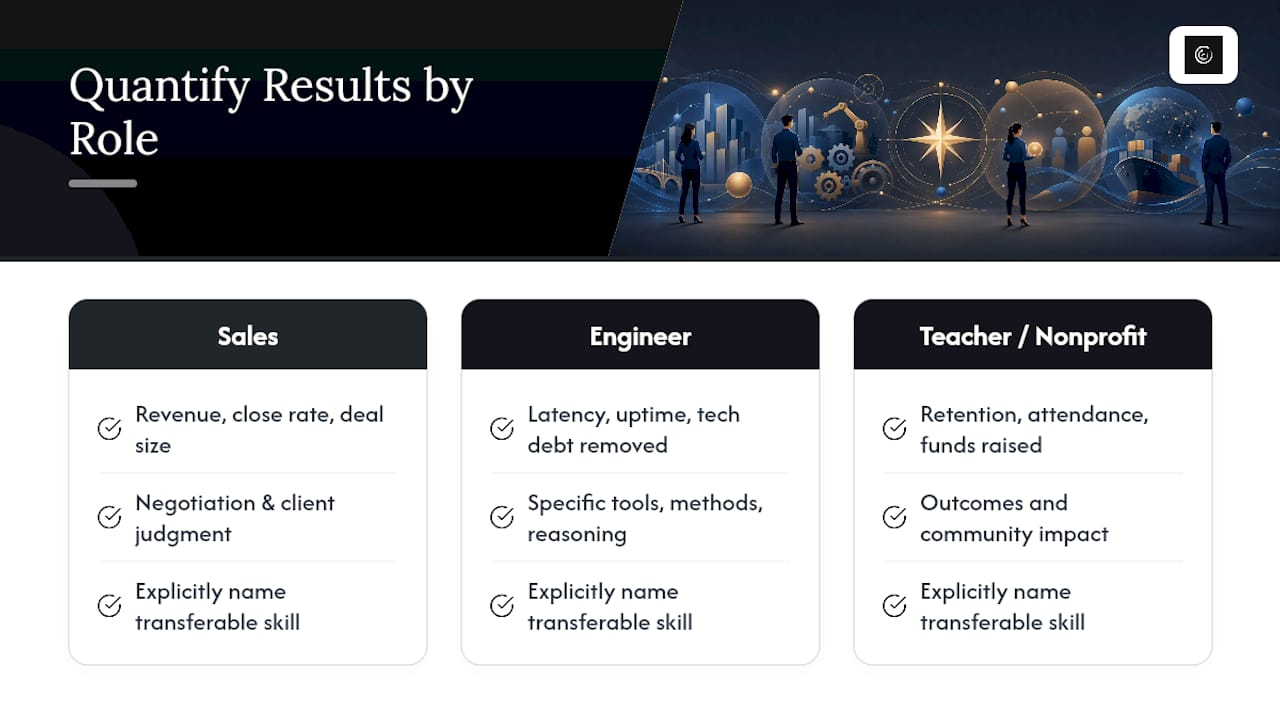
The structure of STAR doesn’t change by industry, but what counts as a strong Result does. A sales candidate should quantify in revenue, close rate, or deal size. An engineer should quantify in latency, uptime, or lines of technical debt removed. A teacher or nonprofit worker should quantify in outcomes like retention, attendance, or funds raised, since dollar figures aren’t always available or appropriate.
For technical roles, interviewers often want more granularity in the Action section: which specific tool, which specific method, which specific line of reasoning led to a fix. For client-facing or leadership roles, the Action section should show more judgment calls involving people, not just process.
If you’re switching industries, pick stories where the underlying skill transfers even if the setting doesn’t. A retail shift lead’s story about de-escalating an angry customer maps directly onto a “conflict” competency question in a corporate interview, even though the industries look nothing alike. Name the transferable skill explicitly in your Result or reflection line so the interviewer doesn’t have to make that connection themselves.
Startups and small companies tend to value initiative and scrappiness stories more heavily. Larger, more structured companies often want to see how you operated inside a process, not just around one. Read the job posting’s language closely. If it repeatedly says “cross-functional,” prepare a teamwork story that spans departments, not just your immediate team.
Delivering STAR Answers on a Video or Phone Call
Virtual interviews strip away some of the cues you’d normally rely on, like a nod that tells you to wrap up the Situation. Without that feedback, candidates tend to run long on setup and never make it to a strong Result before the interviewer moves on.
A few adjustments help. Keep a printed or on-screen version of your story worksheet just out of camera view, with only the competency name and one keyword per story, not full scripts. Reading a full script off-screen makes your eyes drift in a way that’s obvious on video.
On phone interviews, silence reads differently than in person. A two-second pause to organize your Action section can feel like dead air to the interviewer even though it’s normal thinking time. Say “let me walk you through how I approached that” to fill the gap naturally while you organize your thoughts.
Audio and video lag can also cause interviewers to interrupt right as you’re transitioning from Task to Action. If that happens, don’t restart the whole story. Say “to pick back up, the main thing I did was…” and go straight into Action. That recovery line alone signals composure, which matters more on camera than it does in a conference room where body language fills in the gaps.
When a Question Doesn’t Fit the STAR Structure
Not every behavioral question maps cleanly onto Situation, Task, Action, Result. Questions like “what’s your biggest weakness” or “how do you handle ambiguity in general” ask for a pattern across situations, not one story.
For pattern questions, use a compressed version: state the pattern in one sentence, then illustrate it with a single short example instead of a full four-part story. “I tend to over-prepare for meetings. For example, on a recent client call, I brought three backup data cuts nobody asked for. I’ve since started asking beforehand exactly what the room needs.”
For hypothetical questions (“what would you do if…”), you can still borrow STAR’s shape by drawing on a real past situation that’s close enough, then explicitly noting the parallel: “I haven’t faced that exact scenario, but something close happened when…” This keeps your answer grounded in real judgment instead of speculation.
If a question is genuinely too broad, ask a clarifying question before answering. “Are you asking about a technical decision or a people decision?” costs you five seconds and saves you from picking the wrong story entirely.
Weak vs. Strong: The Same Story, Two Ways
Weak version: “We had a project that was behind schedule, so we all worked really hard and pulled together and eventually we got it done and the client was happy.”
That answer has no Task ownership, no specific Action, and a Result with no number. An interviewer walks away knowing nothing about what this candidate actually contributed.
Strong version: “I was the lead on a client deliverable that was two weeks behind. I broke the remaining work into three tracks, took on the most technical piece myself, and reassigned a stuck teammate to a task better suited to their strengths. We shipped six days later than original schedule instead of the projected three weeks late, and the client renewed their contract the following quarter.”
Same underlying situation, completely different level of evidence. The strong version names a specific action (breaking work into tracks, reassigning based on strengths), owns a personal contribution, and closes with two concrete results. That’s the gap between an answer that gets forgotten and one that gets a callback.
What Fast, Honest Feedback Does for Your STAR Answers
Most candidates don’t know their Action section is vague until someone points it out, and by then it’s often the real interview. Grading your own delivery is hard. You know what you meant to say, which makes it nearly impossible to hear what you actually said.
Iterationinterview’s approach pairs graded practice rounds with targeted drills built from your specific weak responses, so instead of guessing which story needs work, you get pointed at the exact sentence where the Result went soft or the Action stayed too general.
— Iteration
Practice Your STAR Answers With Immediate, Specific Feedback
Reading examples gets you halfway there. The harder part is knowing whether your own version of a leadership or conflict story actually lands, and generic AI chat prompts tend to give you the same polished, forgettable feedback no matter what you paste in.

Iterationinterview grades your answer against what interviewers are actually listening for, then builds drills around your specific weak spots instead of handing you a generic rewrite. You can try a timed practice round right now with one of your prepared stories, or paste a full answer in for instant, structured grading on your Action and Result phrasing. If you’ve relied on ChatGPT for interview prep before, see how a purpose-built grading tool compares before your next round. Start with one story, get the feedback, and fix the sentence that’s actually holding your answer back.