Star vs Car Method: Which Wins Your Next Interview?
Star vs Car Method: Which Wins Your Next Interview?

Use CAR when the question wants a quick, results-focused answer. Use STAR when it demands context or process. That is the whole decision in one sentence, and most interview stress comes from not knowing which one the moment calls for.
Two cues tell you fast: if the interviewer asks “give me an example,” lean CAR. If they ask “walk me through,” lean STAR. Watch the clock too, since panel interviews often budget one question per five minutes and a rambling answer eats your next chance to shine.
-
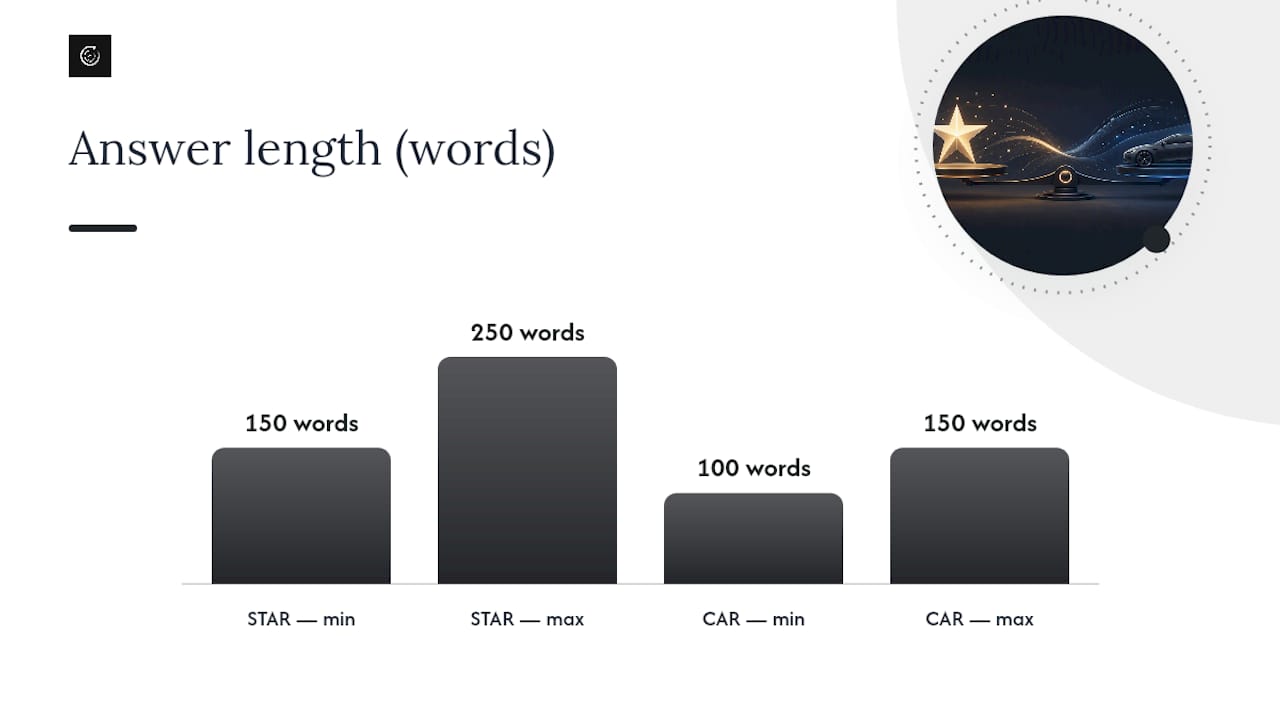
CAR: about 1 to 2 minutes, roughly 100 to 150 words about 100 to 150 words
-
STAR: about 2 to 3 minutes, roughly 150 to 250 words about 150 to 250 words
-
Interviewer says “briefly” or “give me an example”: start with CAR
-
Interviewer says “tell me about a time” or “walk me through”: lead with STAR
Key Takeaways
The right interview framework depends on the question’s scope: CAR wins on speed and impact, STAR wins on context and complexity, and switching between them mid-interview signals real adaptability.
| Point | Details |
|---|---|
| Match format to the ask | Use CAR for “briefly describe” prompts and STAR for “walk me through” prompts. |
| Respect the clock | Target 1 to 2 minutes for CAR and 2 to 3 minutes for STAR responses. |
| Bridge when unsure | Open with CAR, then offer to expand into STAR detail if the interviewer wants more. |
| Add tradeoffs at senior levels | Director-level rounds often expect reasoning, not just outcomes, so consider PARADE or PAR. |
| Practice with structured feedback | Iterationinterview’s timed practice and AI review flag over-polish and missing metrics before a real interview does. |
Table of Contents
- Star Vs Car: What Star Actually Requires
- Star Vs Car: What Car Compresses
- Star Vs Car: A Side-By-Side Comparison
- How Do You Choose Between Star And Car Mid-Interview?
- Fill-In Templates You Can Practice Today
- What Do Good Car And Star Answers Sound Like?
- A Two-Week Plan To Build Timing Instinct
- Why Flexibility Beats Picking One Framework
- Practice Star And Car Answers With Real Feedback
- Frequently Asked Questions
- Sources
Star Vs Car: What Star Actually Requires
STAR stands for Situation, Task, Action, Result, and each letter earns its place in a full behavioral answer. The Situation sets the scene in one or two sentences. The Task names your specific responsibility, not the team’s. The Action is where most of your time goes, because it shows how you think under pressure. The Result closes with a measurable outcome, ideally a number.
A working example: you’re asked about a time you resolved a conflict on a team. Situation: two engineers disagreed on architecture two weeks before launch. Task: you were the lead responsible for the decision. Action: you ran a 30-minute tradeoff session, documented both options, and picked based on maintenance cost. Result: launch stayed on schedule and the chosen approach cut deployment time by 40%.

STAR’s strength is context. It shows collaboration, judgment, and process, which matters for roles where how you work is as important as what you shipped. Government hiring guidance treats STAR and CAR as the two dominant behavioral frameworks precisely because STAR’s extra Task step gives interviewers fuller context before judging the outcome. The risk is rambling. A Situation that runs 45 seconds before you’ve said a single action is what recruiters call “theatre of polish,” where the story sounds rehearsed but says little about your actual contribution.
Pro Tip: Cut your Situation to one sentence. If you need more than that to set the scene, the interviewer will ask a follow-up. Answering the follow-up shows more skill than front-loading detail nobody asked for.
Star Vs Car: What Car Compresses
CAR stands for Context, Action, Result, and it folds STAR’s separate Task step into a single Context sentence. Instead of setting up Situation and Task as two beats, you name the challenge and your role in one breath, then move straight to what you did.
A CAR answer for “tell me about a result you’re proud of” might run: Context, our support queue backlog hit 300 tickets and I owned resolution time. Action, I built a triage script that auto-tagged tickets by urgency and reassigned overflow to underused reps. Result, average resolution time dropped from 26 hours to 9 within a month.
CAR’s edge is speed. The compact three-step structure works well for rapid-fire interview rounds or when a recruiter specifically asks for a brief example. It puts the outcome front and center instead of making the interviewer wait for it.
- Best for: quick-turnaround questions, phone screens, panel rounds with tight timing
- Main risk: it can flatten genuinely complex situations into something that sounds simpler than it was
Pro Tip: Add one clause of context, like “on a team of three with no dedicated designer,” right after your Challenge line. It costs five seconds and prevents the interviewer from misjudging the difficulty of what you pulled off.
Star Vs Car: A Side-By-Side Comparison
| Factor | STAR | CAR |
|---|---|---|
| Best for | Complex projects, leadership, conflict resolution | Quick results, phone screens, rapid rounds |
| Typical length | 2 to 3 minutes, 150 to 250 words | 1 to 2 minutes, 100 to 150 words |
| Context required | High, separate Situation and Task | Moderate, folded into one Context line |
| Strengths | Shows process, collaboration, judgment | Shows impact fast, respects the clock |
| Main risk | Rambling, sounds over-rehearsed | Can underplay real complexity |
| When to prefer | Interviewer asks “walk me through” or seniority is high | Interviewer asks “briefly” or time is short |
Watch for red flags mid-answer. If the interviewer starts checking notes or glances at the clock while you’re still in your Situation, cut to CAR mode immediately. If they lean in and ask “what made that hard,” that’s your cue to expand into full STAR detail on the next question.
How Do You Choose Between Star And Car Mid-Interview?
Rank these signals in order when you’re deciding, because they conflict more often than you’d think:
- Listen to the interviewer’s exact wording. “Briefly describe” beats every other signal and means CAR.
- Check the time allotted for the question. Under two minutes signals CAR; open-ended time signals STAR.
- Weigh the complexity of the story itself. A single clean win fits CAR; a multi-stakeholder project needs STAR’s room.
- Factor in seniority. Director-level and above interviews often expect the reasoning behind decisions, not just outcomes, which favors STAR or a heavier framework.
Red flags that mean “add more context”: the interviewer asks “why did you choose that approach” or “what were the alternatives.” Red flags that mean “cut to the chase”: visible time pressure, a stated question limit, or a interviewer who says “just the headline is fine.”
One bridge technique works in almost every ambiguous case: open with a CAR-length answer, then say “happy to go deeper on any part of that.” If they push on the reasoning, expand into STAR live. Skip this bridge only when the question explicitly demands full narrative detail up front, since starting compressed there can read as dodging the question.
Fill-In Templates You Can Practice Today
Copy these and swap in your own details. Keep the bracketed language conversational, not corporate.
Compact CAR template: “[Situation] created [specific problem]. I was responsible for [your role]. I [specific action], which resulted in [metric or outcome].”
Fuller STAR template: “In [role/project], we faced [situation]. My task was [specific responsibility]. I [step one action], then [step two action], while managing [tradeoff or constraint]. That resulted in [measurable outcome].”
Bridge template (CAR expanding to STAR): “[Compact CAR answer]. If it’s useful, I can walk through how I weighed [tradeoff] before landing on that approach.”
- Insert your strongest metric in the Result slot, not buried mid-answer.
- Name your actual title or role explicitly rather than saying “we.”
- Add one tradeoff phrase (“I chose speed over full test coverage because…”) if the role is senior or the environment is resource-constrained.
Pro Tip: Read your template out loud before an interview. If it sounds like something you’d hand someone in writing rather than say to a friend, rewrite it until it doesn’t.
What Do Good Car And Star Answers Sound Like?
As the product lead, I ran five user interviews, found the signup form was the drop-off point, and cut it from nine fields to four.
STAR example (about 2.5 minutes): Walks through a cross-team migration where the Situation covers a legacy system sunset, the Task names the candidate as technical lead, the Action details three stakeholder alignment meetings and a phased rollout plan, and the Result reports zero downtime across the switch.
- The CAR sample works because the metric appears twice, at baseline and after.
- The STAR sample earns its length because the stakes (a legacy sunset) justify the extra setup.
- Notice neither example uses filler transitions like “so basically” or “and then what happened was.”
A Two-Week Plan To Build Timing Instinct
Timing sense comes from repetition, not memorization. Behavioral frameworks are built for spoken delivery, and research on interview prep confirms that spoken pacing runs differently than written pacing, so reading your answer silently won’t tell you if it runs long.
- Days 1 to 3: record yourself answering five common prompts using CAR only, timing each one.
- Days 4 to 7: repeat with STAR, aiming for 2 to 3 minutes without a script in hand.
- Days 8 to 10: pair with a friend or mentor and practice switching formats based on their follow-up cues.
- Days 11 to 14: run mixed drills where you don’t know which format the question demands until you hear it.
Track four things every session: total time, whether your metric landed clearly, whether you disclosed any tradeoff, and whether your delivery sounded rehearsed. A platform that grades your recorded answers against these exact criteria catches over-polish faster than self-review, since it’s hard to hear your own rambling in real time.
Why Flexibility Beats Picking One Framework
Neither format wins outright. For those preparing for senior roles, taking a leadership style test can help identify the best frameworks to apply in advanced decision-making scenarios. The strongest candidates treat STAR, CAR, and even more advanced structures like PARADE as a toolkit, choosing based on the question in front of them rather than a favorite format memorized in advance.
In high-constraint environments, add a one-line tradeoff disclosure. Interviewers now expect it. For director-level rounds, PARADE or PAR often outperforms STAR because it forces you to explain the reasoning behind a decision, not just the sequence of events.
Practice Star And Car Answers With Real Feedback
Reading templates only gets you so far. The gap between knowing the STAR structure and delivering it smoothly under a ticking clock is exactly where most candidates lose points, and that gap is hard to see in your own head.
Iterationinterview grades your timed, on-camera or mic answers against the same criteria this guide covers: whether your metric landed, whether your tradeoff got disclosed, and whether your pacing matched a CAR or STAR structure without rambling. Instead of guessing whether your Situation ran too long, you get a structured review that flags it directly, plus drills built from your own weak spots rather than generic prompts. If you’re deciding between practicing alone or getting a second opinion, an AI-graded review shows you exactly where a real interviewer would have zoned out. Paste your last answer or start a timed practice round and see how your current STAR or CAR delivery actually scores.
Frequently Asked Questions
Is CAR just a shorter version of STAR? Mostly, yes. CAR folds STAR’s separate Task step into one Context sentence, which is why it runs shorter, typically 100 to 150 words versus STAR’s 150 to 250.
Which method do interviewers actually prefer? Neither universally. Government hiring guidance treats both as standard, and the better move is matching the format to the question’s wording rather than guessing a house preference.
Can I use STAR and CAR in the same interview? Yes, and doing so deliberately shows range. Start compressed with CAR on quick questions, then shift to full STAR when a question invites more depth.
What if I run out of time mid-STAR answer? Skip straight to the Result. A clear outcome delivered late beats a Situation and Task that never reach a payoff.
Are there frameworks beyond STAR and CAR for senior roles? Yes. PARADE and PAR are increasingly recommended for mid-to-senior interviews because they require explaining tradeoffs and rationale, not just the sequence of events.
Sources
- STAR interview technique — UCD Professional Academy
- STAR® and CAR techniques — Government Digital and Data Hub
- How to use the CAR interview method — Indeed Career Guide