30–60 Second Interview Stories Job Seekers Can Use to Win Offers
30–60 Second Interview Stories Job Seekers Can Use to Win Offers

Tell short, evidence backed stories, thirty to sixty seconds long, built on situation, action, and result. That single change makes an answer memorable and hard to argue with. A good interview story proves a skill with concrete examples, gives the interviewer something memorable, and often prompts a follow-up question, which is a positive sign. The rest of this piece covers the frameworks, the editing steps, and the practice routine that get you there.
TL;DR:
- Keep interview stories to 30 to 60 seconds, focusing on a specific situation, action, measurable outcome, and a key insight for maximum impact.
- Use frameworks like STAR or narrative arc depending on the question type and seniority, tailoring each story to highlight concrete results or learning.
- Prioritize forming a small, competency-based story bank of eight to ten well-crafted anecdotes that prove key skills and experiences for the target role.
- Practice delivering stories aloud, recording, and grading them with timed feedback to ensure clarity, brevity, and effective storytelling under pressure.
- Incorporate sensory details, tension, and tone variations to make stories memorable, while avoiding vague outcomes, team-focused language, or over-rehearsed scripts.
Table of Contents
- Why Storytelling in Interviews Beats a List of Facts
- Which Storytelling Framework Should You Use?
- How to Pick and Prioritize Your Interview Stories
- The 30 to 60 Second Story Recipe, Step by Step
- Six Annotated Sample Answers You Can Adapt
- How to Practice Until It’s Automatic
- Storytelling for Behavioral and Situational Questions
- Adjusting Your Stories for Phone, Video, and Panel Interviews
- Using Stories to Explain Resume Gaps and Weak Spots
- Storytelling Mistakes That Undercut a Good Interview
- What Makes a Story Genuinely Memorable, Not Just Well-Structured
- Why Practice Matters More Than Talent Here
- Practice Your Story With Iteration Before the Real Interview
- Sources
Why Storytelling in Interviews Beats a List of Facts
Interviewers remember stories longer than they remember qualifications. That is not a motivational line, it is how memory works. Narrative research on recall shows that information wrapped in a story creates stronger memory associations than the same information delivered as a flat statement, because a narrative gives the brain a sequence and a cause to hold onto, not just a fact to file away. Say “I’m good under pressure” and it evaporates. Describe the night a vendor missed a shipment forty eight hours before launch and what you did about it, and the interviewer can picture it.
There’s also a hiring problem storytelling quietly solves. Organizations pick the wrong manager in roughly 82% of hiring decisions, according to Gallup’s research on management selection. That statistic exists because most interviews reward confident talkers over people who can actually do the job. Interviewers know this, consciously or not, which is why so many lean on behavioral questions. They are trying to find real evidence before they commit to a hire that costs the company months to unwind.
A specific story is that evidence. It shows:
- What situation you were actually in, not a hypothetical
- What you personally decided to do, not what “the team” did
- What changed because of your action, ideally with a number attached
- What you took away from it, which signals whether you’ll repeat the mistake
Quick fact: Career coaches at the University of Denver recommend keeping interview stories to about 30 to 60 seconds and centered on two or three key messages. Longer than that, and even a great story starts losing the room.
Which Storytelling Framework Should You Use?
Pick the framework based on the question and the seniority of the role, not on whichever one you memorized first. Here’s how the main four actually differ in practice.
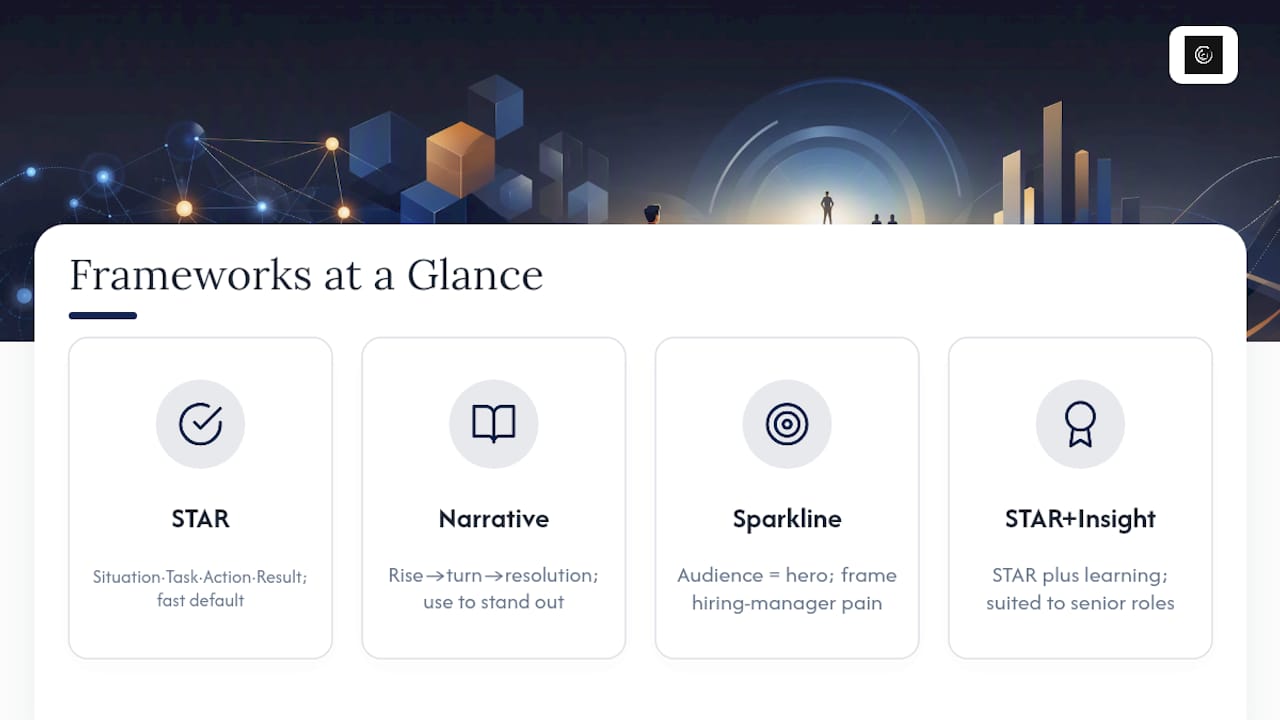
STAR (Situation, Task, Action, Result) is the fastest, safest default. It’s the structure most career sites and interview guides recommend for behavioral questions because it forces you to name a concrete result, not just describe effort. Use it when you’re under time pressure, answering a rapid fire round of behavioral questions, or unsure how much detail the interviewer wants. It’s also the easiest framework to rehearse because the four beats map cleanly to four sentences.
Narrative arc (Freytag’s structure) borrows from fiction and journalism: rising tension, a turning point, then resolution. Narrative interviewing techniques used in nonfiction storytelling lean on finding the conflict and the arc to make an account compelling rather than just accurate. Use this when you want one story to genuinely stand out, say, the anecdote you’ll tell in a panel interview when three other candidates gave the same generic answer.
Duarte’s Sparkline flips the usual approach. Instead of centering the story on you, you center it on the interviewer’s problem. Nancy Duarte’s method argues that the audience is the hero, and persuasive communication moves between “what is” and “what could be” to build belief in a specific action. In an interview, that means framing your story around the hiring manager’s likely pain point: their team’s turnover, their broken process, their missed targets, and showing how your action moves them from the current state toward the better one.
STAR+Insight adds a fifth beat onto STAR: what you learned and how you’ve applied it since. This works best for leadership and senior roles, where interviewers care less about the single result and more about whether you grow from experience.
Pro Tip: Match the framework to the question verb. “Tell me about a time” usually wants STAR. “What’s a moment you’re proud of” rewards the narrative arc. “How do you develop your team” want STAR+Insight.
How to Pick and Prioritize Your Interview Stories
Building the right story bank matters more than perfecting any single story. Most candidates either walk in with one overused anecdote or twelve half-formed ones. Neither works.
- Map each story to a competency, not a job title. List the five or six skills the posting actually tests, things like conflict resolution, prioritization under deadline, or cross-team persuasion, then find one story per competency instead of one story per past job.
- Cap your bank at eight to ten stories total. That’s enough coverage for a full interview loop without turning prep into a research project. Beyond ten, you start forgetting your own material.
- Choose two or three core messages for this specific interview, based on the job description, and pick which of your eight to ten stories deliver those messages most directly. Not every story needs airtime in every interview.
- Favor failures that show learning over failures that reveal a character flaw. A missed deadline because you underestimated scope is fair game. Blaming a coworker by name is not.
- Prefer turning-point moments over steady, uneventful successes. Stories built around a decision made under pressure, where plans went sideways and you had to choose a path forward, read as more honest and more memorable than smooth wins with no real tension.
- Run each candidate story through a quick fit test: Does it prove a competency the interviewer cares about? Does it have a measurable outcome? Can you tell it in under a minute without rushing?
If a story fails that fourth question, either trim it or drop it from the bank. A story you can’t compress usually means you haven’t decided what the point of it is yet.
The 30 to 60 Second Story Recipe, Step by Step
Most interview answers run long because the candidate hasn’t decided what to cut. This recipe forces that decision before you ever sit in the chair.
- Write the four beats as one sentence each: setup, action, outcome, insight. Setup states the stakes in one line (“Our biggest client threatened to leave over a billing error”). Action names the specific choice you made, not the team’s choice. Outcome includes a number wherever possible, revenue saved, time cut, retention improved. Insight is one sentence on what you’d do differently or what you now do because of it.
- Read the four sentences aloud and time them. If you’re already past 45 seconds on the written version, you have too much detail before you’ve even added filler words.
- Run the “first cut” drill: delete every adjective that isn’t load bearing. Words like “really,” “very,” “a lot,” and generic scene setting (“it was a busy Tuesday morning”) add nothing an interviewer remembers. Cut them first.
- Run the “second cut” drill: read it to a timer and cut ten more words for every five seconds over your target. This forces you to compress the setup, which is almost always where candidates over explain.
- Practice the story twice from memory of the beats, not from a memorized script. Reciting a script sounds rehearsed and falls apart the moment the interviewer interrupts with a follow-up. Knowing the four beats lets you adapt the wording live, which is what makes practiced micro-stories reduce interview nerves instead of adding pressure.
Reusable template: “In [role/context], we faced [specific stakes]. I chose to [specific action, using ‘I’ not ‘we’]. As a result, [measurable outcome]. That taught me [one insight you now apply].”
Pro Tip: Say your story into your phone’s voice recorder once, then play it back at 1.5x speed. If it still makes sense at that speed, you’ve probably trimmed enough. If you lose the thread, cut more from the setup, not the outcome.
Six Annotated Sample Answers You Can Adapt
Each of these follows the recipe above. Notice what gets cut, not just what gets included.
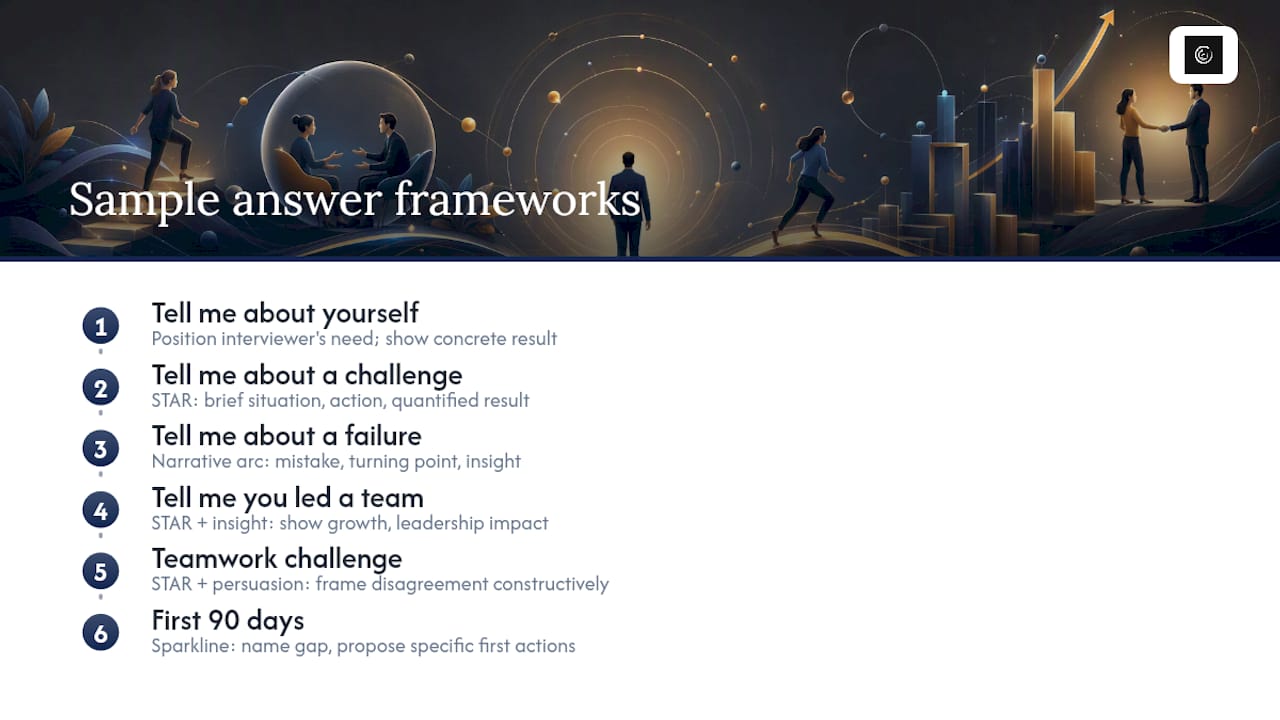
“Tell me about yourself.” “I’m a product manager who’s spent the last four years turning messy customer feedback into shipped features. At my last company, I built a triage process that cut our feature backlog review time from two weeks to three days. I’m looking for a role where I can do that at a bigger scale.” Framework: Duarte style, positions the interviewer’s likely need (efficient prioritization) as the hero of the pitch. Tighter cut: swap “at a bigger scale” for the specific scale of the target company if you know it.
“Tell me about a challenge you solved.” Uses classic STAR, situation stated in one line, action described as a specific decision, result quantified. Interviewer takeaway: this candidate acts without waiting for permission. See a full worked example on handling competing priorities for the extended version.
“Tell me about a failure.” Narrative arc works best here: build the tension of the mistake, then the turning point where you caught it. Read a detailed failure story breakdown to see how the insight beat gets phrased without sounding rehearsed.
“Tell me about a time you led a team.” STAR+Insight, because leadership roles need the growth beat. Check the leadership story example for how the insight line separates senior candidates from mid-level ones.
“Tell me about a teamwork challenge.” STAR with a persuasion twist works well; see the persuasion story guidance for how to frame disagreement without sounding combative.
“What would your first 90 days look like?” This one isn’t a past story, it’s a forward-looking Sparkline: state the current gap the team likely faces, then the specific first actions you’d take. Interviewers remember candidates who name a plausible problem over ones who list generic priorities like “build relationships” and “learn the systems.”
How to Practice Until It’s Automatic
A story you can’t deliver cold under mild stress isn’t ready. The fix isn’t memorizing harder, it’s a rehearsal cycle that catches the gaps before the real interview does.
Delivery basics that matter more than most people expect:
- Use “I,” not “we,” for the action beat. Interviewers are grading you, not your former team.
- Cut filler qualifiers (“kind of,” “sort of,” “I guess”) that make a confident action sound tentative.
- Add one deliberate pause after the outcome number, before the insight. It signals the number matters.
- End on the insight, not on “and that’s basically it,” which undercuts everything you just said.
The rehearsal cycle that actually works follows five steps: draft the four beats, time yourself reading them, record yourself answering out loud without notes, review the recording for pacing and filler words, then revise and repeat. Two short drills a week, ten minutes each, beat one long cram session the night before an interview.
What you’re really measuring across that cycle: how close you land to the 30 to 60 second target, how specific your language is versus generic, and how many follow-up questions the story draws out of a practice partner or a grading tool. Follow-up questions are a good sign, not a bad one, they mean the story created curiosity.
This is exactly where A rehearsal loop fits the process. AI grading can review a recorded or transcribed answer against those same signals, timing, specificity, and structure, and flag targeted drills where your story runs long or loses its outcome beat. Ranked practice rounds add pressure similar to a real interview, which is closer to how you’ll actually need to perform.
Pro Tip: Record the same story three separate times across a week instead of three times in one sitting. Spacing out rehearsal catches inconsistencies that memorization in one sitting hides.
Storytelling for Behavioral and Situational Questions
Behavioral questions ask about the past (“Tell me about a time…”), situational questions ask about the hypothetical (“What would you do if…”). Both reward the same story structure, but the prep differs.
For behavioral questions, storytelling is straightforward: pull from your existing story bank and match the competency being tested. STAR handles the vast majority of these cleanly.
Situational questions are trickier because you don’t have a real memory to pull from. The best approach is still a story, just framed as a plan instead of a memory: state the likely stakes of the hypothetical, describe the specific first two or three actions you’d take, and name what outcome you’d be watching for. Interviewers can tell the difference between a candidate who lists generic best practices (“I’d communicate clearly and set expectations”) and one who describes an actual sequence of decisions. The second answer sounds like it came from someone who has actually managed a similar situation before, even if this exact one hasn’t happened yet.
One habit that helps with both question types: whenever you can, anchor the hypothetical to a real past experience. “This reminds me of a situation where…” lets you answer a situational question with real evidence instead of speculation, which is almost always more convincing.
Adjusting Your Stories for Phone, Video, and Panel Interviews
The story stays the same. The delivery has to change with the format.
Phone interviews strip away every visual cue, so your pacing and vocal variety carry the entire story. Slow down slightly more than feels natural, add a beat of silence after your outcome number so it registers, and avoid stacking too many numbers in one sentence since the interviewer can’t glance at notes to keep track. Keep stories on the shorter end of the 30 to 60 second range here, without a face to read, listeners lose patience faster.
Video interviews need you to fight the instinct to look at your own image on screen. Look at the camera lens during the outcome and insight beats specifically, those are the two moments you most want to land. Trim any story that requires hand gestures or physical demonstration, since webcam framing usually cuts off below the shoulders.
Panel interviews require picking a primary story for the group and knowing which single panelist’s likely priority it speaks to. Address your answer to the person who asked the question, but let your eyes move briefly to the others during the outcome line. If multiple panelists ask variations of the same behavioral question, tell a different story to each rather than repeating yourself, panels compare notes afterward, and repetition reads as a shallow bench of experience.
Using Stories to Explain Resume Gaps and Weak Spots
A gap on a resume invites speculation unless you fill it with a fact first. The fix isn’t a vague line about “personal reasons.” It’s a short, honest story that gives the interviewer a real reason and, ideally, an insight that shows the time wasn’t wasted.
Structure it like any other story, just shorter: state what happened plainly, name what you did during that period, and land on what you learned or built that’s now relevant to the role. A caregiving gap, a layoff, or a career pivot each deserve the same three beats. “I left the workforce for eighteen months to care for a parent. During that time I kept my project management skills current through volunteer coordination for a local nonprofit, managing a fifteen-person event on a fixed budget. That experience is part of why I’m confident stepping into a fast-paced coordination role now.”
The same approach works for a resume weak spot, like switching industries or lacking a specific tool the job lists. Don’t apologize for the gap in your background. Tell the story of how you closed it: the course you took, the side project you built, the transferable skill from your last role that maps directly onto this one. Interviewers aren’t looking for a flawless resume. They’re looking for evidence you’re aware of the gap and have already done something about it. A story proves that in a way a resume bullet never will.
Storytelling Mistakes That Undercut a Good Interview
Most storytelling failures in interviews aren’t about picking the wrong story, they’re about execution.
The most common mistake is running long because the setup eats the clock. Candidates spend forty seconds on backstory and ten seconds on the actual outcome, which is backward. The outcome and insight are what the interviewer remembers, so they need the most protected airtime, not the least.
A close second is describing team actions instead of personal ones. “We decided to restructure the workflow” tells the interviewer nothing about you specifically. Swap every “we” in your action beat for “I” and see how much of the sentence still makes sense, if it falls apart, you were hiding behind the team.
Vague outcomes are the third big one. “It went really well” or “the client was happy” gives an interviewer nothing to remember or probe. Even a rough estimate, “cut response time by about a third,” beats a feeling-based outcome every time.
Overcorrecting into a rehearsed, word-for-word script creates its own problem: it sounds stiff, and it collapses the moment an interviewer interrupts with a follow-up you didn’t script for. Know the four beats, not a memorized paragraph.
Last, choosing a failure story that quietly blames someone else. Interviewers notice immediately, and it reads as a character flaw regardless of how the actual event unfolded.
What Makes a Story Genuinely Memorable, Not Just Well-Structured
Structure gets a story understood. A few extra choices get it remembered after the interview ends.
Specific, sensory detail beats generic description almost every time. “The dashboard was throwing red alerts every four minutes” sticks in a way “there were a lot of errors” never will. You don’t need many of these details, one sharp, concrete image per story is usually enough.
Naming a real number, even an imperfect one, gives the interviewer something to repeat back to a hiring committee later. “Cut onboarding time by two days” is more citable in a debrief than “made onboarding faster.”
Tension is what separates a memorable story from a forgettable success. A story with no real obstacle, where everything simply went to plan, gives the listener nothing to hold onto. The turning point, the moment things nearly went wrong, is usually the most interesting part of any story you’ll tell.
Finally, tone matters more than most candidates think. A story delivered with a flicker of humor or genuine reflection lands differently than the same facts delivered flat. You’re not performing. You’re just letting the interviewer see that the moment actually mattered to you.
Why Practice Matters More Than Talent Here
Most advice on interview storytelling stops at structure, learn STAR, pick a good story, done. That’s incomplete. The candidates who actually perform well under interview pressure are the ones who’ve rehearsed enough that the story survives being interrupted, rushed, or asked from an angle they didn’t expect. Structure without repetition is a script waiting to fall apart the first time a follow-up question knocks it off course.
What tends to get underestimated is how much measurable feedback speeds this up. Vague practice, running through a story in your head on the drive to the interview, doesn’t reveal where it runs long or where the outcome gets buried. Timed, recorded, graded practice does. That combination, real story frameworks plus objective measurement, is a more reliable path to a confident answer than either piece alone.
— Iteration
Practice Your Story With Iteration Before the Real Interview
Reading about story structure only gets you halfway — mastering the art of sales and the importance of excellent communication is equally crucial for effective storytelling in interviews, as detailed in this career-learning resource. There are platforms where you can say the story out loud, on camera or by voice, and get graded feedback on the exact things covered above, timing, specificity, and whether your outcome actually lands.

Run one story through a timed practice round, review the AI feedback on where it ran long or where the insight beat got lost, then repeat with a targeted drill built from that weak spot. The ranked practice format turns rehearsal into something closer to a real interview instead of a solo run-through in front of a mirror. If you want a running start, browse the library of worked interview answers for question-specific examples before you record your own. Start with one story, get it under 60 seconds, and let the feedback tell you what to fix next.
Sources
- Most organizations choose the wrong managers, Gallup finds
- Presentation storytelling: audience is the hero
- Acing interviews: storytelling techniques (University of Denver Professional Studies)
- 10 storytelling interview questions with sample answers | Indeed