Strengths and Weaknesses: Interview Scripts That Actually Work
Strengths and Weaknesses: Interview Scripts That Actually Work

Name the trait, give one specific proof point, then connect it to the job. That’s the whole formula. For a strength: “I’m strong at prioritization. I cut a backlog from 40 open tickets to 6 in three weeks by triaging by customer impact. That’s the same kind of triage this role needs.” For a weakness: “I used to avoid delegating. I started assigning one task per sprint to a teammate and asking for feedback, and my team’s output rose without me working nights.” Career guides like the Harvard Business Review recommend rehearsing exactly this kind of tight, evidence-backed answer instead of winging it. The STAR framework (situation, task, action, result) is the backbone for the strength side, and a platform like Iterationinterview can grade your delivery against that structure before you ever say it in a real room.
- Strength formula: trait → proof (metric or outcome) → tie to the role
- Weakness formula: real weakness → what you changed → measurable result
- Skip “disguised strengths” like “I work too hard” or “I’m a perfectionist.” Interviewers hear those constantly and they signal you didn’t actually reflect.
Pro Tip: If your weakness answer doesn’t include a specific action you took, it’s not a weakness answer. It’s a humblebrag, and hiring managers can tell the difference instantly.
Key Takeaways
A strong strengths-and-weaknesses answer pairs a role-relevant trait with specific evidence and, for weaknesses, a concrete improvement action and result.
| Point | Details |
|---|---|
| Use the formula | Trait or weakness → specific example or evidence → connection to the role or improvement taken. |
| Match strengths to the job | Pull two or three requirements from the posting and pick strengths that overlap directly. |
| Structure weaknesses in three parts | Name the weakness, show its impact, then describe the fix and the result. |
| Avoid disguised strengths | Skip “I work too hard” or “I’m a perfectionist” and prepare a genuine, coachable weakness instead. |
| Rehearse under time pressure | Iterationinterview offers timed AI-graded practice rounds that flag rambling or missing evidence before the real interview. |
Table of Contents
- What Do Interviewers Really Want From Strengths and Weaknesses Questions?
- How Do You Choose the Right Strength to Highlight?
- How Should You Structure a Weakness Answer?
- Sample Scripts for Strengths and Weaknesses
- What Mistakes Sink an Otherwise Strong Answer?
- A 10-Minute Drill to Sharpen Your Answers Before an Interview
- Tailoring Your Answer to the Job and Industry
- Do Strengths and Weaknesses Answers Really Affect the Outcome?
- An Editor’s Take: Practice Beats Polish
- Practice Your Answer Before It Counts
- Frequently Asked Questions
- Sources
What Do Interviewers Really Want From Strengths and Weaknesses Questions?
They’re not fishing for a flaw to disqualify you. They’re testing four things at once: whether you know yourself accurately, whether your skills match what the role actually needs, whether you can take feedback without getting defensive, and whether you’ll behave the same way on the job as you do in the interview. Coursera’s breakdown of this question frames it as a direct gauge of self-awareness and growth potential, not a trick question.
A candidate who says “I struggle with delegating, so I started assigning smaller tasks to junior teammates and checking in weekly” is showing ownership and a working feedback loop. That lands better than a flawless-sounding answer with no evidence behind it, because Dovetail’s research on interview behavior finds interviewers use this question specifically to probe how you respond to your own shortcomings.
Expect follow-ups. “Can you give an example?” or “How did your manager react?” are common probes, and they exist to check whether your first answer was rehearsed fluff or something real.
- Self-awareness: do you actually know your own patterns?
- Role fit: does your strength map to what this job demands?
- Feedback receptiveness: can you describe being corrected without getting defensive?
- Ownership: did you take action, or wait for someone else to fix it?
How Do You Choose the Right Strength to Highlight?
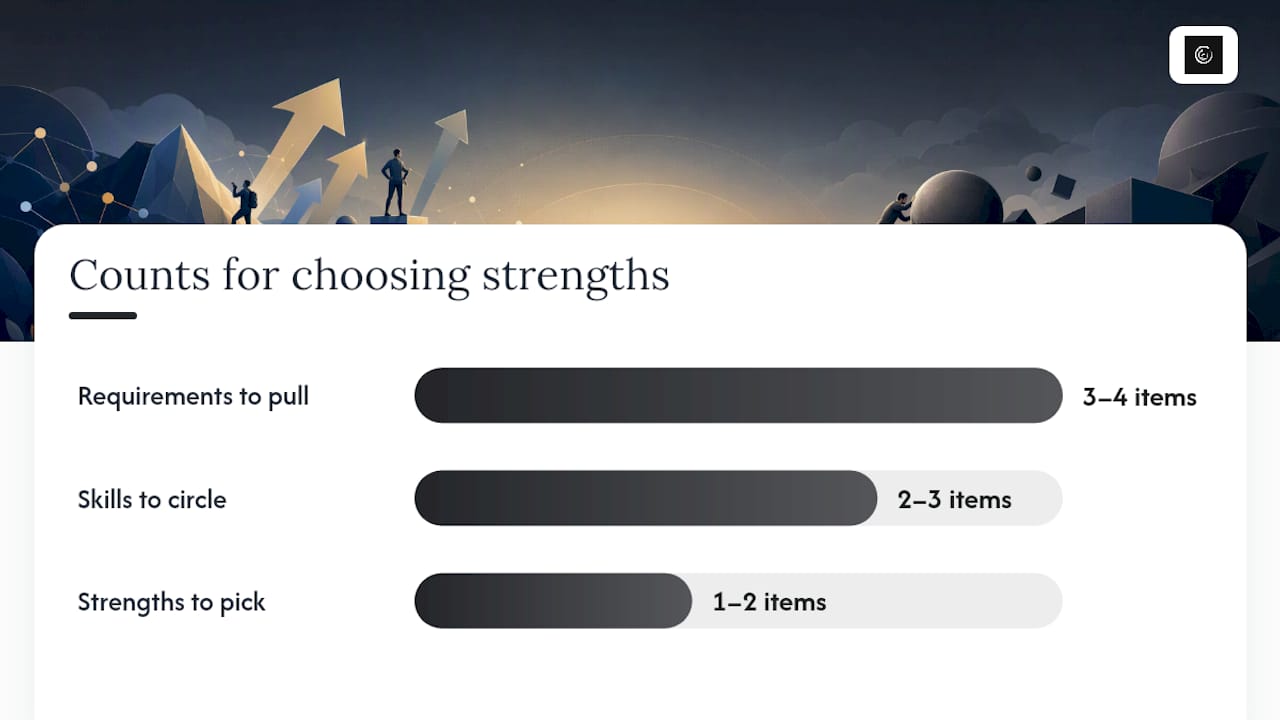
Start with the job posting, not your resume. Pull the top three or four requirements listed and ask which of your real strengths overlaps with them. A strength that’s technically true but irrelevant to the role wastes your airtime.
- Scan the job description and circle the two or three skills mentioned most often or listed first.
- Pick one strength (two at most) that genuinely overlaps with those requirements.
- Find a specific piece of evidence: a metric, a project outcome, or a moment someone gave you credit for it.
- Compress that evidence into a two to three sentence STAR micro-story: situation, task, action, result, trimmed down until it fits in about 20 seconds of speech.
A full STAR answer for a strength might run: "Our support queue backed up during a product launch (situation and task). I built a triage system that ranked tickets by revenue impact instead of first-come order (action). Shrink it, don’t summarize it into vague adjectives.
- Do tie the strength directly to a requirement in the posting.
- Do attach a number or concrete outcome whenever you can.
- Don’t name an abstract trait (“I’m a leader”) with zero evidence behind it.
- Don’t pick a strength just because it sounds impressive if it has nothing to do with the role.
Problem-solving, clear communication, and prioritization under deadline pressure are consistently valued across roles, according to Indeed’s list of interview strength and weakness examples, but the specific metric you attach is what makes any of them memorable.
Pro Tip: If you can’t name a number, name a moment. “My manager asked me to train the new hires because I explained the process clearest” works almost as well as a percentage.
How Should You Structure a Weakness Answer?
Use three parts, in this order: name a real weakness, briefly describe how it showed up or affected your work, then explain the specific action you took and what changed. Indeed’s career guide frames this structure as the standard for a reason. It skips the awkward humility theater and gets straight to growth, which is what the interviewer is actually listening for.
Weaknesses that tend to be safe across most roles include trouble delegating, nervousness with public speaking, limited experience with a specific tool, or a tendency to over-focus on small details at the expense of deadlines. Each one is coachable, and none of them typically touch the core function of the job you’re interviewing for.
- Trouble delegating tasks, paired with a story about assigning work and following up.
- Public speaking nerves, paired with joining a practice group or requesting more presentation reps.
- Limited experience with a specific tool, paired with a self-guided course or certification you completed.
- Overattention to small details, paired with a time-boxing habit you built to stay on schedule.
Avoid anything that touches a core requirement of the role you want, and avoid character-flaw territory like “I don’t work well with others” or “I get impatient with people.” Also skip disguised strengths. “I care too much” is not a weakness, and interviewers have heard it a thousand times.
Keep a second weakness ready. If you get pushed for another example, interviewers are often testing composure under follow-up pressure more than they’re hunting for a real flaw, so a calm, genuine second answer matters more than a clever one.
Pro Tip: For technical roles, choose a weakness that sits just outside your core responsibilities. A backend developer admitting weak public speaking skills is fine. Admitting shaky debugging skills is not.
Sample Scripts for Strengths and Weaknesses
Five strength scripts you can adapt in under a minute:
- “I’m strong at simplifying complex information. I rewrote our onboarding docs and new hire ramp time dropped by two weeks. That’s directly useful for a role that involves training clients.”
- “I prioritize well under pressure. During a product launch, I re-ranked our task list by customer impact and we hit the deadline with capacity to spare.”
- “I build relationships fast. I onboarded three new vendor partners in my last role and all three are still active accounts a year later.”
- “I catch problems early. I flagged a data discrepancy before a client report went out, which saved the account from a credibility hit.”
- “I communicate technical concepts to non-technical stakeholders clearly. My last manager had me present to the executive team specifically because of that.”
Five weakness scripts using the three-part structure:
- “I used to avoid giving direct feedback to peers. I started using a simple template for feedback conversations, and my last two reports told me they appreciated the clarity.”
- “I get nervous presenting to large groups. I joined a local practice group and now volunteer for smaller internal presentations to build reps.”
- “I didn’t have deep experience with SQL when I started my last job. I completed a certification and now write most of my own reporting queries.”
- “I used to take on too much myself instead of delegating. I now assign at least one task per project to a teammate and check in weekly.”
- “I can get too focused on small details. I started time-boxing tasks so perfectionism doesn’t eat into deadline buffer.”
To personalize any of these fast: swap in your own metric, change the verb tense to match your current role, and add one sentence of context only if the interviewer asks a follow-up. Don’t pad the original answer preemptively.
What Mistakes Sink an Otherwise Strong Answer?
- Giving a disguised strength. “I’m too much of a perfectionist” reads as evasive. Swap it for a real weakness with a real fix.
- Naming a disqualifying weakness. Don’t tell a sales interviewer you’re bad at building relationships. Match the weakness to something peripheral to the role.
- Skipping the improvement plan. A weakness with no action attached just sounds like a confession, not growth.
- Rambling without evidence. If you can’t back a strength with a number or a specific moment, it’s an opinion, not an answer. Trim it and add proof instead.
A 10-Minute Drill to Sharpen Your Answers Before an Interview
This works the night before an interview or as a weekly habit if you’re job hunting actively.
- Five minutes of self-reflection. List three pieces of feedback you’ve gotten from managers or peers, plus two moments you’re genuinely proud of. This is essentially a mini SWOT self-assessment, adapted from the business framework to map your own controllable strengths and habits.
- Five minutes of scripting. Write one strength in STAR format and one weakness in the three-part structure. Keep each under four sentences.
- Five minutes of rehearsal. Say both answers out loud, ideally recorded on your phone.
Play the recording back and check for role relevance, actual evidence, concision, and whether the growth part of your weakness answer sounds honest instead of scripted. Practicing under time pressure surfaces rambling you won’t notice just writing the answer on paper.
Pro Tip: Ask a friend to interrupt you mid-answer with “can you give a specific example?” That’s the exact follow-up real interviewers use, and it’s the fastest way to find the holes in your script. For a more objective pass, a timed practice round on Iterationinterview grades your delivery and flags weak spots you’d miss reviewing yourself.
Tailoring Your Answer to the Job and Industry
A strength that lands in a sales interview can fall flat in an engineering one. Sales and client-facing roles reward strengths tied to relationship building, persuasion, or hitting numbers under pressure. Technical roles respond better to strengths around debugging speed, systems thinking, or code quality, backed by a specific project.
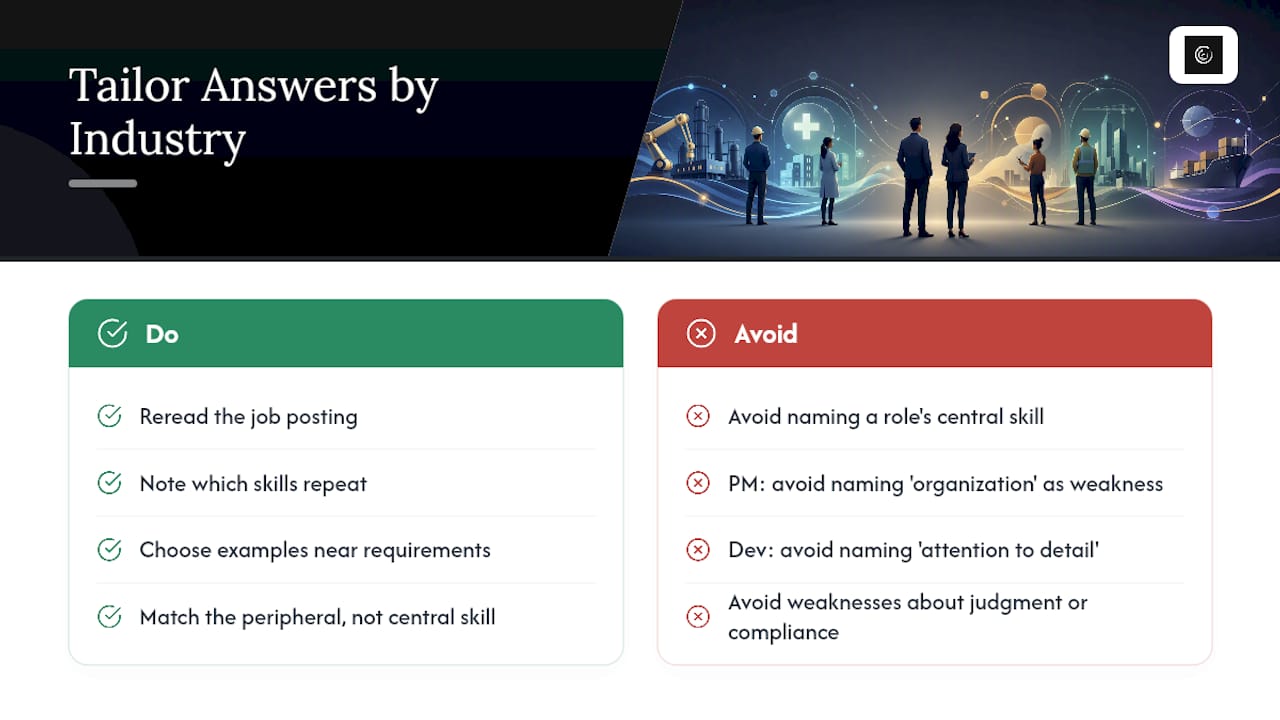
Weaknesses shift by industry too. In fast-moving startups, admitting you’re still building comfort with ambiguity can actually read as honest. In more structured environments, like finance or healthcare administration, a weakness around adapting quickly to new software or systems tends to land safer than anything touching judgment or compliance.
The safest approach is the same one used to pick a strength: reread the job posting, note which skills appear first or repeat, and choose examples that sit near those requirements without touching the role’s most sensitive function. A project manager should avoid naming “organization” as a weakness. A developer should avoid naming “attention to detail.” Match the peripheral skill, not the central one, and the answer holds up regardless of industry.
Do Strengths and Weaknesses Answers Really Affect the Outcome?
Yes, more than most candidates assume. This question usually comes early in the interview, and it sets the interviewer’s frame for everything that follows. A vague or rehearsed-sounding answer signals low self-awareness before you’ve even reached the harder behavioral questions.
A strong answer does the opposite. It shows the interviewer you can self-assess accurately, take feedback without flinching, and speak about your own shortcomings without getting defensive, three traits every hiring manager is quietly scoring even when the rubric doesn’t say so explicitly. Coursera notes that employers use this exact question to gauge growth potential, not just current skill.
The compounding effect matters too. Interviewers take notes and compare candidates afterward. A specific, evidence-backed weakness answer is easier to remember and easier to defend in a hiring debrief than a generic one, and it often becomes the detail that separates two similarly qualified finalists.
An Editor’s Take: Practice Beats Polish
The candidates who nail this question aren’t the most naturally confident. They’re the ones who rehearsed an honest example enough times that it stopped sounding rehearsed. Polish without substance gets caught by the first follow-up question. Pick one strength you can prove with a real metric and one weakness you can show actively improving, then say both out loud until they feel like your own words instead of a script.
Practice Your Answer Before It Counts
Reading sample scripts gets you halfway there. The gap most candidates never close is hearing how their own weakness answer actually sounds under time pressure, which is exactly where a scripted-sounding delivery gets exposed. Iterationinterview runs timed, on-camera or mic practice rounds and grades your response with AI feedback, then hands you a structured breakdown of where the answer got vague, rambled, or lacked evidence.
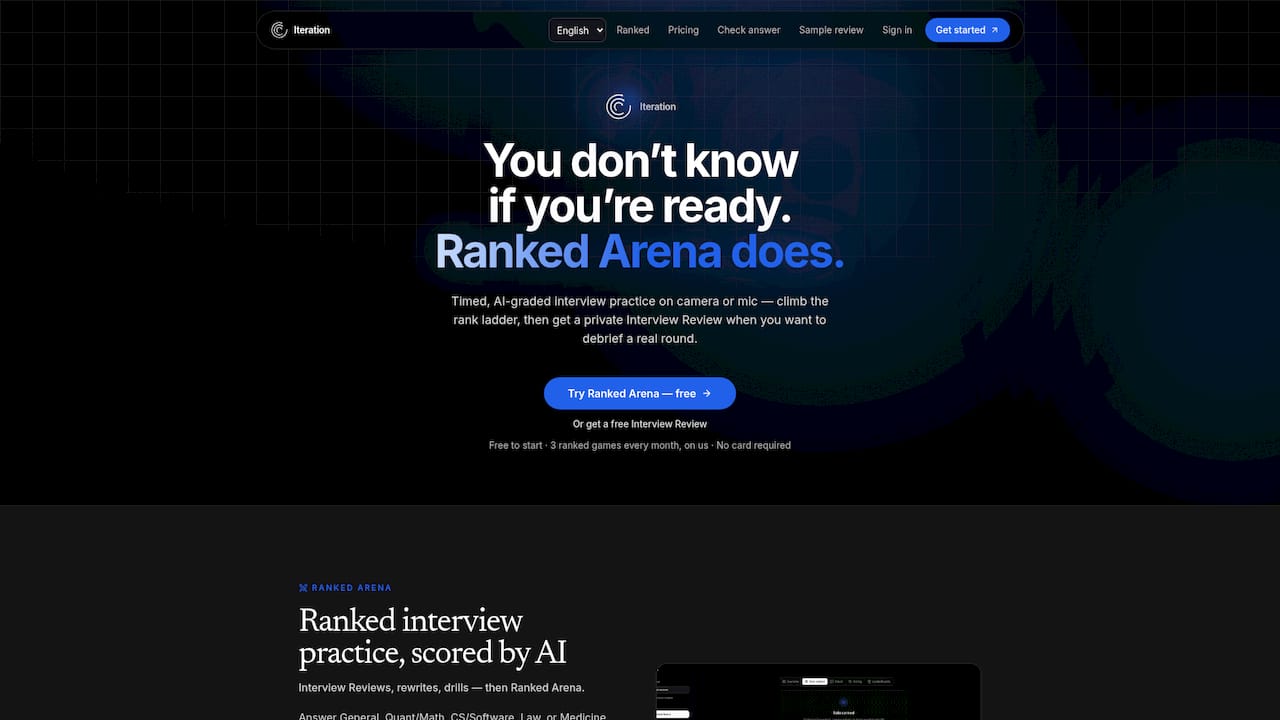
You can paste in a past transcript for review or start fresh with a single practice question, including this one. The platform also builds targeted drills around your weakest answers instead of making you repeat questions you’ve already got down, and the free tier lets you test a round before committing to anything. If you want an honest read on your weakness answer before an interviewer gives you one, try a timed practice round and see what the feedback flags.
Frequently Asked Questions
What is the best weakness to give in an interview? A real but role-peripheral one, like trouble delegating, public speaking nerves, or limited experience with a specific tool, paired with a concrete action you took to improve it.
How do you answer “what is your greatest weakness” without hurting your chances? Name a genuine weakness, briefly show how it affected your work, then explain the specific step you took and the result. Skip anything that touches a core requirement of the job.
What’s a good example of a strength for an interview? Pick a strength that appears in the job posting’s top requirements and back it with one measurable outcome, such as a project result, a metric, or specific recognition from a manager.
Should I use the same strengths and weaknesses for every interview? No. Reread each job description and adjust which strength you lead with based on what the role actually prioritizes, whether that’s technical depth, client relationships, or process management.
How long should my strengths and weaknesses answer be? About 20 to 30 seconds each, roughly three to four sentences. Longer answers tend to ramble and dilute the one piece of evidence that actually matters.
Sources
- What weaknesses reveal in interviews | Dovetail
- How to Answer ‘What Are Your Strengths and Weaknesses?’ | Harvard Business Review
- 10 Examples of Strengths and Weaknesses for Job Interviews | Coursera