How to Answer "Tell Me About Yourself" in Any Interview
How to Answer “Tell Me About Yourself” in Any Interview

About 93% of hiring managers open with “tell me about yourself,” which means this is the one question you can prepare for with near certainty. The best answer is a concise, job-focused pitch of 30–90 seconds that connects what you do now, what shaped you, and why you want this role.
Fill-in-the-blank template: “I’m a [current role/field] with [X years/key skill]. I’ve [one relevant accomplishment]. I’m looking to [forward-looking goal tied to this role].”
Example: “I’m a data analyst with three years in e-commerce. I built a reporting dashboard that cut weekly reporting time by 40%. I’m looking to bring that kind of process thinking to a larger, product-driven team.”
Keep these three points in mind before you walk into any room:
- Lead with your current role and one defining skill, not your life story.
- Anchor the middle with a clear example.
- Close by connecting your goal to the specific role you’re interviewing for.
Key Takeaways
A concise, job-focused pitch of 30–90 seconds, built on a clear framework and at least one quantified result, is the single most reliable way to answer “tell me about yourself” well.
| Point | Details |
|---|---|
| Lead with relevance, not history | Open with your current role and one defining skill; skip the chronological autobiography. |
| Use a two-part framework | Present → Past → Future works for experienced hires; Mission → Evidence → Link fits career changers and recent grads. |
| Quantify at least one result | One specific number makes your answer more memorable than any amount of general description. |
| Tailor in five minutes | Match the top three job requirements to your own experience before every interview. |
| Practice with a rubric | Score yourself on clarity, relevance, evidence, delivery, and timing; use Iterationinterview for AI-graded rounds and targeted drills. |
Table of Contents
- Why do interviewers ask “tell me about yourself”?
- What are the common variations of this question?
- How should you structure your answer?
- Practical tips for length, tone, and delivery
- Sample answers for common situations
- Common mistakes and what not to say
- How do you tailor your answer to the job description?
- How to practice and score your own answer
- Practice your answer with AI feedback
- Sources
Why do interviewers ask “tell me about yourself”?
The question sounds casual. It isn’t. Interviewers use it to accomplish several things at once before the structured part of the interview begins.
A hiring manager is listening for how you frame your own experience. Do you lead with what’s relevant, or do you start with where you grew up? A recruiter on a screening call is checking whether you can communicate clearly under mild pressure. A panel wants to see whether your story holds together across multiple listeners.
What they’re all measuring, at some level, is fit, clarity, and self-awareness. Harvard’s career center frames it as a storytelling opportunity: a coherent beginning, middle, and end that connects past experience, current strengths, and future goals. The interviewer is not looking for your autobiography. They want to know whether you understand what the role needs and whether you can make a case for yourself in under two minutes.
Confidence matters here too. A flat, hesitant delivery signals that you haven’t thought about why you want the job. A sharp, specific answer signals preparation and genuine interest.
What are the common variations of this question?
The phrasing changes. The underlying ask doesn’t. Here are the versions you’ll encounter most often, and how to adjust your core pitch for each:
- “Walk me through your resume.” Add a brief signpost at each career stage (“After two years in X, I moved to Y because…”). Keep it forward-moving, not a recitation of job titles.
- “Tell me a little about your background.” Slightly more casual. You can open with a broader framing sentence before narrowing to your most relevant experience.
- “What should I know about you that’s not on your resume?” This one invites a non-resume highlight: a side project, a cross-functional skill, a perspective shaped by an unusual path. Don’t repeat your LinkedIn summary.
- “How would you describe yourself professionally?” Lean into two or three defining traits backed by brief evidence. “I’m someone who builds systems before they’re needed” lands better than “I’m a hard worker.”
- “Give me your elevator pitch.” Tightest version. Thirty seconds, one role, one result, one goal.
In panel interviews or technical screens, interviewers often want more depth. If you sense that, finish your core pitch and add: “I’m happy to go deeper on any part of that.” It signals confidence and keeps the conversation in your hands.
How should you structure your answer?
Two frameworks cover almost every situation. Pick the one that fits the role and your experience level.
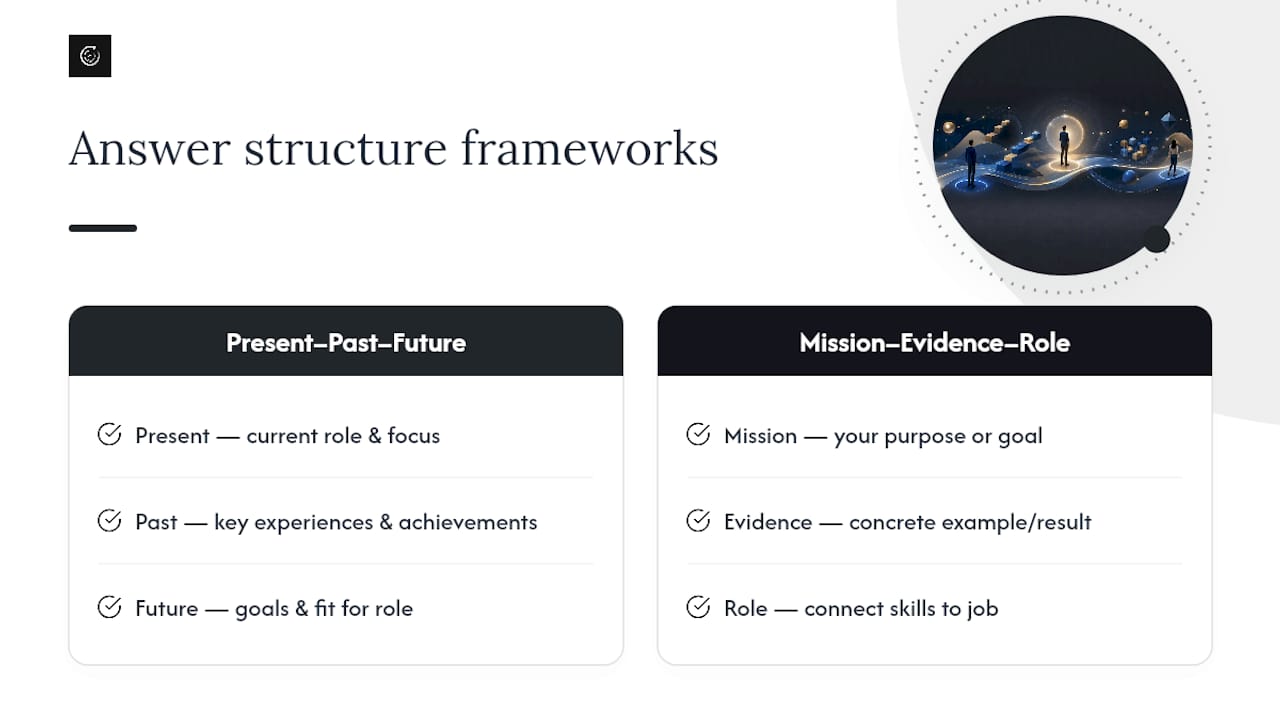
Framework A: Present → Past → Future
Start with what you do now, briefly explain what led you there, then state where you want to go. UPenn’s career services recommends this structure for its clarity and natural flow.
Best for: Roles where recent work experience is the primary qualification, experienced hires, and interviews where the job description closely matches your current title.
Quick checklist:
- Present: current role + one defining skill or result
- Past: one sentence of relevant context (not a full history)
- Future: one sentence connecting your goal to this specific role
Example sentence: “I’m currently a product manager at a mid-size SaaS company, where I’ve led three feature launches in the past year. Before that, I spent two years in UX research, which shaped how I think about user problems. I’m looking to bring that research-grounded approach to a company building at a larger scale.”
Framework B: Mission → Evidence → Link to Role
Career coach Fran Berrick calls this the “one, two, three punch”: open with a one-line mission statement, back it with two specific examples, then tie it directly to why you want this role.
Best for: Career changers, recent graduates, and anyone whose job title doesn’t fully capture their value. Also works well when the role requires a blend of skills that don’t map neatly to a single past position.
Quick checklist:
- Mission: one sentence that captures your professional identity
- Evidence: two brief, specific examples (one hard result, one soft skill)
- Link: one sentence on why this role is the logical next step
Example sentence: “My focus has always been making complex data legible for non-technical audiences. This role appeals to me because it sits at exactly that intersection of technical depth and stakeholder communication.”
Practical tips for length, tone, and delivery
What to do
- Tailor every time. Read the job description the morning of the interview and pick the two accomplishments that map most directly to the top requirements.
- Quantify at least one result. Numbers create credibility fast. “Reduced churn by 15%” is more memorable than “improved retention.”
- Stay forward-looking. End on where you’re going, not where you’ve been. Interviewers are hiring for the future.
- Practice out loud, not in your head. Saying it aloud reveals the awkward phrases that silent rehearsal misses.
What to avoid
- Don’t recite your resume. The interviewer has it. Give them context and relevance instead, as Robert Half advises.
- Don’t share protected or personal details. Marital status, age, number of children, religion — none of it belongs in this answer.
- Don’t go negative. Criticizing a past employer, even subtly, raises a red flag about how you’ll talk about this company later.
- Don’t over-explain. Answers longer than two minutes tend to feel unfocused. If you’re still talking at the 90-second mark, wrap up.
Pro Tip: Use micro-pauses deliberately. A half-second pause after your opening sentence signals confidence, not hesitation. It gives the interviewer a moment to register what you said before you move on, and it keeps your delivery from sounding memorized.
Sample answers for common situations
These examples follow the 30–90 second target from UPenn’s career guidance. Adapt the specifics to your own background.
Recent graduate (Framework B, ~45 seconds)
Context: No full-time experience yet; applying for a marketing coordinator role.
“My focus throughout college was understanding what makes people act on information. I studied communications and ran our student newspaper’s social accounts, growing the Instagram following from 800 to 4,200 in one year. I also completed a summer internship doing content analytics for a regional retailer. I’m drawn to this role because it combines both sides of that work: creating content and measuring what actually moves the needle.”
Customization note: Swap the internship detail for a relevant class project or thesis if you have no internship experience.
Early-career professional (Framework A, ~50 seconds)
Context: Two years in customer success; applying for an account management role.
“I’m currently in customer success at a B2B software company, where I manage a portfolio of about 40 accounts. Over the past year, I improved customer retention by building a proactive check-in cadence. Before that, I worked in retail management, which gave me a strong foundation in reading what customers actually need versus what they say they need. I’m ready to move into a more strategic account management role where I can own the full client relationship.”
Customization note: Adjust the churn figure to your own metric, or replace it with a retention or upsell number.
Experienced contributor (Framework A, ~60 seconds)
Context: Seven years in financial analysis; applying for a senior analyst role.

“I’m a financial analyst with seven years in corporate finance, currently at a manufacturing firm where I lead quarterly forecasting for a $200M business unit. My work over the past two years has focused on building models that give the operations team faster visibility into cost variances. Earlier in my career, I spent three years at a consulting firm, which trained me to communicate financial complexity to non-finance stakeholders quickly. I’m looking for a senior role where I can mentor junior analysts while continuing to work on complex modeling problems.”
Customization note: Replace the business unit size and model type with your own specifics.
Manager or team lead (Framework B, ~60 seconds)
Context: Engineering manager; applying for a director-level role.
“I lead engineering teams that ship on time without burning people out. In my current role, I grew a team from four to eleven engineers while keeping voluntary attrition at zero over 18 months. I’ve also built the onboarding process we now use company-wide, cutting ramp time for new hires by three weeks. I’m interested in this director role because I want to operate at the organizational level, shaping how multiple teams work together rather than managing a single one.”
Customization note: The attrition and ramp-time figures are the most compelling details here — replace them with your own retention or efficiency metrics.
Career pivot (Framework B, ~55 seconds)
Context: Former teacher moving into instructional design.

“My career has been about designing learning experiences that actually change behavior. As a high school teacher for six years, I built curriculum from scratch and tracked student performance data to iterate on what worked. Last year, I completed a certification in instructional design and built two e-learning modules for a nonprofit to improve onboarding efficiency. I’m making this transition because I want to apply that same design thinking at scale, and this role is exactly where those skills translate.”
Customization note: Robert Walters recommends leading with transferable skills and one measurable result for career-change candidates — this example follows that directly.
Remote or hybrid preference (Framework A, ~45 seconds)
Context: Experienced project manager; applying for a remote-first role.
“I’m a project manager with five years of experience coordinating cross-functional teams, most recently at a company that went fully remote in 2020. I’ve managed projects across four time zones and built async communication systems that kept delivery timelines intact. Before that, I worked in an office environment, so I understand both modes well. I’m specifically looking for a remote-first role because I do my best work in that structure, and I want to bring that experience to a team that’s already built for it.”
Customization note: Only include the remote preference if the role is explicitly remote or hybrid — don’t raise it unprompted in an in-person interview.
Common mistakes and what not to say
The most frequent errors
- Rambling. Starting with childhood, college, and every job in order is autobiography, not an interview answer. Pick a starting point that’s relevant to the role.
- Resume recitation. Reading your work history in chronological order wastes the interviewer’s time and yours. They want context, not a verbal LinkedIn profile.
- Negativity about past employers. Even a mild “it wasn’t a great fit” signals risk. Reframe every departure as a move toward something, not away from something.
- Over-sharing personal information. Mentioning your family situation, health history, or financial pressures doesn’t help your case and can introduce unconscious bias.
Protected topics to leave out entirely
Interviewers are legally restricted in many countries from asking about marital status, age, number of children, religion, national origin, or disability status. You’re equally protected from volunteering that information. If a probing question pushes into that territory, redirect cleanly:
Script: “I’d rather focus on what I bring to the role. In terms of my availability and commitment, I’m fully prepared to meet the requirements of this position.”
That response is professional, direct, and closes the door without creating tension. Robert Half’s guidance is consistent on this point: keep the answer job-relevant, and don’t feel obligated to fill silence with personal detail.
How do you tailor your answer to the job description?
This takes five minutes and makes a measurable difference. Here’s the exercise:
- Pull the top three requirements from the job description. Look for the skills or experiences listed first or repeated more than once.
- Match each requirement to one piece of your own experience. It doesn’t have to be a perfect match — a transferable skill counts.
- Pick your strongest measurable result from that matched experience. One number is enough.
- Pick one soft-skill example that shows how you work, not just what you’ve done.
- Write one sentence that connects your goal to the company’s stated mission or the role’s core function.
Quick mapping example:
Job requirement: “Experience managing cross-functional stakeholders.” Your answer sentence: “In my last role, I coordinated weekly syncs between engineering, legal, and marketing to keep a product launch on schedule — we shipped two weeks ahead of the original timeline.”
For technical roles, weight your evidence toward hard results and specific tools. For nontechnical roles, weight it toward communication, collaboration, and impact on people or process. When you’re talking to a recruiter (versus a hiring manager), keep the language accessible — skip the technical jargon and lead with outcomes.
Robert Walters advises choosing two or three relevant accomplishments rather than trying to cover everything. Fewer, sharper points land better than a comprehensive list.
How to practice and score your own answer
Two-week micro-practice schedule
- Days 1–2: Write your answer using one of the two frameworks. Read it aloud and time it.
- Days 3–4: Record a 60-second version on your phone. Watch it back once.
- Days 5–7: Practice the 30-second version (opening only) until it feels natural, not memorized.
- Days 8–10: Run a full mock interview round, either with a peer or using an AI practice tool. Get feedback on clarity and relevance.
- Days 11–14: Drill follow-up questions. Practice pivoting from your pitch to a specific behavioral question (“Tell me more about that project”).
UPenn’s career services recommends a short self-review rubric to track progress across practice rounds. Use this one:
| Dimension | What to check | Score (1–5) |
|---|---|---|
| Clarity | Could a stranger understand your role and value in 10 seconds? | 1 = confusing, 5 = crystal clear |
| Relevance | Does every sentence connect to the target role? | 1 = generic, 5 = tightly tailored |
| Evidence | Did you include at least one specific result or example? | 1 = none, 5 = quantified and vivid |
| Delivery | Did you sound natural, not recited? | 1 = robotic, 5 = conversational |
| Timing | Did you finish within 90 seconds? | 1 = over 2 min, 5 = 60–90 sec |
Score yourself after each practice round. A total of 20 or above means you’re ready. Below 15, identify the lowest-scoring dimension and drill that one specifically before your next full run-through.
Micro-drill examples:
- 30-second drill: Opening sentence only. Repeat until it sounds like something you’d say to a colleague, not read from a script.
- 60-second drill: Full pitch. Time it. Cut anything that doesn’t directly support your case for the role.
- Follow-up drill: After your pitch, answer “Can you tell me more about [the result you mentioned]?” Practice expanding one specific detail without losing the thread.
The question is an opening, not an obstacle
Most candidates treat “tell me about yourself” as a hurdle to clear before the real interview starts. That framing costs them. The first 90 seconds set the tone for everything that follows. An interviewer who hears a sharp, specific, forward-looking answer in the first minute is already leaning in.
The candidates who struggle most are the ones who prepare a memorized script rather than a flexible story. Business Insider’s career coaching coverage makes this point directly: prepare three to five key points you can arrange on the fly, not a word-for-word paragraph you’re trying to recall under pressure. That flexibility is what lets you adapt when the interviewer phrases the question differently, or when the conversation shifts mid-answer.
Keep one vivid, job-relevant example ready at all times. Not a vague claim (“I’m good at leading teams”) but a specific moment (“I took over a project that was three weeks behind and shipped it on time by restructuring the sprint cadence”). That example is your anchor. Everything else in your pitch can flex around it.
The self-review rubric and the two-week practice schedule above aren’t just preparation tools. They’re a way to measure whether your answer is actually improving, not just feeling more comfortable. Comfort and quality are not the same thing. Score yourself honestly, drill the weak dimension, and repeat.
Practice your answer with AI feedback
Knowing the framework is one thing. Hearing how your actual answer lands is another. Iterationinterview gives you timed, on-camera practice rounds with automated AI grading on the exact dimensions in the rubric above: clarity, relevance, evidence, delivery, and timing. After each round, you get structured feedback on what worked and what to cut.
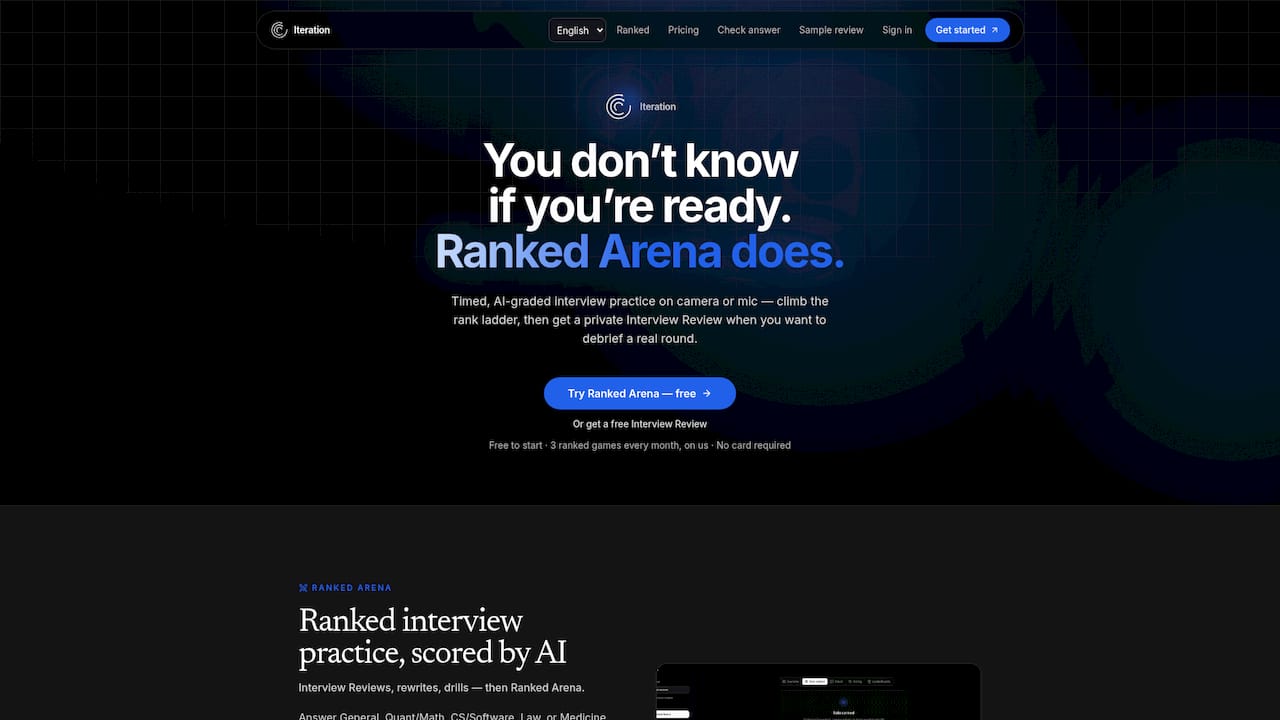
The platform also supports transcript-based reviews: paste in an answer you’ve already given (or one you’ve written out), and the AI grades it and suggests rewrites. Targeted drills then focus your next practice session on the specific dimension where you scored lowest, so you’re not repeating the same round and hoping for different results. Unlike generic AI feedback, Iterationinterview’s grading is structured around real interview performance signals, not general writing quality.
Start a free practice round and see exactly where your answer stands before the interview does.
Sources
The guidance in this article draws on the following career-center and expert resources:
- The Best Way to Handle ‘Tell Me About Yourself’ in a Job Interview - Business Insider
- How to Answer: ‘Tell Me About Yourself’ – Harvard FAS | Mignone Center for Career Success
- How to Answer: ‘Tell Me About Yourself’ – Career Services | University of Pennsylvania
- How to answer “Tell me about yourself” | Robert Half
- How to Answer ‘Tell Me About Yourself’ (Interview Examples) | Robert Walters