The Best "Why This Company" Answer Uses Three Layers, Not One
The Best “Why This Company” Answer Uses Three Layers, Not One

Here’s the script that works in most interviews: name one specific, recent thing the company did, connect it to a real skill or story from your background, then say exactly what you’ll contribute in the first few months. That’s it. Say it in 45 to 90 seconds, and no longer.
For a phone screen, compress it further: “I saw [specific fact], and it maps directly to [your relevant experience] — I want to bring that to [specific contribution].” Twenty words, one breath, done.
- Layer 1: A verifiable company fact from the last 6 to 12 months, not the About page.
- Layer 2: How your background lines up with that fact.
- Layer 3: What you’ll actually do once you’re in the seat.
Statistic: Interview coaches consistently recommend keeping spoken answers to roughly 45 to 90 seconds — long enough to show substance, short enough that the interviewer doesn’t tune out.
Key Takeaways
A defensible “why this company” answer runs 45 to 90 seconds, cites one verifiable recent fact, and closes with a specific contribution rather than a compliment.
| Point | Details |
|---|---|
| Use the three-layer template | Pair a company fact, your alignment, and a contribution statement in every answer. |
| Keep it timed | Target 45 to 90 seconds spoken, matching common interview-coaching guidance. |
| Research for 30 minutes | Check press releases, engineering blogs, job postings, and leadership posts for one deep fact. |
| Cut generic praise | Replace mission recitals and vague enthusiasm with specific, dated details. |
| Practice with feedback | Iterationinterview scores transcripts against the three-layer framework and assigns targeted drills to fix weak spots. |
Table of Contents
- How to Build a “Why This Company” Answer That Sticks
- Where Do You Find a Fact Worth Mentioning?
- Sample “Why This Company” Answers by Role
- Six Mistakes That Make Your Answer Sound Generic
- How Do You Practice and Improve This Answer?
- How Do You Make the Answer Sound Like You, Not a Script?
- What’s the Best Way to Show You Know the Company?
- How Do You Connect Your Goals to Their Opportunities?
- How Do You Sound Enthusiastic Without Sounding Rehearsed?
- What Hiring Managers Are Actually Listening For
- Practice the Answer Before You Say It Out Loud for the First Time
- Sources
How to Build a “Why This Company” Answer That Sticks
Every strong response runs on the same three-part engine, and each layer does a different job in the interviewer’s head. The three-part structure (specific fact, alignment, contribution) is the format hiring managers expect, because it filters out candidates who copy-pasted the same answer into ten applications.
The fact proves you did homework. The alignment proves you understand your own value. The contribution proves you’re thinking about their problem, not just your paycheck. Skip any one layer and the answer collapses into filler.
- Company fact: “I noticed you shipped [specific feature/initiative] last quarter.”
- Alignment: “That’s close to what I did at [previous role], where I [specific action and result].”
- Contribution: “I’d want to bring that same approach to [team/problem] here.”
Fill-in templates by level:
- Entry-level: “I read about [initiative]. In school/internship, I built [project], which taught me [skill]. I want to apply that here on [team].”
- Mid-level: “Your recent [product launch/expansion] caught my attention. I’ve spent [X years] doing [function], including [metric-backed result]. I’d bring that track record to [specific challenge].”
- Senior: “[Company]'s move into [market/initiative] signals [strategic read]. I’ve led similar transitions at [company], delivering [outcome]. I can help you navigate [specific risk or opportunity].”
Career-changers should swap the alignment layer for a transferable-skill bridge (“the analytical rigor from my old field maps to your data problem”). Recent grads should lean on a class project, capstone, or internship instead of years of tenure, and keep the contribution layer more curious than declarative.
Pro Tip: Write your three layers as three separate sticky notes before you memorize a script. If you can’t fill all three without stalling, you haven’t researched enough yet.
Where Do You Find a Fact Worth Mentioning?
You need one deep fact, not ten shallow ones, and you can find it in about 30 minutes if you know where to look. Career-development offices recommend a short, prioritized research sequence rather than an open-ended scroll through the company website.
- Minutes 0 to 10: Recent press releases or news coverage. Look for a launch, funding round, or leadership change in the last 6 to 12 months.
- Minutes 10 to 18: The engineering or product blog. Technical teams publish detail nobody else repeats in interviews.
- Minutes 18 to 24: A current job posting for a similar role. The language reveals what they actually value right now.
- Minutes 24 to 28: LinkedIn posts from the hiring manager or team lead. Recent commentary beats old mission statements.
- Minutes 28 to 30: The product changelog or release notes, if public.
A surface fact sounds like “you’re a leader in your industry.” A deep fact sounds like “you rebuilt your onboarding flow around asynchronous video last quarter” or “your latest changelog shows a shift toward self-serve billing.” Surface facts are interchangeable across ten competitors; deep research artifacts can’t be swapped to another employer, which is exactly what makes them defensible under follow-up questions.
Note the fact in one sentence the moment you find it: source, date, and why it matters to the role. That fifteen-second habit is the difference between citing something naturally and fumbling for it mid-answer.
Sample “Why This Company” Answers by Role
Adapt these directly. Each one tags which clause does which job.
- New grad (entry-level analyst): “I saw your team published a case study on automating quarterly reporting last month. In my capstone project, I built a similar dashboard that cut manual review time by half. I want to bring that same instinct for automation to your analytics team.” (~45 seconds)
- IC engineer: “Your engineering blog post on migrating to event-driven architecture stood out to me. I led a comparable migration at my last job, which reduced latency issues significantly. I’d like to help your team push that architecture further into the payments flow.” (~50 seconds)
- Analyst: “I noticed your Q3 investor update mentioned expanding into a new region. I spent two years doing market-entry analysis for a similar expansion, and I’d want to apply that same rigor to your go-to-market data here.” (~50 seconds)
- Mid-level marketing/product: “Your recent rebrand shifted messaging toward a more technical buyer. I’ve run positioning work for that exact audience shift before, with measurable lift in qualified leads. I want to bring that playbook to your next campaign cycle.” (~55 seconds)
- Senior/manager: “Your leadership team’s public comments about scaling customer success internationally tell me you’re entering a phase I’ve navigated twice before, including building a support function from three people to thirty. I’d want to bring that operational blueprint here, and honestly, the timing lines up with where I want to grow next.” (~65 seconds)
Six Mistakes That Make Your Answer Sound Generic
The fastest way to lose credibility is to say something that could apply to any company in the sector. Here’s what kills the answer, and how to fix it on the spot.
- Praising vague qualities (“you’re innovative”) instead of naming a fact.
- Reciting the company’s stated values word for word.
- Mentioning salary, benefits, or remote flexibility as your reason for interest.
- Telling a three-minute story when the answer needs 60 seconds.
- Skipping the company fact entirely and jumping straight to your resume.
- Ending on alignment with no contribution statement.
Before: “I love your mission to innovate.” After: “Your changelog shows you just launched a self-serve onboarding flow, and I’ve built two of those from scratch.”
Before: “I’ve always wanted to work somewhere collaborative.” After: “Your engineering blog described a cross-functional sprint model I used at my last company to cut release cycles by a third.”
Before: “This role pays well and the benefits are strong.” After: “This role sits right at the intersection of the data work I did last year and the scaling challenge your team just posted about.”
If a follow-up question probes deeper, answer with more specifics, not more enthusiasm. Volume isn’t a substitute for detail.
Pro Tip: Read your answer out loud once before the interview. If it would sound identical describing a competitor, rewrite the fact layer.
How Do You Practice and Improve This Answer?
Track four numbers every time you rehearse: answer length in seconds, count of company-specific facts you referenced, count of concrete metrics in your alignment layer, and whether you could defend the fact when someone pushed back on it. Practicing with mock follow-up questions is what separates a memorized script from an answer that survives a real conversation.
Three drills work well:
- Time-box rewrite: Give yourself 10 minutes to rewrite your answer to hit 60 seconds exactly.
- Peer defense: Have someone ask “why does that matter to you specifically?” three times in a row.
- Recorded mock: Record yourself answering, then answer one follow-up question cold, unscripted.
Interview-prep platforms and career offices generally recommend recording practice answers to review length and specificity before the real conversation.
An AI grading platform speeds this up by analyzing your transcript directly, flagging when you skip the contribution layer or run long, then assigning a targeted drill so you’re not guessing which part of your delivery needs work.
How Do You Make the Answer Sound Like You, Not a Script?
Personalization starts with specificity, not sentiment. Anyone can say a company’s culture “resonates” with them. Almost nobody can explain why a specific initiative connects to a specific piece of their own history, and that specificity is what reads as genuine rather than rehearsed.

Pull from your own record instead of the job description. If the company recently expanded into a new market and you spent a summer doing competitive research on that exact region, say so. If their engineering team just open sourced a tool and you’ve used a comparable tool in production, mention the friction points you hit. The goal is a fact-to-experience pairing that couldn’t apply to any other candidate in the room, because it’s built from your actual history, not from adjectives.
Culture fit works the same way. Instead of claiming you’re “collaborative” or “detail-oriented,” describe a specific working habit: “I check in daily during launch weeks because I’ve seen silent teams miss small bugs that become big ones.” That’s a concrete behavior an interviewer can picture, and it says more about fit than any values-page vocabulary ever could.
One more test before you finalize an answer: could a stranger who has never worked with you have written this same sentence? If yes, it’s still generic. Keep revising until the answer only makes sense coming from your specific background.
What’s the Best Way to Show You Know the Company?
Knowledge shows up in specificity, and the fastest way to demonstrate it is picking a detail your competitor-candidates almost certainly missed. A mission statement is public and repeated by every applicant. A comment buried in a recent earnings call, a technical decision explained in an engineering post, or a hiring manager’s own LinkedIn commentary is not.
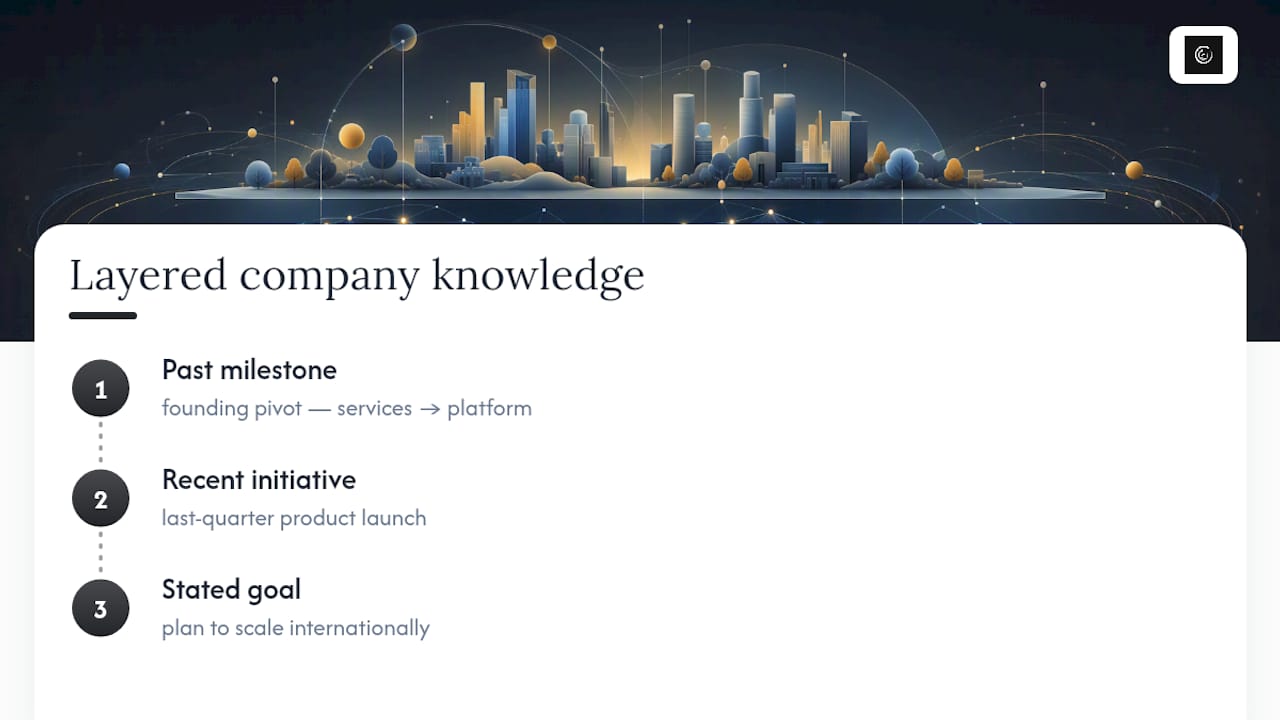
Layer your knowledge across three time horizons in a single sentence when possible: where the company has been (a milestone or pivot), where it is now (a recent launch or hire), and where it’s headed (a stated goal or expansion). That structure signals you understand trajectory, not just a snapshot. “You moved from a services model to a platform model two years ago, just shipped your first self-serve tier, and your job posting mentions scaling that motion internationally” tells an interviewer more in one breath than five minutes of praise.
Recent developments carry more weight than founding-era facts, because they prove your research happened this week, not from a five-year-old Wikipedia summary. A product launch from last quarter, a new executive hire, or a shift in the company’s public messaging all work better than anything from the “About Us” page.
Avoid values recitation entirely. If you want to reference culture, translate it into a behavior you observed, not a word you read. “Your team ships weekly, based on the changelog cadence I checked” beats “you value agility” every time, because one is evidence and the other is a guess.
How Do You Connect Your Goals to Their Opportunities?
The strongest version of this answer treats your career goals and the company’s challenges as the same sentence, not two separate paragraphs stapled together. Start by identifying one real challenge the company is visibly working through, something from a job posting, an investor call, or a public roadmap, and then explain how solving that particular challenge is also the next step you want for your own career.
This works best when you’re honest about timing. If you’re at a point where you want to move from execution into strategy, and the company is scaling a function that currently lacks strategic ownership, say exactly that. If you’re a recent grad who wants to specialize in a technical domain and the company just built a team around that exact domain, name the team. Vague statements about “growth opportunities” say nothing. Specific pairings between your trajectory and their current gap say everything.
Be careful with one common trap: framing the company purely as a stepping stone for your own advancement. That reads as self-serving fast. The fix is to always close the loop back to their problem. “I want to grow into a leadership role, and your team’s stated plan to double headcount this year means someone will need to build that structure from scratch. I want to be the person who does it” ties your ambition directly to their need instead of floating it separately.
If your goals genuinely don’t overlap with where the company is headed, that’s useful information too. Forcing alignment where none exists produces an answer that unravels under a good follow-up question.
How Do You Sound Enthusiastic Without Sounding Rehearsed?
Genuine enthusiasm sounds specific and slightly imperfect. Rehearsed enthusiasm sounds smooth, uses words like “passionate” and “excited” without anything underneath them, and rarely changes based on what the interviewer actually says.
The fix is structural, not tonal. Instead of trying to inject more energy into your delivery, build your answer around a detail that would actually make you curious if you heard it as an outsider. If a specific technical decision or business move genuinely interests you, your voice will carry that without effort, because you’re describing something true rather than performing a feeling.
Leave room for the interviewer’s reaction to change your answer slightly. If they nod at your mention of a recent product launch, ask a quick follow-up yourself: “Was that always the plan, or did it come out of a specific customer problem?” That single move does more to signal real interest than any adjective could, because scripted answers don’t leave room for a live exchange.
Cut every sentence that describes a feeling instead of a fact. “I’m really excited about this opportunity” adds nothing an interviewer hasn’t heard fifty times that week. “I noticed you shipped this feature and I have opinions about how you’d extend it” cannot be faked, and it reads as far more enthusiastic precisely because it’s specific rather than emotional.
What Hiring Managers Are Actually Listening For
Hiring managers aren’t grading your enthusiasm. They’re testing for intentionality, whether you’d have applied to any company in the sector or specifically this one, and a single deep fact paired with a real contribution answers that faster than any amount of energy in your voice. Before your next interview, find one recent company fact and build a 30-second connection you could defend if someone pushed back on it.
— Iteration
Practice the Answer Before You Say It Out Loud for the First Time
Most candidates write a “why this company” script, read it twice, and walk into the interview hoping it lands. That’s the gap Iterationinterview closes: instead of guessing whether your 60-second answer actually hits all three layers, you get AI grading and structured feedback on the transcript itself, flagging exactly where the fact, alignment, or contribution clause is missing or too thin.
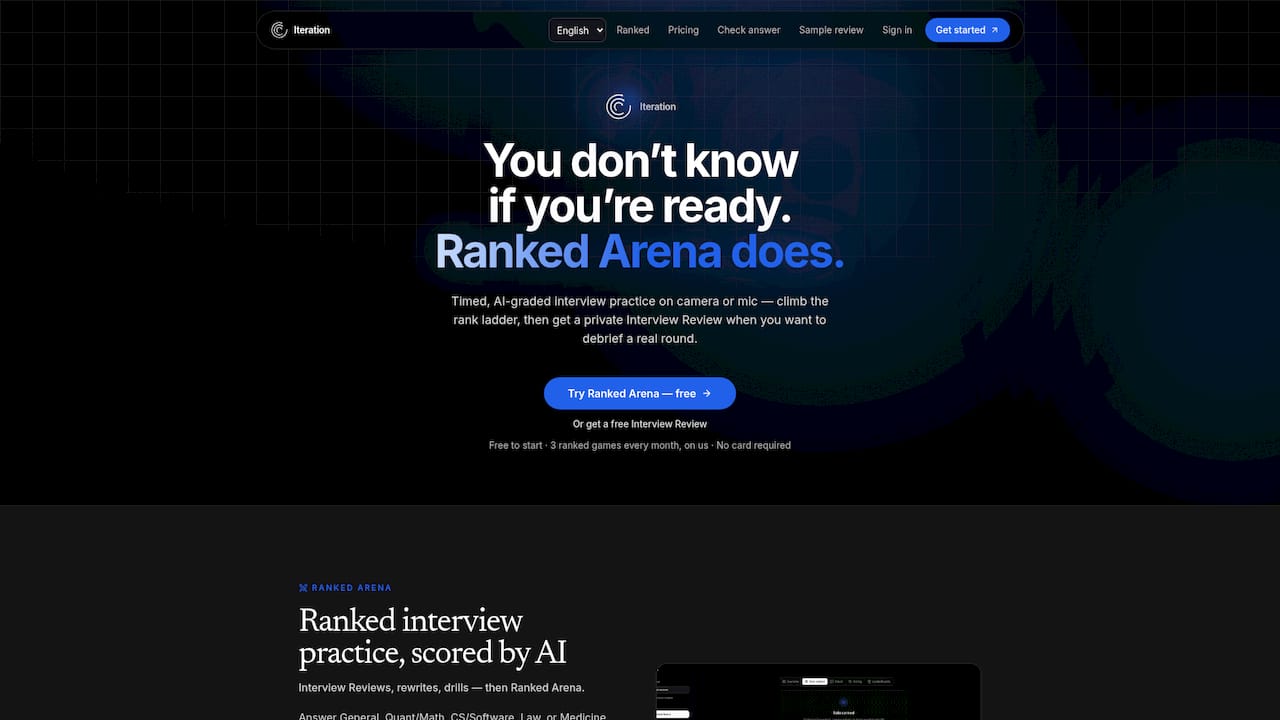
The platform reviews your answer against the framework directly, then assigns targeted drills based on what’s weak, whether that’s timing, specificity, or how well you’d hold up under a follow-up question. You can upload a transcript or record a practice round and see the scored breakdown before you ever say the answer to an actual interviewer. If you’re deciding between a general chat tool and something built specifically for interview scoring, the comparison against generic AI feedback shows where structured grading catches issues a chatbot won’t. Start with one practice round and see what your current answer is missing.
Sources
- How long should interview answers be
- Why This Company? Interview Answer: Research-Backed Scripts (2026)
- How to Answer ‘Why Do You Want to Work Here?’