Fix Interview Weak Spots in 15 Minutes With AI Grading for Candidates
Fix Interview Weak Spots in 15 Minutes With AI Grading for Candidates
Interview self review is a structured process where you capture your interview transcript or notes, score each answer against a framework like STAR, and turn the weak spots into timed practice drills, ideally graded by AI for objectivity. The single most important action happens fast: record or write down what was actually said within 30 minutes of walking out the door, before memory decay erases the details you need to improve.
TL;DR:
- Recording interview details within 30 minutes captures essential facts before memory fades, including questions, answers, interviewer reactions, and emotions.
- Scoring answers on relevance, clarity, impact, and delivery helps identify specific weaknesses, especially when breaking answers into STAR components.
- Creating targeted practice drills for specific gaps, such as timed rewrites or role-specific questions, accelerates improvement and builds confidence.
- Conducting a quick debrief immediately after the interview and a comprehensive review within 24-48 hours reveals patterns and prioritizes high-leverage fixes.
- Using AI-powered tools to analyze transcripts and generate structured feedback ensures objective, consistent self-assessment and tracks progress over multiple interviews.
Table of Contents
- What To Record In The First 30 Minutes After An Interview
- How To Score Your Answers: Scorecard, STAR, And Pattern Detection
- Turning Weak Spots Into Targeted Practice Drills
- The 15-Minute Debrief And The 60-Minute Loop Debrief
- Turning Your Review Into A Follow-Up And A Stronger Story Bank
- Setting Up A Self-Review Before You Walk Into The Room
- Common Mistakes That Undermine A Self-Review
- What A Strong Self-Review Reflection Actually Looks Like
- Tracking Progress Across Multiple Interviews
- Tools And Apps That Make Self-Review Easier
- Using Your Self-Review To Lower Interview Anxiety
- Why Structured, AI-Graded Review Beats Gut-Feel Reflection
- Paste Your Transcript And See What Landed
- Sources
What To Record In The First 30 Minutes After An Interview
Memory starts degrading almost immediately. Path Forward’s post-mortem guidance recommends capturing details within 30 minutes precisely because the emotional high (or crash) of an interview filters out the specifics you’ll need later. Wait until tomorrow and you’ll remember how you felt, not what you actually said.
Use one consistent template every time so your notes are comparable across interviews. At minimum, capture:
- Date, company, role, and interview format (phone, video, panel, on-site)
- Interviewer names and roles, if you caught them
- The literal questions asked, word for word where possible
- Your answers, paraphrased or pasted if you’re working from a transcript
- Any visible interviewer reactions: nodding, note-taking, a follow-up that signaled interest or confusion
- Technical hiccups (dropped video, audio lag) that might have affected delivery
- A quick emotion log: where you felt confident, where you felt shaky
- An immediate gut-check rating from 1 to 5 on overall performance
Voice memos work well for this. So does a phone recording, a pasted transcript from a video-call platform, or a bare-bones Google Doc or Notion page you duplicate for every round. If you’re recording audio or video during the actual interview, get explicit permission first. Some jurisdictions require it by law, and even where they don’t, asking builds trust rather than breaking it.
Pro Tip: Keep the template identical every time, even the field order. When you review five interviews side by side later, structural consistency is what makes patterns visible instead of buried in mismatched notes.
How To Score Your Answers: Scorecard, STAR, And Pattern Detection
Raw notes tell you what happened. A scorecard tells you what to fix. InHerSight’s interview autopsy framework recommends scoring each answer on defined dimensions rather than relying on a vague sense of “that went fine.”
Rate every answer from 1 to 5 across four categories:
- Relevance. Did you actually answer the question asked, or drift into a related but different story?
- Clarity. Could a stranger follow your answer without asking a clarifying question?
- Impact. Did you quantify the result, or leave the interviewer to guess at the outcome?
- Nonverbal delivery. Pace, filler words, eye contact, posture, if you were on video.
For behavioral questions, break each answer down into its STAR components (Situation, Task, Action, Result) and score each piece separately. This matters because a 3-out-of-5 answer usually fails for one specific reason, not four vague ones. Maybe your Situation was clear but your Result was mush (“it went really well”) instead of a number. That’s a fixable, isolated problem once you’ve isolated it.
Parakeet AI’s research on self-assessment found that structured checklists and numeric scales produce more accurate self-assessments than unaided impressions, and that recording practice sessions further improves objectivity because you’re rating what actually happened, not what you remember happening.
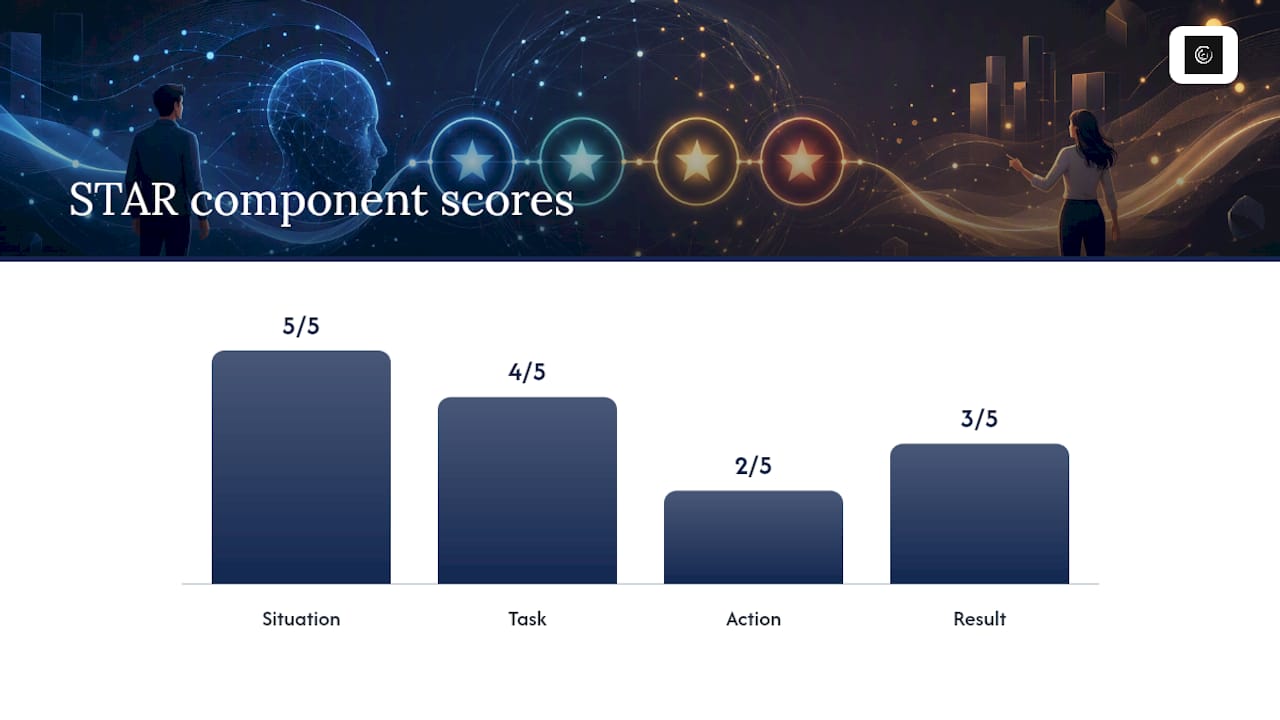
Here’s a worked example. A candidate answered “Tell me about a conflict with a coworker” and rated the whole thing a 3. Breaking it down: Situation (5, specific and clear), Task (4, reasonably defined), Action (2, described the outcome but not the actual steps taken), Result (3, mentioned “it worked out” with no metric). The fix isn’t “practice this question more.” It’s “practice describing concrete actions,” a much narrower and more useful target.
Run this scoring across four or five interviews and patterns surface fast: maybe every “weakness” question scores low, or every technical answer runs long and loses clarity near the end. That pattern is your practice priority, not any single flubbed answer.
Turning Weak Spots Into Targeted Practice Drills
A score without a drill is just a diagnosis nobody treats. Once you know which STAR element or which question type keeps failing, build a drill around exactly that gap.
Four drill formats cover most weaknesses:
- Timed STAR rewrite (5 to 10 minutes): Take your weakest answer and rewrite it from scratch with a strict word count for each STAR section.
- Delivery playback: Record yourself answering the same question again, then count filler words (“um,” “like,” “kind of”) against your first attempt.
- Concise-answer sprints (60 to 90 seconds): Force yourself to answer in under 90 seconds when your original ran three minutes.
- Role-specific question banks: Pull five questions specific to the role you’re targeting and drill only those.
Set a measurable goal for each drill instead of just “get better.” Track filler words per answer, a clarity score out of 5, or STAR completeness (all four elements present versus missing one). Teknita’s reflection framework recommends converting each reflection into one or two concrete, time-limited action items rather than a long to-do list that never gets touched.
This is where AI grading earns its keep. Paste a transcript or a single answer into a tool built for this, get an automated score and structured feedback back, do the suggested drill, then re-score the rewrite to confirm it actually improved. Ranked practice games that track your scores over time add a layer of accountability that a private notes document doesn’t.
Pro Tip: Drill one weakness per practice session, not three. A focused 10 to 20 minute session on filler words retains better than a scattered session touching filler words, STAR structure, and posture all at once.
The 15-Minute Debrief And The 60-Minute Loop Debrief
Two different debriefs serve two different purposes, and timing each one correctly is what separates a system from a pile of notes you never revisit.
- Right after the interview (15 minutes). Capture the raw details, rate each answer quickly on your 1 to 5 scale, pick exactly one action to practice, and schedule a 30 to 60 minute drill session before your next round.
- Within 24 to 48 hours. Run the full scorecard against your notes, flag one to three story-bank gaps (questions you had no strong story for), and put drills on the calendar for each gap.
- After the loop ends (60 minutes). Step back and look across every round: what patterns repeated, which stories need retiring or rewriting, and whether to keep pursuing the role or move on. If you’re advancing, this is also when you plan any follow-up or negotiation prep.
CodeSnatch’s reflection research backs both windows specifically because reflecting too late lets memory decay erode the data, while skipping the loop-level debrief means you never see the pattern that spans multiple rounds. A single bad answer is noise. The same weak spot showing up in three interviews is signal, and you only catch it if you’re comparing notes across the full loop, not just replaying the last one.
Turning Your Review Into A Follow-Up And A Stronger Story Bank
The review only pays off once it changes what you do next. Start with the follow-up email: pull the one insight from your self-review that’s most likely to matter to the interviewer, and turn it into a single added sentence. If your Result was mushy in the room, use the follow-up to state the number you left out.
Rewriting a weak STAR story follows a fixed sequence:
- Clarify the Situation so it’s specific enough that a stranger understands the stakes without extra context.
- Narrow the Task to one clear objective, not three overlapping ones.
- Rebuild the Action around concrete steps you personally took, not the team’s actions in general.
- Quantify the Result with a real number: percentage, dollar amount, time saved, headcount affected.
Before your next round, run a short readiness check: rehearse three banked stories out loud, complete one targeted drill tied to your last review, and reread your notes for anything company-specific you flagged. Iteration’s worked answer library is a useful reference when you’re rebuilding a story from scratch and want a model to compare against, particularly for a tricky prompt like describing a time you received difficult feedback.
Setting Up A Self-Review Before You Walk Into The Room
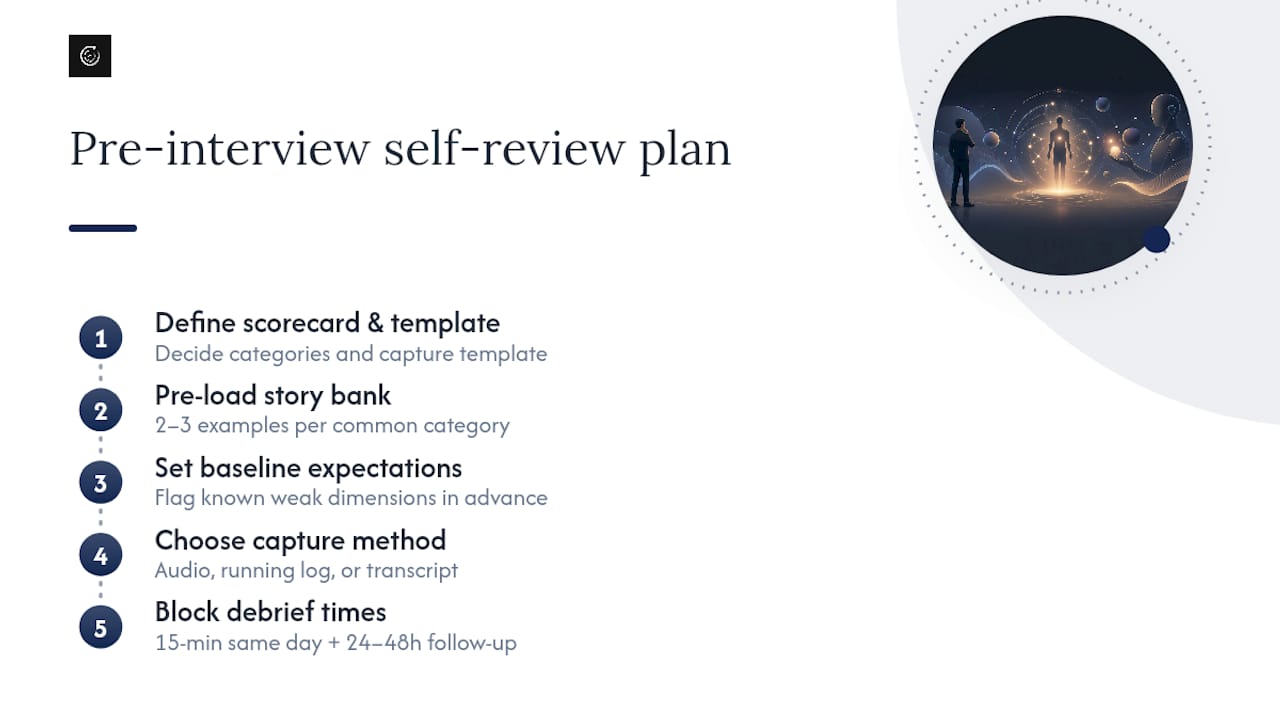
A good self-review actually starts before the interview, not after it. Decide your scorecard categories and your capture template in advance, so you’re not designing a system while you’re also exhausted from the interview itself.
Pull up your target role’s likely question set and pre-load your story bank with two or three candidates for each common category: a conflict story, a failure story, a leadership story, a “greatest weakness” answer. Iteration’s guide on framing a weakness is a solid model for turning a soft spot into a development narrative rather than a confession.
Set your baseline expectations honestly. If you know clarity is your weak dimension from past reviews, flag it before you walk in, so you’re listening for it in real time rather than discovering it cold during the debrief. Decide, too, how you’ll capture the interview: audio recording with permission, a typed running log, or a transcript pulled from the platform afterward. Having the method decided ahead of time means you’re not scrambling to remember your template while adrenaline is still running high.
One more prep step matters more than people expect: block time on your calendar for the debrief itself, both the 15-minute version and the 24 to 48 hour follow-up. A self-review you intend to do “later” almost never happens. A self-review with a calendar block at 6 p.m. that same day happens close to every time.
Common Mistakes That Undermine A Self-Review
The biggest mistake is delay. Waiting a few days to reflect means you’re grading your memory of the interview, not the interview itself, and memory tends to flatter or punish unevenly depending on mood.
The second mistake is scoring on vibes instead of a framework. “I felt like it went okay” isn’t data. A 1 to 5 rating across defined dimensions is, because it forces you to separate relevance from delivery from impact instead of blending them into one fuzzy impression.
A third mistake: reviewing only the answers you flubbed and skipping the ones that went well. Successes are just as informative as failures, since they show you the pattern worth repeating on purpose rather than by accident.
Fourth, treating every weak answer as equally urgent. If you try to fix five things after one interview, you’ll fix none of them well. Pick the highest-leverage gap, drill that, then move to the next.
Fifth, skipping the loop-level view entirely. Debriefing after every single round but never stepping back to compare rounds means you miss the pattern that only shows up when you line up three or four interviews side by side.
Finally, being either too harsh or too generous with yourself. Neither extreme produces useful data. The goal of a self-review isn’t to feel better or worse about the interview. It’s to produce an accurate enough picture that the next drill actually targets the right problem.
What A Strong Self-Review Reflection Actually Looks Like
Vague reflections produce vague improvement. Compare these two entries from the same interview.
Weak: “The behavioral questions were tough. I think I did okay but could have done better.”
Strong: “Question: ‘Tell me about a time you disagreed with a manager.’ Situation and Task were clear, but my Action section described what the team decided rather than what I specifically did. Result was vague, ‘things improved,’ no number. Score: 2/5 on impact. Fix: rewrite with one concrete step I took and one measurable outcome. Drill scheduled for tomorrow, 15 minutes.”
The difference isn’t length. It’s specificity tied to a framework. A strong reflection names the exact question, isolates the exact STAR element that broke, assigns a number, and commits to a scheduled action. It reads almost like a lab note, because that’s effectively what it is.
Another strong example, this time on delivery: “Video call lagged twice during my answer on cross-team collaboration. I noticed myself saying ‘um’ at least six times in a two-minute answer, worse than my usual baseline. Nonverbal score: 3/5. Fix: record a 90-second answer to the same question tonight and count filler words against tonight’s baseline.”
Notice both examples end in a drill, not a feeling. That’s the tell of a reflection that will actually change your next interview instead of just documenting the last one.
Tracking Progress Across Multiple Interviews
A single interview review tells you what happened once. Tracking across interviews tells you whether you’re actually improving, which is the only number that matters if you’re job hunting for weeks or months.
Keep a running log, a spreadsheet works fine, with one row per interview and columns for your scorecard dimensions, your overall rating, and the specific drill you ran afterward. Over four or five interviews, look for the trend line on each dimension separately rather than the overall score alone. It’s entirely possible for your clarity to improve while your impact score stalls, and averaging them together hides that.
Watch for the questions that keep tripping you regardless of company or role. If “tell me about a failure” scores low three interviews in a row, that’s not bad luck. That’s an unbuilt story, and it belongs at the top of your drill list.
Also track something softer but real: how your 1 to 5 immediate self-rating compares to your later, more careful scorecard rating. If the gap between your gut reaction and your structured score keeps narrowing over time, that’s a sign your calibration is improving, and Parakeet AI’s research points to closer alignment between self-assessment and external feedback as a marker of genuine skill growth, not just growing confidence.
Tools And Apps That Make Self-Review Easier
A notebook and a stopwatch will get you through a basic self-review. But a few categories of tools remove friction at each stage of the loop.
For capture, your phone’s voice memo app or a video platform’s built-in recording feature covers most needs, paired with a reusable Notion or Google Docs template so every entry follows the same structure.
For analysis, AI-graded review tools built specifically for interview transcripts save real time over manual scoring. Paste a transcript or a single answer, and instead of guessing at your own STAR completeness, get a structured breakdown flagging exactly which element is weak, along with a numeric score you can track over time.
For practice, look for tools that generate role-specific question banks and let you re-score a rewritten answer against your original, so you can confirm a drill actually worked instead of assuming it did. Ranked practice formats with a visible leaderboard add a bit of competitive pressure that a private log doesn’t, which helps some people stick with the habit longer than they otherwise would.
If you’re prepping across borders or for a role where English isn’t the interviewer’s first language either, resources like Japanese Explorer’s guide to interview phrases are worth a look for phrase-level cultural cues that a generic interview guide won’t cover.
Using Your Self-Review To Lower Interview Anxiety
Anxiety feeds on uncertainty, and a self-review directly attacks that uncertainty by replacing “I don’t know if I’m good at this” with a specific, trackable answer. Once you can say “my clarity score moved from 3 to 4 over the last three interviews,” you’re no longer guessing about your trajectory.
The scorecard also reframes a bad answer. Instead of a global feeling of failure, you have one isolated data point: Result scored a 2 because you left out a number. That’s a narrow, fixable thing, not a verdict on your competence. Path Forward’s research notes that reflecting on both what went well and what didn’t accelerates learning specifically because it stops failure from feeling like the whole story.
Confidence built this way tends to hold up better under pressure than confidence built on hope, because it’s backed by evidence you generated yourself, interview after interview. Walking into round four with three documented improvements from rounds one through three is a fundamentally different experience than walking in and hoping this time goes better.
Why Structured, AI-Graded Review Beats Gut-Feel Reflection
Most job seekers already know they should reflect after an interview. Almost none of them do it with any consistency, and the ones who try usually stop after the second or third round because unaided reflection is slow and the payoff feels fuzzy.
The honest problem with gut-feel reflection isn’t laziness. It’s that scoring your own performance accurately, in the moment, without a framework, is genuinely hard. You’re too close to the material, and you’re grading your delivery while also still feeling the emotional residue of the room. That’s exactly the gap AI grading closes: a transcript-based score doesn’t care how you felt walking out, only what the words on the page actually did.
Iteration’s approach treats every practice answer and every imported transcript as data to be scored, not just reviewed. Grading a transcript against structured dimensions, then generating a drill aimed at the specific weak point, turns a vague sense of “that interview could’ve gone better” into a numbered task list. Ranked practice games and private interview reviews exist for the same reason the loop debrief exists: momentum only compounds when you can see the trend, not just the last data point.
— Iteration
Paste Your Transcript And See What Landed
Iteration is built for the exact workflow this article walks through: capture, score, and drill, minus the manual spreadsheet work. Instead of grading your own STAR structure by eye, you paste the transcript and get automated, structured feedback on relevance, clarity, and impact within minutes.
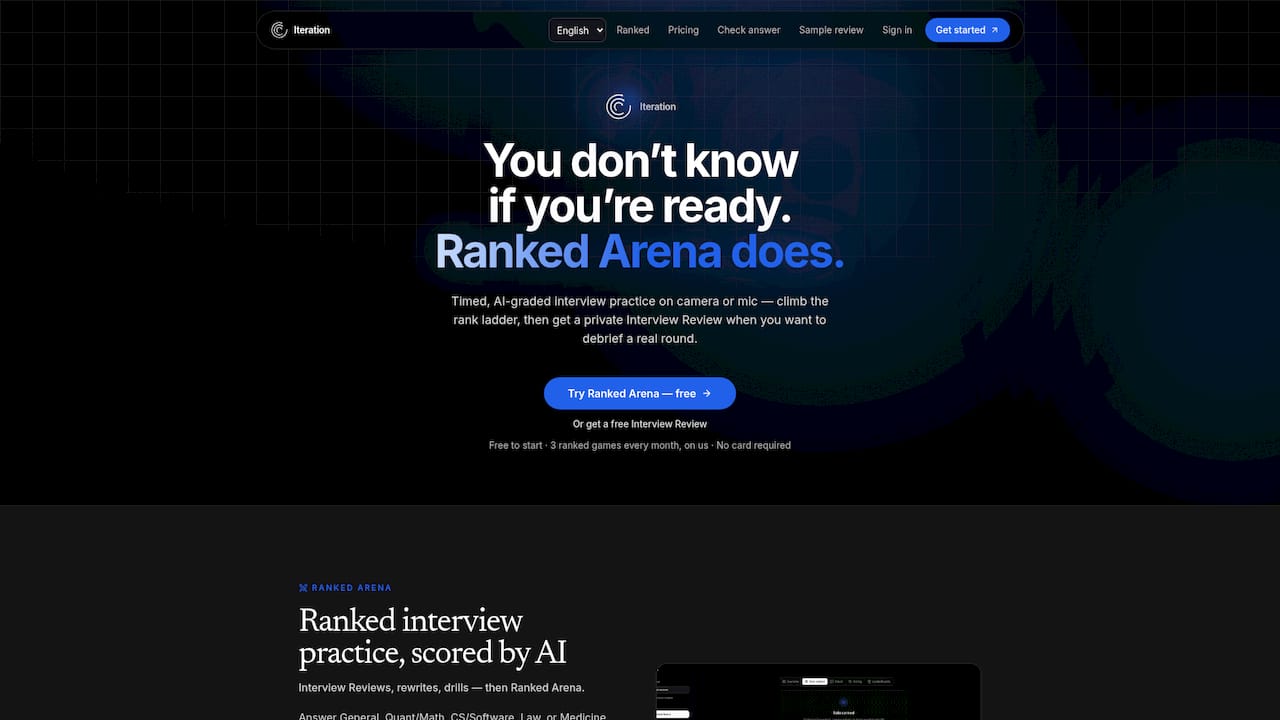
The fastest way to see it work is to paste an interview and see what landed. Drop in a transcript from a real interview or a practice answer, and the platform grades it against the same kind of scorecard covered above, then points you toward a targeted drill instead of a generic tip sheet. The free tier covers limited monthly practice, and paid plans offer deeper analysis and more practice rounds for active job seekers. Explore the full ranked practice and review platform to see how the drills, scoring, and leaderboard fit together before your next round.
Sources
- The importance of interview post-mortem | Path Forward
- Interview autopsy: how to conduct a productive post-interview review | InHerSight
- Post-Interview Reflection & Continuous Improvement | CodeSnatch
- How to self-assess interview performance effectively | Parakeet AI blog
- Post-Interview Reflection: Learning from Each Experience | Teknita